Top

Heal the Bay Blog

Category: Locations

Heal the Bay is joining the fight to protect sharks this Earth Month by promoting legislation that would outlaw the sale of shark fins. Sign now!

Every year, fins from tens of millions of sharks are used for shark fin soup. The human appetite for shark fins is a major contributor to the near collapse of shark populations worldwide, including in California. One of the most effective ways to protect sharks is to eliminate the market for fins by prohibiting their sale. AB 376, a bill being considered in the California state legislature, will ensure stronger protections for sharks by banning the possession, sale, trade and distribution of shark fins. Hawaii and the Commonwealth of Northern Mariana Islands have recently passed similar legislation, and Guam, Oregon, and Washington state legislatures are also considering similar bans.
 
The ruthless practice of shark finning (which leaves live animals finless and unable to swim) remains legal in many parts of the world. It is dangerously efficient because it enables fishing crews to throw out low-value, unmarketable shark carcasses and retain only the fins. As predators at or near the top of marine food webs, sharks help maintain the balance of marine life in our oceans. Research shows that the massive depletion of sharks has cascading effects throughout the oceans’ ecosystems. AB 376 will give critical protection to sharks and preserve the health of our oceans.
 
California represents a significant market for shark fins in the United States, and this demand helps drive the practice of shark finning and declining shark populations. San Diego and Los Angeles are two of the top U.S. entry points for shark fin imports. Most fins are processed in Asia and exported around the world, and fins sold in California may come from these markets.
 
Although shark fin soup has long been a popular entrée because of its association with prestige and privilege, concerned individuals across Asia – including China, Taiwan, Singapore and Hong Kong – have formed shark protection groups to highlight the plight of sharks. Some governments and businesses in the Pacific region have pledged to not serve shark fin soup at government functions, business meetings and celebratory banquets. Likewise, a growing number of globally recognized Asian chefs support alternatives to shark fin. We recognize the cultural importance of shark fin soup as a ceremonial dish, and the sacrifice that the Chinese community in California will be making to give it up in their support of ocean health. This leadership is also reflected by the group of respected Asian Pacific American leaders, elected officials, celebrities and advocates that have joined in support for AB 376.
 
Look out for petitions during Earth Month at Heal the Bay booths at festivals and fairs, or get more information when you stop by our Santa Monica Pier Aquarium during public hours, or at the Victor Douieb Shark Sculptures Premiere.

ACT NOW: Sign the petition to end shark fin sales in California.

Photo: USFWS Pacific via Flicker


This guest blog post was written by Eveline Bravo, Heal the Bay’s Beach Programs Manager

The Chivas USA professional soccer team and Home Depot Center in Carson are working hard to green their organizations and recently collaborated with Heal the Bay to help others do the same. That’s why three special schools have been selected to step up their recycling efforts on campus in a cross-town challenge. Point Fermin Elementary in San Pedro, Loreto Elementary near Downtown and Stonehurst Elementary in the San Fernando Valley have been pitted against each other for a match to see who will win the challenge to recycle the most.
 
All three partner schools have been amazing, with each principal taking a major role in inspiring the kids to recycle at every opportunity. Heal the Bay recognizes that competitions at schools for prizes also mean additional work for school staff and parents, but it has been truly fantastic to witness the genuine excitement of Stonehurst, Loreto and Point Fermin to do more to be environmental stewards. Of course, great prizes also help.
 
Chivas USA gathered a long list of gifts, but in this competition to do good for the environment’s sake, there are no losers. Obviously the real winner is the planet, but the students of the winning school will receive XBox consoles, gift cards, field trips and gift baskets to share and distribute at school. Not to mention that all, and we do mean all, students and staff will receive tickets to the Chivas USA green home game, where each school will be honored for their participation during a special, field-level, pre-game ceremony. What an experience it will be for the kids that get to walk on the field and receive their recognition from the famous Chivas Fighter.
 
This competition is also supported by the City of Los Angeles Department of Public Works Bureau of Sanitation, who will be distributing and collecting the bin equipment for this challenge. A special delivery of 60 blue recycle bins will make their way from the city to the schools April 4-14 for the competition.
 
Heal the Bay was excited and honored to host the announcement assemblies at each of the schools. We couldn’t wait for the opportunity to teach, encourage and motivate everyone to do their best. We even brought out the “bag monster” to get the message across that there are many things that can go in the blue bins to be recycled, including those pesky single-use plastic bags. If only we had a Styrofoam monster in time for our presentations, since that too can go in the blue bins of City of Los Angeles.

We can’t wait to see the results and to recognize the student winners of the 2011 Chivas USA and Heal the Bay Recycling Competition on April 30 at the big game.

Hopefully, you too can join us at Home Depot Center!


While many are preparing to take a field trip this spring, Heal the Bay’s Santa Monica Pier Aquarium is ready to help teachers plan their field trips for the 2011-2012 school year. Reservation books open April 1st and if past years are any indication, prime spring field trips spots book up fast and furiously.

School year programs are offered from September 19, 2011 through June 8, 2012, Monday through Friday, two times a day. The morning program runs from 9:30 to 11:30 a.m. and a second program is offered from 12:00 noon to 2:00 p.m.

Reserving space a year ahead of time is easy: either FAX a downloaded field trip reservation form to send to the Aquarium with three dates and times that would work, or call the Aquarium to make a reservation at 310-393-6149, ext. 105. Please leave a voice mail message if no one is available; a faxed form is a request only and does not guarantee a reservation. Reservations are filled on a first-come, first-served basis.

Learn more about the Aquarium’s education programs and to find a downloadable reservation form. Reserve early; field trip programs fill up quickly. View our 2011-2012 school year flyer.


Chivas and Heal the Bay put our heads together to come up with a fun way to teach kids about the importance of recycling this Earth Month. Starting this coming Monday, three local elementary schools will start competing to fill recycling bins on their campuses. The schools stand to win some amazing prizes, including Chivas tickets (two per student and school staff member) and a free field trip to Malibu with Heal the Bay. To check out photos of the kick off at Point Fermin School and to see the cast of characters who showed up to cheer on the students, see this article in the Daily Breeze.

Photo: Scott Varley, Daily Breeze


Heal the Bay is looking for people to join our Angler Outreach Team! This group of dedicated people spends their days on local piers talking to fishermen about the importance of avoiding contaminated fish. The national EPA recently awarded the program one of its top honors for protecting public health.

In Santa Monica Bay, most fish are safe to eat. Some species, however, are contaminated with DDT, PCB and mercury dating from the decades old hot spot off the coast of Palos Verdes. This is particularly true for white croaker (also called Kingfish or Tomcod), barred sand bass, black croaker, topsmelt and barracuda.

If you’re interested in joining the Angler Outreach program, please visit our jobs page. Or learn more about the DDT contamination off the coast of PV.


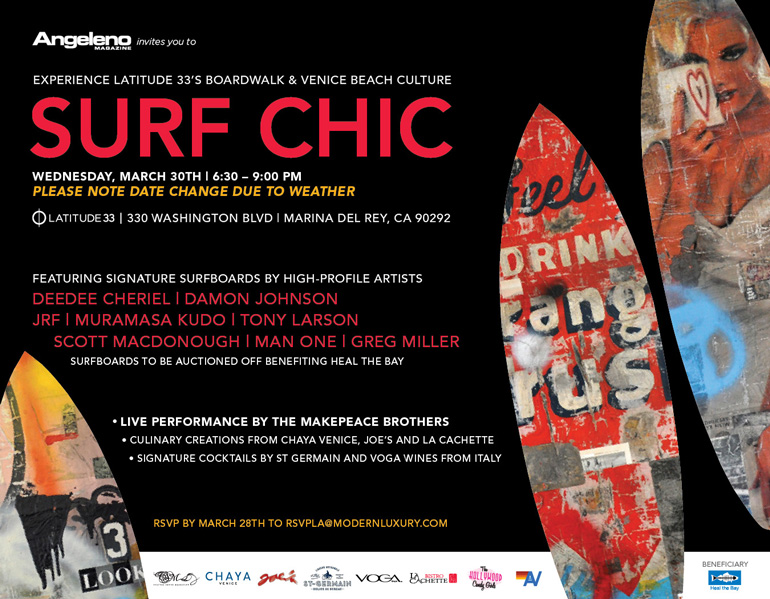
Latitude 33 and Angeleno Magazine to Host Surfer Chic Fundraiser Featuring Auction of Artist Made Surfboards and Musical Performers The Makepeace Brothers on March 30th in Venice Beach

Large portion of surfboard auction proceeds to benefit Heal the Bay

LOS ANGELES, CA (March 16, 2011) — Latitude 33, the 122-unit modern beach-inspired community located at 330 Washington Blvd. in Marina del Rey, Calif., and Angeleno magazine have announced a March 30th fundraiser event to be held in conjunction with Heal the Bay. In homage of the local vibrant art and music experience of the Venice Beach boardwalk, the event will feature an auction of unique one-of-a-kind surfboards handmade by eight well-known artists as well as a live acoustic musical performance by local roots rock favorite The Makepeace Brothers. The event auction proceeds will benefit Heal the Bay and its efforts to keep our coastlines and waterways clean.

The RSVP-only March 30th fundraiser will be held from 6:30 pm to 9:00 pm onsite at Latitude 33 in the BOARDWALK Collection, one of the beach chic community’s three eclectic living options offering lushly landscaped outdoor living spaces and a mix of contemporary floorplans. Upon arriving, guests will be greeted and directed toward the artistic display of surfboards created by artists Damon Johnson, Greg Miller, Muramasa Kudo, Tony Larson, Deedee Cheriel, Man One, Scott MacDonough and JRF. Once viewed, guests will bid on these eight custom designed surfboards that evening from 6:30 pm to 8: 45 pm in an auction curated in conjunction with Culture Shock Marketing (CSM) with proceeds benefiting Heal the Bay. All bidders at the live event must be present to claim their surfboards.

During the week prior to the March 30th event, one special surfboard will be placed for auction online at www.CharityBuzz.com. Participants will be able to place bids on the board from March 15 through March 30. Bidding will start at $1,000 and increase in $250 increments until the board is sold.

As part of the contemporary beach experience, The Makepeace Brothers, a local roots rock favorite known for their exceptional acoustic style, will entertain guests at the event with a live performance. Culinary favorites will be served by local artisanal eateries Chaya, La Cachette and Joes. Guests will also experience an assortment of beach-inspired cocktails provided by St. Germain, a shaved ice display and a selection of wine from sponsor Voga Italia Wines.

Favorite local lifestyle retailers Linus Bikes and Aviator Nation will also play important roles in the March 30th fundraiser. Linus Bikes, purveyor of the French inspired utilitarian city bike, will auction off a bike. Aviator Nation, the vintage t-shirt line, will conduct informal modeling of their unique clothing pieces and will furnish the closets in the BOARDWALK model unit.

For event details and to RSVP, see our calendar listing.

SURF CHIC Invitation


simplehuman Adopts Torrance Beach; Gives Back to Community

LOS ANGELES – March 14, 2011 – simplehuman, renowned for its numerous design awards, patented innovations and quality housewares products, can now add the adoption of Torrance Beach to its list of endeavors.

On Friday, March 18th, the high-end housewares brand will hold its third beach cleanup with Heal the Bay, making simplehuman an official adopter of Torrance Beach. Heal the Bay is a non-profit public interest group dedicated to improving the quality and cleanliness of Southern California’s coastal waters and watersheds.  After sponsoring the conservation efforts of Heal the Bay’s Beach Report Card program in 2007, simplehuman made it a priority to clean up Torrance Beach three times a year as a commitment to its community and to the environment.

simplehuman is completing its final requirements to become an official beach adopter at a time when these efforts are needed most. After the devastating loss of millions of fish in the Redondo Beach marina in early March, programs like Heal the Bay’s beach cleanups are essential to the recovery and preservation of the California coast.

“It is important for us to take care of our environment and the beaches of Los Angeles, but it is also important to give back to our community,” says simplehuman CEO, Frank Yang.

Based in Torrance, CA, simplehuman transformed the trash can with the introduction of the award-winning stainless steel “butterfly” step can in 2000, and has expanded its product line to an extensive array of cleaning, organization and recycling solutions. Today, the company’s mission to make “tools for efficient living” has produced a line of more than 100 products. The simplehuman collection has received international design recognition and is available at fine specialty retailers and at www.simplehuman.com.

To learn more about ways you can help Heal the Bay, visit HealtheBay.org/Get Involved.


With the massive fish kill in Redondo’s King Harbor earlier this week, the most pressing issue now is the clean-up. It’s critical that all the dead fish are removed within the next couple of days to prevent an even worse problem.

Fish Kill Cleanup: Volunteer!

  • For information on how and when to volunteer, contact the Redondo Beach CERT Hotline at 310.318.8111
  • Cleanups efforts vary, please call to receive correct instructions
  • Water, food, sunscreen will be provided to volunteers

More News, Photos & Videos

To volunteer for the Redondo Beach fish cleanup, please contact the Redondo Beach CERT (Community Emergency Response Team) Hotline at 310-318-8111 for information on how and when to volunteer. Cleanups efforts do vary so you must call to receive correct instructions. Information is updated at 8 p.m. each night.

Water, food and sunscreen will be provided to volunteers. No experience or supplies are required — only enthusiasm. Volunteers are needed throughout the weekend.

In the meantime, scientists are analyzing samples of fish and water to determine the cause of the die-off in King Harbor. Heal the Bay is monitoring the situation through colleagues at the Redondo Beach SEA Laboratory and the University of Southern California.

Samples will be analyzed for the presence of any harmful algae, though early reports indicate there is no discoloration of the water to indicate massive amounts of algae. It has been reported that dissolved oxygen levels in the water are extremely low, meaning there is limited oxygen for fish to breathe in the water.

Heal the Bay will continue to monitor the situation and will offer updates as we receive more details. According to Brent Schiewe, director of the SEA Lab, very large schools of baitfish were seen in all the harbor’s basins the day before the fish kill, possibly due to the storm.


Finescale Triggerfish

The Finescale Triggerfish (Balistes polylepis) is the latest resident of the Santa Monica Pier Aquarium’s Beneath the Pier exhibit. Triggerfish are usually associated with tropical water, but their range stretches from San Francisco all the way to Peru. This fish has a feisty reputation and reportedly has been seen attacking sharks. Our triggerfish was shy at first, but has lately been seen coming right up to the glass, seemingly to check out our visitors and making it hard to tell who is observing whom.

Fun Facts

Triggerfish are often found in caves and crevices, but are also seen swimming in the open along the sandy bottom adjacent to rocky reefs and in waters as shallow as 10 feet. With powerful jaws and a set of eight teeth on each jaw, this fish is equipped to eat spiny sea urchins, small crustaceans, mollusks and other animals that are normally protected by a shell or armor.

The finescale triggerfish can reach a length of up 30 inches and usually weighs up to 10 pounds. The largest reported specimen was 16 pounds. Fossils of finescale triggerfish teeth dated at 25 million years old have been found in Santa Ana and Bakersfield.

Some triggerfish are toxic if eaten, but the finescale triggerfish has never been found to be toxic. Still the finescale doesn’t show up on the dinner table often because their tough hide makes it difficult to skin.

To get checked out by our finescale triggerfish, visit our Santa Monica Pier Aquarium.

photo by Nick Fash