The stars of Disney Channel’s Teen Beach Movie lend a helping hand to clean the beaches with Heal the Bay leading up to Coastal Cleanup Day.

Top
Heal the Bay Blog
Category: News
Last year, Heal the Bay speakers reached more than 40,000 Angelenos across Los Angeles with our message about solutions to pollution.
How the heck did we do that? No cloning was involved, just hours of time donated by our Speakers Bureau volunteers, Heal the Bay’s elite pollution fighting team!
We thank our longtime cadre of dedicated speakers who fan out to schools, clubs, cleanups and all kinds of events to help us raise awareness about how to protect the ocean. This week we “graduated” and trained 21 new Speakers Bureau volunteers – a record number for Melissa, our Speakers Bureau coordinator.Thanks to our new class! We look forward to partnering with you in the months and years to come.
Thank you also to Buca di Beppo, which donated food to fuel our new speakers.
We also thank our neighbors Jersey Mike’s and Fresh Brothers, as well as Just Chill for providing refreshments to our Corporate Healers, volunteers and staff these past few weeks.
Learn more about how you can reach out to – and improve– your own community via one of our volunteer programs.
Exhilarating! That’s how I describe my recent expedition with the Pacific American Volunteer Association (PAVA) to Korea. Our mission was to explore some of the many water spaces the Koreans have transformed over the past two decades. Beyond the adventure of seeing a new land and exploring a culture quite different from my own (this being my first trip to Asia), I had the opportunity to glimpse what potentially awaits so many of our own local water spaces.
For those of you unfamiliar with this story, I mentioned a few weeks back that one of our community partners was taking me on a journey with them to Korea to hear and see the story of how different cultures and civilizations deal with water in the environment. For the past three years, the students of PAVA Jr have joined me on an educational exploration of water in the environments throughout Los Angeles, and this year was about taking those lessons one step further.
Some of the highlights of my trip:
- Mallipo Beach in Taean County, where a 2007 oil spill devastated a beach tourist community, leaving local marine ecosystems coated in 290,000 tons of thick sludge and local residents in a thick economic and very personal depression. But, in the face of such an overwhelming catastrophe, community members from throughout the region joined forces to volunteer in one of the world’s largest single efforts, bringing together just over 1 million people to help clean the beaches and remove oil. Now, Taean Love (a local organization) continues to keep Mallipo beautiful, and after five short years of recovery, the city has seen tourism return to normal. As we prepare locally for Coastal Cleanup Day, I can feel swell with excitement at what can happen when people join together to volunteer.
- Oncheoncheon River near Busan, Korea’s second largest city. Here, in a dense urban center, what once was a creek polluted beyond recognition from local development and nearby industrialization, is now part of a green belt through the city, providing much needed recreation and habitat space for both people and animals to enjoy. A bicycle path, park space, and outdoor sports fields fill the outer reaches of the floodplain, while riverside reeds, shrubs, and native birds fill the shores and banks. Again, standing in this space so far from home, I couldn’t help but think of the Glendale Narrows section of our own Los Angeles River, where for the first time in 80 years, people have been allowed to recreate this summer, I can only be excited by the possibilities!
- Suncheon Bay, an extremely well preserved coastal wetland complete with quick little red crabs that dart in and out of holes when you’re trying to take pictures of them (I myself have no pictures for this site as my camera died right when was I was trying to capture the moment). At just over 6,000 acres, Suncheon Bay boasts the widest reed bed of all of Korea, and is also home to several rare and endangered bird species, including the Hooded Crane and the Chinese Egret. This space was my favorite of the whole trip, if only because standing in such a wide and open wetland with reeds dancing in the wind all around you feels like you’re floating in a sea of green. Here too, I can only think of our own Ballona Wetlands could become, once restoration begins.
- The Cheonggyecheon in Seoul, the heart of South Korea’s capital for 600 years. This river provides local freshwater for drinking and cleaning, and well as food from fishing and trapping. After the Korean War, when hyper industrialization began to drive population inwards from rural settlements to the urban center, the Cheonggyecheon became home to shanty towns built unsteadily over the creek space. Later, when the city’s need became transportation, a freeway was built over the space to provide a thoroughfare from east to west for the bustling city. Much like our own Los Angeles River, the Cheonggyecheon became the victim of urbanization and growth, hidden beneath concrete and impaired beneath a city that no longer saw it.
Then, in the mid-90s, Korea began to change its environmental tune, investing time, money, and political and social capital in revitalization their urban waterways. The Cheonggyecheon was daylighted from beneath its concrete enclosure, and once again brought into the city’s daily life. While it is not the greenway that the Oncheoncheon in Busan is, nor the sprawling eco-preserve that Suncheon Bay, the Cheonggyecheon offers the hustling and bustling city a return to calmer times. Walking along its banks, I felt a sigh of relief from the skyscrapers and traffic that detail so much of life in Seoul, and the exhaustion from my trip gave way to soaking my feet in the water’s cool flow while watching several ducks bathe themselves. I can only hope that when the Los Angeles River is made anew, it will offer up this same urban getaway.
And thus my travels ended in Seoul. I will say my experience in Korean waters is but a glimpse of the potential that we strive for here in our own city. It’s true that the students and I saw many visions of the future and of potentially cleaner waters on this trip, but most of all we received a renewed sense of drive to protect what we love in our own home town.
— Eddie Murphy, Heal the Bay’s Watershed Education Manager
Discover the wide range of Heal the Bay’s public education resources.
You think you’re green. You tote around your own water bottle, remember your cloth grocery bags and pack your kids’ lunches in colorful, eco-friendly, reusable containers.
Then you attend your first PTA event and find yourself holding a Styrofoam cup of coffee in a room decorated in balloons in school colors. And when it’s over, all the cups are overflowing the trash can, heading to the landfill and God only knows where those balloons are headed. You realize you’ve only just begun to go green; you’ve got to convince your school to join you.
Don’t despair! Even for a Sustainability Award-winning school such as Mariposa School of Global Education in Agoura Hills, there remains room for improvement, says Amy Romeo, a parent who chairs the school’s “Green” committee.
“Our long-term goal is to make it effortless – so it’s so engrained at our school to everyone, from students to teachers and staff and parents so much that (being more sustainable) becomes simply second nature,” she says.
Ultimately, Amy hopes, her school’s eco efforts will inspire families to do more at home. For instance, she says: “If kids are composting at school, they may wonder why they don’t compost at home and encourage their parents to do it — that would be a measure of success for sure!”
Here are some tips we’ve gathered (with assistance from Amy) to help events at your school — or business, club, church or temple — become more sustainable:
- Find festive alternatives to balloon decorations. Colored paper lanterns are great at filling a cavernous room such as a hall or auditorium. Paper flowers, made of newspaper or tissue, are also easy to make (even for kids) and are great for filling in corners. Plus, the lanterns and flowers are reusable! Newspaper also makes a fine alternative to plastic tablecloths.
- Go reusable. Advertise the event as “sustainable” and encourage people to bring their own water bottles and coffee mugs. Set up a water bottle refill station with clear signage. Offer small paper cups for those who forget to bring their reusables. Consider selling your own water bottle with your school or organization’s logo on it.
- Wave farewell to waste. Clearly-labeled recycling and trash bins are a good start. Mariposa places recycling and composting bins in a central location for school events, staffed by volunteers. The school uses the compost on their own gardens, so students develop an understanding of the relationship between the products they use and their relationship with the earth. “A good way to think about it is: After I buy this, what will I do with it?” Amy advises. “If the answer is throw it in the trash, try to rethink your options!”
- Reinforce Your Eco Message. Assemblies and workshops — broken down by age group — can help forge connections. At Mariposa, Amy invited Heal the Bay staff to tie in what the kids were learning about going waste-free with a Beach Clean-a-Thon the school hosted as a fundraiser (for Mariposa and Heal the Bay). All students also attended education programs at our Santa Monica Pier Aquarium to help reinforce the message of how pollution affects our ocean. “By having Heal the Bay talk to students about the importance of this [clean-a-thon], it resonated with them and brought more meaning to why we bus every year to the beach to pick up trash,” Amy says.
To schedule a Heal the Bay speaker at your school or organization, contact Melissa Aguayo at 310-451-1500, x146 To schedule a field trip to the Santa Monica Pier Aquarium, call 310-393-6149, x105.
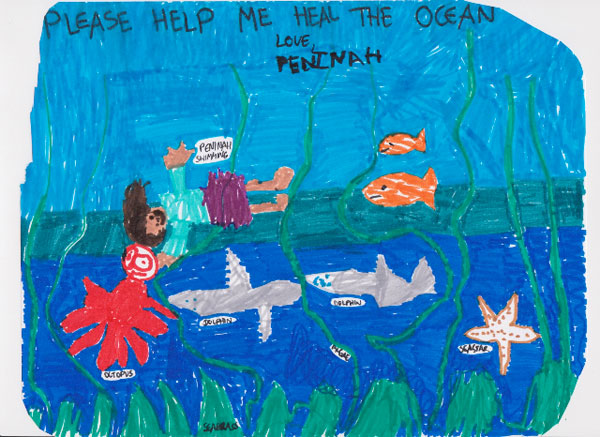
Drawing by Mariposa student Peninah Barasch.
To present an alternative to the Discovery Channel’s Shark Week (and cult TV movies like Sharknado), Heal the Bay staff write about the marine animals they love so much. The general public has been fed terrifying misconceptions about these creatures, and our mission is to raise awareness about the unique and important role sharks play in our local ocean ecosystem.
Through our Angler Outreach Program, Heal the Bay engages fishermen throughout the Santa Monica Bay area to teach anglers about fish contamination. In the process, we also learn about different types of fish and sharks these fishermen catch from the piers, including the Pacific angel shark (Squatina californica).
The angel shark can be observed in shallow waters from Alaska to southern California and from Ecuador to Chile. The forward part is flattened and the rear part similar to the other sharks, eyes and gill openings are at the top, pectoral and pelvic fins are large and horizontally, have two dorsal fins and the lower lobe of the caudal fin is larger than the upper lobe.
They can grow up to five feet long and produce litters of up to 13 pups.
They look harmless, but if disturbed in their natural environment, can cause serious injuries with their bite, as they possess powerful and flexible jaws.
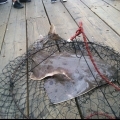
Valued for their meat during the ’80s, California’s angel shark populations were devastated by overfishing. Educational programs for conservation have played a very important role in our environment to protect this and other species of sharks.
Although sightings remain rare, angel sharks have been reported by our educational outreach team members at Santa Monica and Venice piers.
Watch a video of an angel shark feeding.
–Frankie Orrala, Angler Outreach Program Manager
To present an alternative to the Discovery Channel’s Shark Week (and cult TV movies like Sharknado), Heal the Bay staff write about the marine animals they love so much. The general public has been fed terrifying misconceptions about these creatures, and our mission is to raise awareness about the unique and important role sharks play in our local ocean ecosystem.
The Santa Monica Pier Aquarium’s swell sharks were my gateway shark. Growing up on the East Coast and vacationing on the Outer Banks of North Carolina, my surfcasting father created a bit of shark paranoia in me. He spent hours knee deep in the waves, casting for blues, drum, striped bass and mackerel. I was usually not far away, playing for hours in the warm Atlantic waves. On occasion Dad would yell: “Get out of the water, I see a shark circling back!”
I never actually saw a shark in those waves on the Outer Banks, but the fear of the unknown — and the unseen — coupled with my father’s obvious concern left me with an unhealthy, unfounded fear.
Fast-forward to 2001 (we won’t discuss how far forward), and I find myself working in an aquarium with the opportunity to spend some quality time with sharks. Our five swell sharks, Cephaloscyllium ventriosm, aren’t the creatures of my nightmares, but learning interesting facts about their behavior specifically and more about sharks in general has turned my fear into fascination. Images of hammerheads, great whites and whale sharks now surround my desk. I adamantly argue to whomever will listen for shark conservation measures, knowing the vital role they serve in the ocean.
And they are deserving of our respect as an ancient species – fossil deposits containing evidence of swell sharks in Southern California date them back at least 5.3 million years. Another fun fact: swell sharks make up for their size (at maturity they reach a mere three feet in length) by swelling up to deter predators. The shark will twist its body into a U-shape, grab its tail fin and swallow seawater to double its size.
For the last several years, the swell sharks at the Aquarium have been producing eggs, a sign the sharks are well adjusted and thriving. Developing eggs are on display in our shark nursery. What begins looking like a tiny tadpole grows in the egg casing for 10 to 12 months and becomes a fully developed juvenile shark – about six inches long and known as a pup. The pup breaks out, often first swimming upside down as it gets its bearings. Aquarium staff and volunteers love to point visitors to the shark nursery exhibit, providing running commentary on the journey from egg to pup.
So this shark fearing kid grew into an adult armed with enough information to truly appreciate and advocate on behalf of these magnificent creatures.
— Randi Parent
Heal the Bay’s Aquarium Outreach Manager
Anyone can contribute to the health and well being of the Aquarium’s swell sharks through our Aquadoption program. The adult sharks, developing eggs and pups are available for yearlong adoptions, along with seven other species on exhibit at the Aquarium.
Watch one of our baby swell sharks do flips!
To present an alternative to the Discovery Channel’s Shark Week (and cult TV movies like Sharknado), Heal the Bay staff write about the marine animals they love so much. The general public has been fed terrifying misconceptions about these creatures, and our mission is to raise awareness about the unique and important role sharks play in our local ocean ecosystem.
They’re small, timid and super cute! But I forgot all about that when I first encountered a leopard shark during one of my early forays into surfing.
I was out at Sunset Beach with one of Heal the Bay’s awesome volunteers, Boun, who is the perfect surfing teacher, given his supportive and mellow nature, which allowed me to relax and thoroughly enjoy the experience. While we were waiting for that killer wave, we were chatting on our boards when all of sudden Boun said: “Oh cool, a shark!”
Like most people I had heard that sharks can confuse people in wetsuits for seals, so of course I immediately freaked out. Boun saw my frightened face and quickly said: “Oh, no worries…they’re just leopard sharks!” After my momentary panic I remembered that leopard sharks are harmless to humans and — as I mentioned earlier — pretty darn cute.
You can find Leopard sharks in the Pacific coast of North America starting in Oregon all the way down to Mazatlan in Mexico. They measure about 4-5 feet and are easy to identify due to the dark spots and saddle type markings that give them their name. Leopard sharks love to hang out in sand and mud flats, rocky reefs and kelp beds.
If you’ve ever want to see this beautiful creature for yourself, you’re in luck! They frequent local waters, such as Catalina Island. I was lucky enough to be invited to visit USC Wrigley’s Marine Science Center on the island, and we got to snorkel out in the kelp forest where we saw many leopard sharks swimming lazily along the bottom of the kelp bed. And, no, I did not freak out this time!
La Jolla Shores beach in San Diego is another popular leopard shark hangout. Snorkeling and kayaking are great ways to get close to these cuties.
If you are looking for something closer to home you can always try Mother’s Beach or Venice Beach where we have also heard of many leopard shark sightings.
Finally if you are one of those people that prefers a tank between you and your sharks, check them out at our Santa Monica Pier Aquarium (underneath the pier) where every week we host Shark Sunday at 3:30 p.m.
— Melissa Aguayo
Heal the Bay’s Education Outreach Manager
We must use time wisely and forever realize that the time is always ripe to do right.—Nelson Mandela
Our monthly Nothin’ But Sand beach cleanup was made even more significant last week, as it was held in honor of anti-apartheid hero Nelson Mandela as part of an international volunteer effort to encourage people to donate 67 minutes of their time to their favorite causes.
Rico Cabrera, Jr, founder of the locally-based Rico Gets Better Foundation partnered with us to bring 460 volunteers to Will Rogers Beach. Saturday’s effort removed more than 100 pounds of debris from the shore. Thank you to Rico, his crew and our own dedicated beach cleaners!
To spur the spirit of grassroots organizing, we would also like to thank advocacy group Keep Hermosa hermosa for encouraging Hermosa Beach residents to attend a proposed oil drilling EIR scoping meeting at the Hermosa Beach Community Center held on July 24. An oil company, E&B Natural Resources, is proposing to drill four blocks inland from a beloved local beach. Residents will vote on the project in approximately a year. Until then, it’s important to continue to raise informed and well-researched questions about the environmental, economic and community health impacts of opening Hermosa Beach to drilling.
Cigarette butts were the hot agenda item at this week’s Corporate Healer Cleanup with DirecTV. Forty volunteers collected enough cigarettes to measure 6 and a half feet. Thank for being such wonderful corporate citizens!
This week we also extend props to Mattel, Inc. for their commitment to supporting our Youth Education Day 2013, an event that will officially kick off Coastal Cleanup Day activities in September.
And once again, we thank the folks at Golden Road Brewing who guided us through their beer-making process as part of a Heal the Bay members event on July 13 (pictured above). What a relaxing way to spend a hot afternoon, learning about what goes into our favorite craft beer, the Heal the Bay IPA. (Still haven’t tried it? We hear it’s still available at Whole Foods and was even spotted at a Trader Joe’s!)
The big kahuna of cleanups is just around the corner…Coastal Cleanup Day on September 21! Get your friends and family on board!
Have you ever seen small holes on the beach and been perplexed by the mystery of what made them? They are from nocturnal bugs, called isopods, which burrow along our beaches to hide from the heat of the day and predators. They play an important role in beach ecology – breaking down decaying matter, like washed up kelp and seagrass. And, local seabirds, like sanderlings, rely on isopods for a crunchy snack while they walk along the shore.
You might be surprised to hear it, but Southern California’s isopod populations are in peril. Some beach experts fear that they are at risk of extinction, as indicated by a recent study conducted by ecologists, Jenny Dugan and David Hubbard. They examined historical changes in distribution and abundance of two intertidal isopod at SoCal beaches since 1905. The researchers found declining trends region-wide with local extinctions at about 60% of beach sites where they were reported over 100 years ago. Populations were stable at only a handful of beaches – not surprisingly, the more natural areas where beaches aren’t groomed or hardened with seawalls, like Point Dume in Malibu.
Although most people don’t have the same affection for isopods as they do dolphins and sea otters, these little critters are important indicators of change. Living in the upper zone of the beach, they are particularly vulnerable to human-induced environmental threats, like beach grooming and coastal development.
Beach, bluff, and dune protection won’t just help imperiled isopods on our beaches; these natural habitats are also important in buffering coastal communities against the threats associated with climate change.
According to a new study by scientists with the Natural Capital Project on July 14, 2013 natural coastal habitats such as dunes and reefs are vital to safeguarding millions of US residents who live in coastal communities, as well as billions of dollars in property from coastal storms and sea level rise. They found that these natural habitats provide both economic and environmental benefits to coastal communities poised to cope with climate change. Defaulting to seawalls and engineered structures is costly and may have unintended environmental and economic consequences in the long-term.
This research helps stress the importance of local climate change adaptation planning by local governments and the need to build resiliency by investing restoration and conservation of natural habitats, like beaches, dunes, and wetlands to protect coastal communities. Heal the Bay is working with partners in the Los Angeles area to help plan for climate change impacts and advance the adoption of adaptation strategies that protect public safety and the environment.
Check out this interactive map to see sea level rise and storm surge exposure projections for the U.S. over the next century — you can even zoom in to see the risks to your community or favorite spot.
Discover how Heal the Bay is working to address climate change.
California beach funding is a go, as the state’s full $1.8 million was approved and included in California’s budget.
Since 2008 when nearly $1 million was eliminated from the state’s beach monitoring funds, California’s Beach Program has struggled year after year to maintain a sufficient level of beach monitoring.
State funding was in limbo for several years until Senate Bill 482 (Kehoe) was signed into law in 2011. SB 482 allowed up to $1.8 million in permit fees to be directed towards California’s Beach Program. (Of note, the estimated $1.8 million is based on the minimum funding needed to sustain a model monitoring program in California). Unfortunately, only $1 million of the $1.8 million allowed in the bill was approved in the 2012 state budget, a serious shortfall affecting the entire beach monitoring program.
Beach water quality monitoring and strong pollution prevention measures are critical for protecting beach goers from waterborne diseases. Reduced monitoring could compromise not only public health protection but also the ability to track chronically polluted beaches.
Through Heal the Bay’s advocacy, along with the leadership of Assembly Member Richard Bloom and Senator Hannah-Beth Jackson, the full $1.8 million was included in the California state budget to fund California’s Beach Program during the next fiscal year (July 1, 2013 – June 30, 2014). Though there are many uncertainties when it comes to the future of beach funding, this is huge victory for water quality and public health!
— Amanda Griesbach
Beach Water Quality Scientist
Is your favorite beach safe for swimming? Find out by checking our free Beach Report Card.