Top

Heal the Bay Blog

Category: News

Reel in the love this weekend at Fisherman Appreciation Day on the Venice Pier.

Created to teach local anglers ways to ensure the fish they catch are safe to eat, Fisherman’s Appreciation Day will be held this year on June 15 from 7 a.m. – 2 p.m. at the Venice Pier.

Fishing experts will be on hand to share healthy tips on cooking and catching fish, plus there’ll be contests with prizes (such as family passes to Heal the Bay’s Santa Monica Pier Aquarium) and free food!

Among the experts will be members of Heal the Bay’s Angler Outreach Program (AOP team, pictured left), who’ve educated more than 100,000 anglers about the health risks of eating certain fish (e.g., white croaker). Our bilingual AOP team span eight different piers ­‑‑ Santa Monica, Venice, Hermosa, Redondo, Pier J, Rainbow Harbor, Belmont and Seal Beach‑‑ to spread their message.

Download a guide to eating fish caught in the bay and find more tips courtesy of the Fish Contamination Education Collaborative.

Are you an educator? Healthy, sustainable fish choices are also covered in the curricula for our K-5 marine education program, Key to the Sea.

Fisherman Appreciate Day


No one knows good taste like Coastal Living magazine, and now you can have that penchant for a stylized, seaside life in your own backyard!

Through the generosity of our friends at Coastal Living, these gorgeous cabana packages are being auctioned to benefit Heal the Bay.  Each cabana package, valued at $7,500 includes:

  • Lee Industries Nandina Double Chaise Lounge
  • 2 Lee Industries custom Ottomans
  • 2 Wisteria Tray Tables
  • 1 Jaipur Maroc Collection 8×10 rug
  • 2 coral scuptures with succulents
  • 12 battery operated paper lanterns

Along with Coastal Living, the stunning cabanas are provided by Sunbrella, Lee Industries, Wisteria and Jaipur. Here’s to your most stylist summer yet!

Bid now!


It was hard to ignore the front page news that a world-record breaking-size mako shark was caught this week just off our shores in Southern California. Here, Jose Bacallao, diver of 20+ years and the Operations Manager at Heal the Bay’s Santa Monica Pier Aquarium, provides his take on the ethics of this recent shark hunt.

The 1,323-pound mako shark caught off our coast this Monday near Huntington Beach—possibly the largest on record– was reeled in not for food and definitely not for scientific study. A crew filming a reality series for the Outdoor Channel hooked this mako. Therefore, the 12-foot-long shark was sacrificed merely for commercial entertainment purposes.

I am not arguing that the crew who caught this shortfin mako violated any California laws. They were within their full legal rights to do it. In fact they could have legally have done it twice that day, as that’s the limit. And maybe they should have killed two mako sharks, because it would have pointed out just how asinine and ignorant this killing was. Landing this giant mako shark is unintelligent, but it would best be called unethical. There is no reason to hunt this fish unless you are planning on eating it, which these men did not do.

Also disappointing was how the mako catch was portrayed by the members of the media, who allowed Jason Johnston, one of the men who caught the shark, to describe the mako as “definitely a killing machine” without disputing this notion. In reality, in the real world, mako sharks are not a threat to people. Using terms such as “killing machine,” “man-eater” or “monster” is tragically misleading. I have been in the water with mako sharks and I don’t agree with this assessment. It is unfounded and lacks any rationale. The mako does not treat humans as prey.

Another of Johnston’s comments that went undisputed in initial media reports of the mako catch was: “There are not that many sharks being taken out of the water. It’s not hurting the population. If we pull four fish out of the water per year, that’s just four.” This is both inaccurate and illogical. There is overwhelming evidence that global shark populations have been decimated by years of fishing pressure.

This impact along with the ongoing shark finning industry is altering the ocean’s ecosystems. Thank you for the math lesson, Jason Johnston. Clearly, you miss the point. The 1,300 lbs mako could have produced, not four, but dozens of new shark pups. It takes many, many years for these large predators to reproduce. Now that you killed her, for TV viewing entertainment, she will not be able to provide the much-needed contribution to her depleted species. Your hunt, which you did not eat, has removed one of the last few giants out of the ecosystem.

So what exactly were these guys thinking? Apparently the crew has plans to donate the shark’s body for scientific research. Are you kidding me? Donating it to science, really? Your effort, killing this mako shark, is benefiting the scientific community? Please educate me on this strategic plan. Explain to me how you are contributing to the conservation of the species? Give me a break, bro.

I invite these gentlemen to spend a few minutes in the water with a mako shark and me. Get educated and have an understanding as to what this animal actually is. You can reach me at Heal the Bay’s Santa Monica Pier Aquarium.

You can spend a few minutes getting to know the misunderstood shark at Heal the Bay’s Santa Monica Pier Aquarium on Shark Sundays at 3:30 p.m.


World Oceans Day on June 8 provides us with the welcome excuse to celebrate the vast water body that links us all. We hope you find a way to honor the sea this week!

Last weekend, we honored the legacy of ocean lover Nick Gabaldon, who perished while surfing at the Malibu pier in June 1951. Gabaldon, the first documented L.A. surfer of African and Mexican descent, has inspired local surfers for generations. He continued to serve as inspiration on Saturday when the Black Surfers Collective and Surf Bus Foundation provided free surf lessons to kids from Watts and other inland communities. (You can get the feel for how awesome the day was by listening to this NPR story.)

Huge thank yous to L.A. County Supervisor Mark Ridley-Thomas and his staff for their support of the day. We are also grateful to historian Alison Rose Jefferson for sharing her work and expertise with us. In addition, we’d like to thank the following supporters:

As part of the Nick Gabaldon Day celebration, we debuted our new mobile educational game SurfGod for the iPad, iPhone and iPod Touch. While we think the app is super fun, a lot of work went into it. We’d like to thank Matt Fairweather from Torrid Games who dedicated countless hours to making the eco app such a huge success! We’re already at 1000 downloads! Download it for free today and let us know what you think.

Download the Nick Gabaldon Day coloring book pages from the aquarium here.

A big thank you also goes to two partners who made Heal the Bay’s first gay Pride event a memorable success. Thank you to American Apparel for printing our ultra-cute neon yellow tank tops and to Roosterfish bar for hosting the after-party.

We hope you enjoy LA Pride and World Oceans Day this weekend!

Consult our calendar for more ocean celebrations all summer.


On Saturday evening, I drove from Santa Monica to Santa Ana. If you know me at all, you know this in and of itself was a huge feat, as I hate to drive. But some things are worth driving for and PBS SoCal’s A Lifetime of Learning Gala was one of those things.

Last year, Heal the Bay was chosen as one of PBS SoCal’s Community Champions for our educational programs that encourage engagement in learning, and, amidst the chaos of April 2012’s Earth Month, PBS SoCal filmed this lovely PSA about Heal the Bay’s educational impact.

The official award presentation was on Saturday evening, and we were honored amidst so many other effective individuals and organizations. For me personally, having spent the past 7 ½ years managing Heal the Bay’s environmental education programs, it was very rewarding to have these programs acknowledged by such an amazing organization and leader in education itself – PBS SoCal.

Most people know Heal the Bay for our cleanups and tabling events, but we also educate thousands of students every year, introducing them to our rivers, creeks and ocean, helping them to look at our natural world through a scientific lens, and inspiring a conservation ethic. People often assume that we only educate people living coastally, but we strive to provide opportunities for every student whether they live right on the beach or many miles inland to learn about our coastal resources and the ways they can become active stewards of them.

There are few experiences more rewarding than taking a child to the beach for the first time, leading them down the sand (“Teacher! It moves – the ground moves!”), and having them look out, not at buildings and roads, but at the ocean horizon, stretching for miles. Our educational programs do this and other similarly inspiring moments all of the time, so to be acknowledged for it was hugely rewarding.

A heartfelt thank you to PBS SoCal for honoring Heal the Bay for our educational work! And for letting me fulfill a childhood fantasy of having my photo taken with Big Bird! It was definitely worth the drive.

— Tara Treiber

Education Director, Heal the Bay


Three elephant seal pups now reside in the Santa Monica Mountains, checking into a newly-constructed rehabilitation facility at the California Wildlife Center that was built in only three weeks.

According to the Malibu Times, the 100-lb. pups were transported in vans from the Marine Mammal Center in San Pedro to the new shelter in Malibu Canyon.

In an email to supporters, California Wildlife Center Executive Director Marcella Bell reported: “All three of these young and severely underweight animals have been receiving medical care and treatment from our friends at Marine Mammal Care Center/Ft. MacArthur.  Now that they have arrived at CWC, we will continue the work that Marine Mammal Care started and prepare these animals for release back to their ocean home!

“This extra space, and our enhanced ability to care for Northern Elephant Seals in need, will subsequently free up much needed animal care space in Southern California as every attempt is made to care for the hundreds of sick and dying California Sea Lions on our local beaches.”

Bell credited the “outpouring of support” the CWC received since the rescue group began working to accommodate the massive influx of sickly California sea lion pups, which have been stranding on local beaches in record numbers this year.

Heal the Bay staff would like to thank our supporters—including The Waitt Foundation and California Community Foundation – for rallying to care for these animals in need.

 View photos of the new enclosures on the California Wildlife Center’s Facebook page.

Seals

Pictured: “Waitt” (left), rescued at Point Dume Beach on April 18; “Code Blue” (middle) rescued at Cabrillo Beach on April 25; and “Roy” (right) rescued at Will Rogers Beach on April 20.


Tonight (August 8) and tomorrow you will have the rare opportunity to spot the grunion, a sleek fish that comes onto land in the thousands to lay eggs, flopping in the moonlight on our local beaches. As the grunion population is believed to have decreased, it’s important to protect them during spawning for the future population.

Here are some more tips from Heal the Bay Marine & Coastal Scientist Dana Roeber Murray for viewing this amazing sight:

  • Do not to touch or or interfere with spawning.
  • Be quiet and don’t shine a light
  • Leave your dog at home, or watch it closely, as canines may devour the eggs
  • Good runs can be spotted at Surfrider in Malibu, Cabrillo Beach in Santa Pedro, Santa Monica State Beach, Hermosa Beach and Venice Beach.

Consult this grunion schedule for the best times to observe these “silver surfers.”

Observers of grunion runs are urged to report the time and location of the run for scientific purposes.

Grunion run numbers down this year.


We may live on opposite coasts, but pollution runoff affects us all and Marylanders did something about it.

In 2012, Maryland passed legislation that would require the city of Baltmore and the state’s nine largest counties to implement stormwater pollution fees to raise revenue to clean up the Chesapeake Bay, serving up some lessons that we can apply here in Los Angeles as we work on our own Clean Water, Clean Beaches measure.

Since its passage at the state level, Maryland’s counties have either approved, or are working to approve, fees their officials find fair for homeowners and businesses…stirring up plenty of debate along the way. In fact, what opponents have termed the “rain tax,” has thrust the mid-Atlantic state’s water pollution solution into the national spotlight. (A similar program was recently enacted in Philadelphia, resulting in a 25-year “Green City, Clean Waters” plan)

An April 16 op-ed in the Baltimore Sun argued in favor of the new fees and disputed the “rain tax” moniker:

“This isn’t merely about protecting the bay (although that alone would justify the program) but also about protecting the health of freshwater drinking supplies and preventing local flooding, two issues that should strike most Marylanders pretty close to home. …We aren’t taxing rain, we’re taxing the pollution all of us generate, however unintentionally. The rain is just the vehicle by which that pollution is swept away.”

We Angelenos can relate, as we import drinkable water and dare not swim in the ocean too soon after a rainfall, so as not to be sickened by pollution runoff. Flooding is also a potential result of climate change here in Southern California.

Which is why we’re working on funding projects that capture and filter rainwater through the passage of the Clean Water Clean Beaches measure, keeping runoff pollution out of our waterways and bolstering groundwater supplies, which could eventually be used for drinking water.

The L.A. County Board of Supervisors put the measure on hold in March, but we at Heal the Bay remain hard at work to keep it as strong as possible. The consequences of not doing anything are just too dire.

Concerned about sustainable water supply in Los Angeles? So are we. Contact your Los Angeles County supervisor to support the “Clean Water, Clean Beaches” measure.


To help educate California state legislators about the ecological and economic importance of the sea to all Californians, Heal the Bay staff joined our fellow environmental advocates in the 6th annual Ocean Day at the state Capitol on April 16, 2013. The event lets us work with policymakers to find effective legislative solutions that protect and restore California’s iconic ocean and coastline.

Ocean Day participants, representing over a dozen non-governmental organizations, were able to stop by the offices of all 120 California senators and assemblymembers to discuss preventing stormwater runoff and plastic pollution, the success of California’s Marine Life Protection Act, and the impacts of climate change to California’s inland and coastal communities.

The timing of Ocean Day couldn’t have been better. Two important bills that would help prevent plastic pollution from trashing our communities and beaches were heard in the Senate’s Environmental Quality Committee the day after the event: SB 405 and SB 529.

SB 405, introduced by Sen. Padilla (D-Pacoima), would phase out single-use plastic bags in California grocery stores, convenience stores, liquor stores, and pharmacies and place a charge on single-use paper bags with the hope of encouraging people to bring reusable bags. The bill cleared the Senate Environmental Quality Committee with the votes of Sens. Hill (D-San Mateo), Hancock (D-Berkeley), Leno (D-San Francisco), Corbett (D-Hayward) and Jackson (D-Santa Barbara). It will next be heard in the Senate Appropriations Committee.

Heal the Bay has long supported passage of a statewide single-use bag bill as a means to comprehensively address the negative environmental and economic impacts caused by single-use plastic bags, and Ocean Day presented another opportunity to educate legislators on plastic pollution before this critical Committee vote. As Sen. Padilla noted in a news release about the committee hearing, “Single-use plastic bags are not just a coastal issue. In our mountains, the winds blow discarded bags up into the trees, you can also find them in our rivers and streams, in our parks, and throughout our communities. It is a statewide problem that deserves a statewide solution — a solution that focuses on reducing the use of plastic bags.” We will continue to work with Sen. Padilla’s office to ensure passage of this important (and long-overdue) piece of legislation.

Another bill supported by Heal the Bay – SB 529, introduced by Sen. Leno (D-San Francisco) – would move fast-food chain restaurants away from foamed polystyrene and other nonrecyclable/noncompostable plastics, again with the hope of encouraging more sustainable packaging options. The bill also passed the Senate Environmental Quality Committee with the votes of Sens. Hill, Hancock, Corbett, Leno and Jackson. It will next be heard in the Senate Appropriations Committee.

Novelist Ralph Ellison said that education is all a matter of building bridges. Ocean Day was an opportunity for Heal the Bay and others to reach out to legislators and educate them on the problem of plastic pollution and possible legislative solutions. This information was clearly heard by legislators, and today’s Environmental Quality Committee hearing was an important step in ending California’s addition to single-use plastics. Stay tuned for updates on these bills throughout the legislative session!

— Kathryn Benz, Heal the Bay Policy Analyst

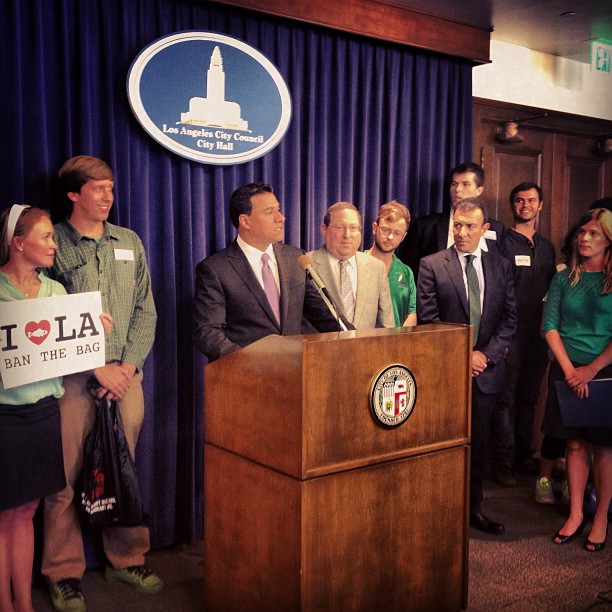
Live in the city of Los Angeles? Urge your councilmember to finalize the single-use bag ordinance that will keep plastic bags from trashing our communities and beaches!