Top

Heal the Bay Blog

Category: Locations

Chivas and Heal the Bay put our heads together to come up with a fun way to teach kids about the importance of recycling this Earth Month. Starting this coming Monday, three local elementary schools will start competing to fill recycling bins on their campuses. The schools stand to win some amazing prizes, including Chivas tickets (two per student and school staff member) and a free field trip to Malibu with Heal the Bay. To check out photos of the kick off at Point Fermin School and to see the cast of characters who showed up to cheer on the students, see this article in the Daily Breeze.

Photo: Scott Varley, Daily Breeze


Heal the Bay is looking for people to join our Angler Outreach Team! This group of dedicated people spends their days on local piers talking to fishermen about the importance of avoiding contaminated fish. The national EPA recently awarded the program one of its top honors for protecting public health.

In Santa Monica Bay, most fish are safe to eat. Some species, however, are contaminated with DDT, PCB and mercury dating from the decades old hot spot off the coast of Palos Verdes. This is particularly true for white croaker (also called Kingfish or Tomcod), barred sand bass, black croaker, topsmelt and barracuda.

If you’re interested in joining the Angler Outreach program, please visit our jobs page. Or learn more about the DDT contamination off the coast of PV.


Latitude 33 and Angeleno Magazine to Host Surfer Chic Fundraiser Featuring Auction of Artist Made Surfboards and Musical Performers The Makepeace Brothers on March 30th in Venice Beach

Large portion of surfboard auction proceeds to benefit Heal the Bay

LOS ANGELES, CA (March 16, 2011) — Latitude 33, the 122-unit modern beach-inspired community located at 330 Washington Blvd. in Marina del Rey, Calif., and Angeleno magazine have announced a March 30th fundraiser event to be held in conjunction with Heal the Bay. In homage of the local vibrant art and music experience of the Venice Beach boardwalk, the event will feature an auction of unique one-of-a-kind surfboards handmade by eight well-known artists as well as a live acoustic musical performance by local roots rock favorite The Makepeace Brothers. The event auction proceeds will benefit Heal the Bay and its efforts to keep our coastlines and waterways clean.

The RSVP-only March 30th fundraiser will be held from 6:30 pm to 9:00 pm onsite at Latitude 33 in the BOARDWALK Collection, one of the beach chic community’s three eclectic living options offering lushly landscaped outdoor living spaces and a mix of contemporary floorplans. Upon arriving, guests will be greeted and directed toward the artistic display of surfboards created by artists Damon Johnson, Greg Miller, Muramasa Kudo, Tony Larson, Deedee Cheriel, Man One, Scott MacDonough and JRF. Once viewed, guests will bid on these eight custom designed surfboards that evening from 6:30 pm to 8: 45 pm in an auction curated in conjunction with Culture Shock Marketing (CSM) with proceeds benefiting Heal the Bay. All bidders at the live event must be present to claim their surfboards.

During the week prior to the March 30th event, one special surfboard will be placed for auction online at www.CharityBuzz.com. Participants will be able to place bids on the board from March 15 through March 30. Bidding will start at $1,000 and increase in $250 increments until the board is sold.

As part of the contemporary beach experience, The Makepeace Brothers, a local roots rock favorite known for their exceptional acoustic style, will entertain guests at the event with a live performance. Culinary favorites will be served by local artisanal eateries Chaya, La Cachette and Joes. Guests will also experience an assortment of beach-inspired cocktails provided by St. Germain, a shaved ice display and a selection of wine from sponsor Voga Italia Wines.

Favorite local lifestyle retailers Linus Bikes and Aviator Nation will also play important roles in the March 30th fundraiser. Linus Bikes, purveyor of the French inspired utilitarian city bike, will auction off a bike. Aviator Nation, the vintage t-shirt line, will conduct informal modeling of their unique clothing pieces and will furnish the closets in the BOARDWALK model unit.

For event details and to RSVP, see our calendar listing.
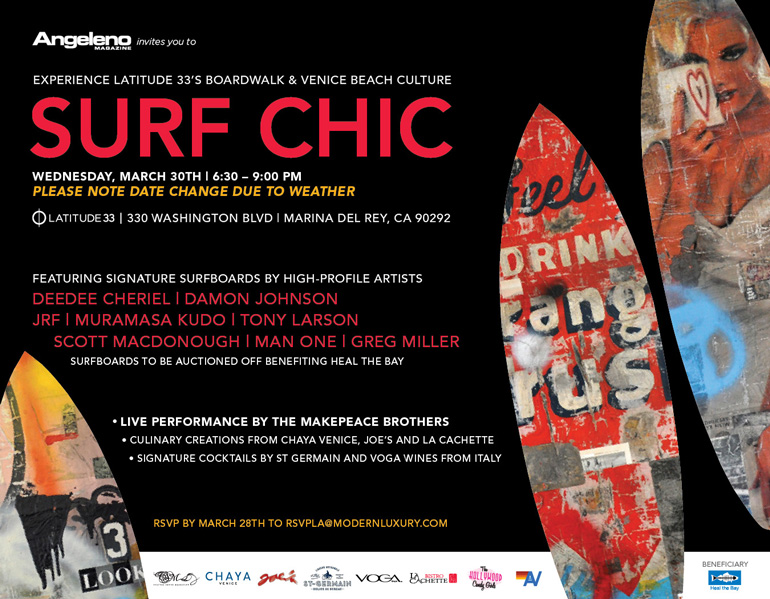
SURF CHIC Invitation


simplehuman Adopts Torrance Beach; Gives Back to Community

LOS ANGELES – March 14, 2011 – simplehuman, renowned for its numerous design awards, patented innovations and quality housewares products, can now add the adoption of Torrance Beach to its list of endeavors.

On Friday, March 18th, the high-end housewares brand will hold its third beach cleanup with Heal the Bay, making simplehuman an official adopter of Torrance Beach. Heal the Bay is a non-profit public interest group dedicated to improving the quality and cleanliness of Southern California’s coastal waters and watersheds.  After sponsoring the conservation efforts of Heal the Bay’s Beach Report Card program in 2007, simplehuman made it a priority to clean up Torrance Beach three times a year as a commitment to its community and to the environment.

simplehuman is completing its final requirements to become an official beach adopter at a time when these efforts are needed most. After the devastating loss of millions of fish in the Redondo Beach marina in early March, programs like Heal the Bay’s beach cleanups are essential to the recovery and preservation of the California coast.

“It is important for us to take care of our environment and the beaches of Los Angeles, but it is also important to give back to our community,” says simplehuman CEO, Frank Yang.

Based in Torrance, CA, simplehuman transformed the trash can with the introduction of the award-winning stainless steel “butterfly” step can in 2000, and has expanded its product line to an extensive array of cleaning, organization and recycling solutions. Today, the company’s mission to make “tools for efficient living” has produced a line of more than 100 products. The simplehuman collection has received international design recognition and is available at fine specialty retailers and at www.simplehuman.com.

To learn more about ways you can help Heal the Bay, visit HealtheBay.org/Get Involved.


With the massive fish kill in Redondo’s King Harbor earlier this week, the most pressing issue now is the clean-up. It’s critical that all the dead fish are removed within the next couple of days to prevent an even worse problem.

Fish Kill Cleanup: Volunteer!

  • For information on how and when to volunteer, contact the Redondo Beach CERT Hotline at 310.318.8111
  • Cleanups efforts vary, please call to receive correct instructions
  • Water, food, sunscreen will be provided to volunteers

More News, Photos & Videos

To volunteer for the Redondo Beach fish cleanup, please contact the Redondo Beach CERT (Community Emergency Response Team) Hotline at 310-318-8111 for information on how and when to volunteer. Cleanups efforts do vary so you must call to receive correct instructions. Information is updated at 8 p.m. each night.

Water, food and sunscreen will be provided to volunteers. No experience or supplies are required — only enthusiasm. Volunteers are needed throughout the weekend.

In the meantime, scientists are analyzing samples of fish and water to determine the cause of the die-off in King Harbor. Heal the Bay is monitoring the situation through colleagues at the Redondo Beach SEA Laboratory and the University of Southern California.

Samples will be analyzed for the presence of any harmful algae, though early reports indicate there is no discoloration of the water to indicate massive amounts of algae. It has been reported that dissolved oxygen levels in the water are extremely low, meaning there is limited oxygen for fish to breathe in the water.

Heal the Bay will continue to monitor the situation and will offer updates as we receive more details. According to Brent Schiewe, director of the SEA Lab, very large schools of baitfish were seen in all the harbor’s basins the day before the fish kill, possibly due to the storm.


Finescale Triggerfish

The Finescale Triggerfish (Balistes polylepis) is the latest resident of the Santa Monica Pier Aquarium’s Beneath the Pier exhibit. Triggerfish are usually associated with tropical water, but their range stretches from San Francisco all the way to Peru. This fish has a feisty reputation and reportedly has been seen attacking sharks. Our triggerfish was shy at first, but has lately been seen coming right up to the glass, seemingly to check out our visitors and making it hard to tell who is observing whom.

Fun Facts

Triggerfish are often found in caves and crevices, but are also seen swimming in the open along the sandy bottom adjacent to rocky reefs and in waters as shallow as 10 feet. With powerful jaws and a set of eight teeth on each jaw, this fish is equipped to eat spiny sea urchins, small crustaceans, mollusks and other animals that are normally protected by a shell or armor.

The finescale triggerfish can reach a length of up 30 inches and usually weighs up to 10 pounds. The largest reported specimen was 16 pounds. Fossils of finescale triggerfish teeth dated at 25 million years old have been found in Santa Ana and Bakersfield.

Some triggerfish are toxic if eaten, but the finescale triggerfish has never been found to be toxic. Still the finescale doesn’t show up on the dinner table often because their tough hide makes it difficult to skin.

To get checked out by our finescale triggerfish, visit our Santa Monica Pier Aquarium.

photo by Nick Fash


If you live in the Palisades, you might notice construction on PCH beginning today. Don’t get frustrated by the slow traffic though. Instead, take a minute to drive slowly and be grateful for the new pipes that will funnel urban runoff from storm drains to the Hyperion Wastewater Treatment Plant (during dry weather, not during rain).

Without the diversions, that water would flow directly across our beaches and into the ocean, carrying with it chemicals and high levels of bacteria that could make you sick.

These low flow diversions are an important part of making sure that during dry weather all of the beaches in the Santa Monica Bay are safe for swimming.

They’re being paid for by Prop O, a 2004 water bond approved by California voters that dedicated $500 Million to cleaning up some of California’s most polluted beaches (some of which, unfortunately, are local).

You can learn more about Prop O, and the local projects it funds, at lapropo.org.


The city of Santa Monica is celebrating the return of its local water supply. In a classic David vs. Goliath case, Santa Monica took on Big Oil to restore the people’s rights to a clean, local water supply.  The combination of leaking underground gasoline storage tanks and the addition of MTBE as an oxygenate in gasoline led to massive contamination of Santa Monica’s Charnock well field in the mid 1990s. The groundwater pollution left Santa Monica completely reliant on high priced MWD water imported from the Delta and the Colorado River. Until the wells were shut off in 1996, approximately 70% of the city’s water supply came from local groundwater. After an incredibly hard fought litigation and negotiations, Shell Oil (the biggest aquifer polluter), ExxonMobil and Chevron settled with the city for about $250 million.

In a world that seems increasingly dominated by Big Oil, Santa Monica stood up to the polluters and successfully fought for one of our basic human rights: clean water.

Read more and comments (new window).


Editor’s note: Nick Fash is one of two teachers at the Santa Monica Pier Aquarium. He and colleague Aaron Kind educate as many as 600 students in a week. Nick chronicles a day in the life of an Aquarium education specialist.

Entering the Aquarium first thing in the morning, flipping on the lights, the quiet tranquility is only broken by the soothing sound of water flowing through pipes.  This will all change in one short hour when 60 excited children will fill this space with ohhs, ahhs and countless wide-eyed questions.  But many things need to get done over the next 60 minutes in order for those children to have “one of the best days ever!”

Checking the schedule, noting the age of the students, their number and the topic for the class, Aaron and I begin to formulate our plan.  We have been doing this for years and can effortlessly communicate the details: setting up the hands-on lab, placing the whale bones out, matching the signage to the different marine mammal skulls on display and prepping the classroom with the correct number of tables and chairs.  By the time the covers are removed from the touch tanks, we are ready to prep our wonderful education docents on what we will need from them and when we will need it done.  We are lucky to have such a devoted team backing us up, as 60 energized students is quite a handful for just the two of us. 

We swing open the patio doors, letting the ocean air into the Aquarium and go about hanging the kelp forest barriers that effectively create a private outdoor addition to our space.  And just in time, a big yellow school bus rumbles to a stop outside of our front door, every window lined with faces, with eyes as wide as can be.

Greeting the teachers we confirm the details and run them through our plan.  As the students gather at the front door, I give the excited students a quick walk through of the rules and the expectations we have for our young ”scientists,” and as I swing the doors open I must watch my toes as the children eagerly flow into the Aquarium.  Many hands are in the touch tanks, all the while rattling off questions at a dizzying pace.  A group of students learns about sharks around our open top shark exhibit, while others have their faces pressed up against the glass of the sea jelly exhibit.  Twenty minutes later we split our group into two small teams. 

One group lines up with Aaron by the front door, where they will be heading for the beach to discover animals in their natural habitat and to learn about impacts of pollution on the sandy beach environment.  The other half tiptoes into the Green Room where we have live tide pool animals ready for them to really get to know.  As they sit quietly on the floor, their eyes fixed upon me, wondering what I am going to say, I begin.  “Where do all of my animals come from?”  As we learn about habitats, whales, sea stars, sea urchins, sea cucumbers and a host of other animals from our local waters, I remind them that they are our neighbors and if we keep our neighborhoods clean, their home will be clean as well.

But the radio belches out Aaron’s 3-minute warning, and I line up the students for our turn at the beach.  As we pass Aaron and his group on the way in, the students swap excited stories of what they had just experienced, but the beach awaits.  Sand crabs, bean clams, kelp, birds and the occasional dolphin or sea lion can all be expected while we dig through the sand and explore the beach in a way many of these children have never done before. 

As we line the students up to clean their hands and gather their belongings, we are already mentally prepping for our next class, as we have just 30 minutes before we do this all over again.  Thank you coffee. 

photos by Maita Moura

Aquarium Field Trip