
Aug. 17, 2016 — Just departed president Alix Hobbs made asking the hard questions look easy, writes Communications Director Matthew King.
No. It’s one of the simplest words in the English language, but often one of the hardest to say.
Heal the Bay has a team of passionate advocates whose heads are filled with big ideas. These well-meaning initiatives, cooked up in the excitement of a brainstorming meeting or a flurry of overly optimistic emails, can quickly take a life of their own. Other priorities established weeks ago are set aside, as the team chases the new concept like 8-year-olds scurrying in unison after a soccer ball at a Saturday AYSO game.
The problem with good ideas is that they are just ideas – and often not very good ones. (“Hey, let’s create a giant sea star on the beach made of glued-together cigarette butts!”) Pursuing them costs time and money – two of any nonprofit’s most precious assets.
Heal the Bay, like any well-run organization, simply needs someone smart to say No. Someone to ask the hard questions. For many years that person was Alix Hobbs, our just departed president.
It isn’t an easy job, nor a glamorous one, but it’s critical to our success. She had to make choices on matters as mundane as selecting our credit card company, and as soul-shaking as personnel reductions. And during my nine-year tenure here, Alix did it with conviction, fairness and a clear sense of purpose.
Nonprofits love to hold meetings. We discuss items to death. We form subcommittees to offer preferred alternatives. Everyone has a voice, and consensus is desperately sought. But ultimately someone has to make a decision. And lately that fell to Alix in her duties overseeing Heal the Bay for the past two years.
A naval commander’s daughter, Alix was to the captain’s bridge born. When faced with a decision, she surveys the options as if scanning the open sea. After careful consideration, amid often conflicting voices, she’ll speak in a firm, clear voice about which way to point the boat. That confidence is reassuring to a busy crew seeking calm in the middle of a minor squall.
Alix had grown up professionally at the organization, serving capably in a variety of roles for nearly 20 years – from volunteer to Coastal Cleanup Day coordinator to Programs Director. But some of her greatest work came serving largely behind the scenes as Associate Director during the tenure of past president Mark Gold. Essentially acting as our CFO, she made sure the trains ran on time — managing budgets, overseeing operations, shepherding grants — so our policy and education teams could do their amazing work.
Then the board threw her into a new challenge – settling the HTB ship after a few turbulent years. As our new chief, she was tasked with spearheading the creation and adoption of a comprehensive 10-year strategic plan. She also was asked to lead a fundraising campaign to solidify our financial foundation as the regional economy finally woke from its slumber.
Speaking directly and confidently with the media and general public, Alix made my job as Communications Director easier. Statuesque with preppy good looks, she exudes self-assurance. I once told her that she reminded me of the dark-haired actress Ali MacGraw. She quickly shot back: “Who’s Ali MacGraw?,” making me feel a thousand years old. (If you’re under 40, you can Google “Love Story” or “Steve McQueen’s wife.”)
But Alix and I occasionally butted heads over the years, be it about staffing levels in my department or the tone of an email blast. I’m a right-brain type, acting on instinct and intuition; she’s a left-brainer, guided by reason and analytics. We usually approached a potential problem from differing perspectives. But we typically came to an agreement that best served the organization. To her credit, she trusted me to do my job and always gave me creative latitude and authority.
Having fulfilled her mandate, Alix is now moving on and has accepted a job as president of the Crystal Cove Alliance in Newport Beach. She’ll get a chance to test out her entrepreneurial skills and expand her management chops in the hospitality field.
The good news is that Alix will remain connected to Heal the Bay. She has accepted a voting position on our board of directors and will have a voice in our future direction.
With respect and gratitude, I look forward to hearing many more No’s from her.







 The more upcoast tide pools near Paradise Cove are formed by tall rocks, making tide pooling possible even at mid-tide! In these northern pools you can see woolly sculpins, sand castle worm colonies, and turban snails. You might even get lucky and spot a beautiful chestnut cowrie, like the one pictured on the right. Remember to tread lightly on rocks to avoid stepping on marine life, be gentle when touching critters, and leave animals in their tide pool homes. Check the tides before you go and time your visit for a low tide. Please be careful and do not climb on the rocks – they are slippery and wet, so it is very easy to fall and hurt yourself.
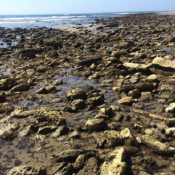 Heading south in Little Dume Cove, the pools are no longer formed by ridges of large rocks and are instead formed by many low rocks and small boulders. This area is very accessible and would be great for the whole family. Be sure to get there at the low tide, the rocks are easy to walk across and there is less chance of getting splashed by incoming waves. These pools have an abundance of life but please don’t take anything home! This is a State Marine Reserve so fishing/harvesting of all marine resources is prohibited. If you see anyone collecting from the tide pools during your trip to Little Dume Cove and the Point Dume State Marine Reserve, please call the California Department of Fish and Wildlife at 1-888-334-CALTIP.