Top

Heal the Bay Blog

Category: Locations

Editor’s note: Nick Fash is one of two teachers at the Santa Monica Pier Aquarium. He and colleague Aaron Kind educate as many as 600 students in a week. Nick chronicles a day in the life of an Aquarium education specialist.

Entering the Aquarium first thing in the morning, flipping on the lights, the quiet tranquility is only broken by the soothing sound of water flowing through pipes.  This will all change in one short hour when 60 excited children will fill this space with ohhs, ahhs and countless wide-eyed questions.  But many things need to get done over the next 60 minutes in order for those children to have “one of the best days ever!”

Checking the schedule, noting the age of the students, their number and the topic for the class, Aaron and I begin to formulate our plan.  We have been doing this for years and can effortlessly communicate the details: setting up the hands-on lab, placing the whale bones out, matching the signage to the different marine mammal skulls on display and prepping the classroom with the correct number of tables and chairs.  By the time the covers are removed from the touch tanks, we are ready to prep our wonderful education docents on what we will need from them and when we will need it done.  We are lucky to have such a devoted team backing us up, as 60 energized students is quite a handful for just the two of us. 

We swing open the patio doors, letting the ocean air into the Aquarium and go about hanging the kelp forest barriers that effectively create a private outdoor addition to our space.  And just in time, a big yellow school bus rumbles to a stop outside of our front door, every window lined with faces, with eyes as wide as can be.

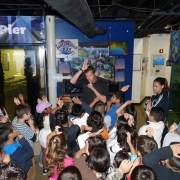
Greeting the teachers we confirm the details and run them through our plan.  As the students gather at the front door, I give the excited students a quick walk through of the rules and the expectations we have for our young ”scientists,” and as I swing the doors open I must watch my toes as the children eagerly flow into the Aquarium.  Many hands are in the touch tanks, all the while rattling off questions at a dizzying pace.  A group of students learns about sharks around our open top shark exhibit, while others have their faces pressed up against the glass of the sea jelly exhibit.  Twenty minutes later we split our group into two small teams. 

One group lines up with Aaron by the front door, where they will be heading for the beach to discover animals in their natural habitat and to learn about impacts of pollution on the sandy beach environment.  The other half tiptoes into the Green Room where we have live tide pool animals ready for them to really get to know.  As they sit quietly on the floor, their eyes fixed upon me, wondering what I am going to say, I begin.  “Where do all of my animals come from?”  As we learn about habitats, whales, sea stars, sea urchins, sea cucumbers and a host of other animals from our local waters, I remind them that they are our neighbors and if we keep our neighborhoods clean, their home will be clean as well.

But the radio belches out Aaron’s 3-minute warning, and I line up the students for our turn at the beach.  As we pass Aaron and his group on the way in, the students swap excited stories of what they had just experienced, but the beach awaits.  Sand crabs, bean clams, kelp, birds and the occasional dolphin or sea lion can all be expected while we dig through the sand and explore the beach in a way many of these children have never done before. 

As we line the students up to clean their hands and gather their belongings, we are already mentally prepping for our next class, as we have just 30 minutes before we do this all over again.  Thank you coffee. 

photos by Maita Moura
Aquarium Field Trip


Ecosystems are fragile. They depend on very intricate foodwebs (rather than the foodchains described in older biology books) that thrive on balance. Unfortunately, people can have very real, and unintentional, impacts on the environment around us. Today, we are starting to see the impacts on the world’s oceans when we overfish and don’t harvest fish sustainably.

In a new study released by scientists at the University of British Columbia, fish populations are spinning out of whack. As we remove popular eating fish like tuna, cod and grouper, smaller foraging fish populations increase. While these smaller fish, like sardines and anchovies, are useful in fishmeal and fish oil, we might be facing a future without fish filets and tuna sandwiches.

The good news is there’s still time. Read more about UBC’s research, and how you can help put an end to overfishing at seaweb.org.


We all have our favorite air travel gripe; tiny plane seats, lenthy lines, tired kids. Well, if your biggest complaint was the amount of plastic water bottles sold, or the difficulty of bringing your own water with the liquid requirements, traveling to or from San Francisco just got a little more tolerable. SFO has installed free water stations throughout the airport. Remember water fountains? Sort of like that, only better.

Learn more at Food and Water Watch.

Photo:JunCTionS vis Flickr


Early Monday about 700 gallons of diesel fuel were spilled into Long Beach Harbor at Tesoro Terminal. According to the US Coast Guard, the spill took place at Berth 84A and happened during a transfer from a tanker.
Floating booms surrounded the spill in an effort to contain the oil while crews planned a cleanup technique. The Coast Guard, the California Department of Fish and Game, and the vessel’s emergency response management company  banded together to begin to clean up the oil.
If you see wildlife covered in oil, call (877) 823-6926.
Photo: Rennett Stowe


Take a minute to visit the Wall Street Journal and vote in today’s poll on whether or not plastic bags should be banned. The accompanying article talks about the numerous cities in California that have banned bags, and whether this city-by-city approach is working. The poll is running today only, so make your voice heard! Take the poll at Wall Street Journal (the poll is half-way down the page).


There’s good news for beach goers in Venice. A new project is set to improve your beach water quality.  A City of Los Angeles Proposition O Clean Water Bond-funded 14 million dollar project is about to happen in your back yard. This month, the Penmar Water Quality Improvement Project begins construction. The overall goal is to reduce pollutants in stormwater runoff from the Rose Avenue storm drain. Right now, that drain goes straight to the ocean, but after the project is completed, the runoff will be diverted to Hyperian Wastewater Plant for treatment. Aging infrastructure will also be rehabilitated.

Learn more.

Photo Dr EG via Flickr


This post was guest-written by Aaron Kind, our education specialist at the Santa Monica Pier Aquarium. Aaron runs our Aquarium’s lecture series. Here, he writes about an innovative new addition to that program.

Being a talented artist, whose works have hung on my mother’s refrigerator and graced a few bathroom stall walls, I was quite excited to host the Santa Monica Pier Aquarium’s first Artist Night.  The event was meant to reach out to the local artists in the community, and by keeping the RSVP list to a minimum the Aquarium had plenty of room for the artists to set up.  The event received some unexpected advertising; Traffic Queen and Shortcuts author Kajon Cermak of KCRW announced the night on her radio program and The Santa Monica Observer generously devoted an entire page in color to our Artists’ Night flyer. 

The Aquarium’s local species were the models for the night; moray eels, octopus, sharks and moon jellies took center stage for the evening’s festivities. Photographers, painters and even a couple of digital sculptors attended the two-hour event.  For the first hour, the Aquarium lights were dimmed to help photographers reduce glare from the tanks for their shots.  For the second hour, the lights were brought back up and sea stars, sea urchins and other denizens of the deep were placed in bins so painters and sketchers could get an up close look.  A little bit of 60’s beachy rock  ‘n’ roll set the mood for the artists and models alike.  After talking with the participants (the ones without the fins) the Aquarium staff is planning to set another artist night in approximately three months.

 “Tonight is about artists hanging out with other artists,” one woman was overheard saying, and we were excited to offer this great community with a venue to do just that. For further information on upcoming events, visit the Aquarium section on this site. Also, join us on Facebook to view pictures from the night.


On an overcast Tuesday morning, a crowd  of 300 volunteers came out to clean the beach at Santa Monica Pier alongside their Los Angeles Dodgers heroes.  Nearly every volunteer was dressed in Dodger gear and some came three hours early to meet Matt Kemp, Rafael Furcal, Steve Garvey, Fernando Valenzeula, Derrel Thomas, Sweet Lou Johnson, Shawn Green, Gabe Kapler, Tony Gwynn Jr. and Jay Gibbons.  Despite the drizzle, everyone had a great time picking up trash, getting autographs and listening to the players tell stories of their exploits on the diamond.

The Dodgers visit, courtesy of team exec Howard Sunkin and owner Frank McCourt, marked a stop on a public service caravan around L.A. before the men in blue take off for spring training and the grapefruit league at Camelback Ranch in Glendale, Ariz.  Howard introduced me to the players on the team bus and I felt a heckuva lot more nervous than I do testifying at city council.  When Steve Garvey and Fernando came off the bus, I felt like I was in a time machine transported to my days as a teenager obsessed with the outcome of all 162 games on the schedule.  After posing for a “team photo” right next to Fernando, I gathered up the nerve to tell the Dodger legend that I was there to watch him pitch as a 19-year-old call up in the September of 1980.  Ever stoic, Valenzuela shook my hand and said nothing.

Then we walked across the sand to the sea of blue of Dodger fans in front of a standing microphone.  I walked alongside former slugger Shawn Green and asked him some small-talk question about what he was up to now in the O.C.  He answered politely.  I always was a big Greenie fan. Star center fielder Matt Kemp took the long way to mic because he didn’t want to get his new black Nike kicks sandy.  He soon got over that.  Of course, Charlie Steiner emceed the event. Steiner remarked “it was a beautiful day for a ballgame” despite the gloomy drizzle.  He introduced the entire Dodger lineup and then welcomed S.M. Mayor Richard Bloom and me.  That’s right, I got an intro from Charlie Steiner.  How cool is that!

Read more & comment» (new window)


The environmental movement appeals to people of all ages, from all walks of life. We each have important and very personal reasons for protecting the world around us.

But young people, in particular, are poised to become the new face of the environment. As they grow older and begin to inherit the earth, with all of its majestic open spaces as well as all of its pollution problems, more and more teenagers and other young people are embracing environmental activism as their legacy.

One of the coolest examples of the connection between teenagers and the environment is a group called Teens Turning Green. It’s a youth-led initiative that brings environmental education and awareness to young people throughout the country.

And we’re not just talking about environmental science. Teens Turning Green focuses on environmentally friendly lifestyles, including making smart purchases, avoiding chemicals in makeup and other products, and other important habits. One of their biggest campaigns has been against lead in lipstick, called Lips Against Lead.

Teens Turning Green is having a free environmental summit in LA on Feb. 26. If you’re interested, or know someone who might be, visit teensturninggreen.org.