Top

Heal the Bay Blog

Category: Santa Monica

Santa Monica, California located in Los Angeles County is a popular eco-friendly coastal destination for families, couples, tourists and Southern California beachgoers.

Thank you Simon Cowell.  An irate Heal the Bay member wrote a scathing e-mail encouraging us to take a stand against your ocean pollution commercial. It’s bad enough that my 12-year-old daughter Natalie is obsessed with his “American Idol” rip-off, “The X-Factor.”  (Try getting her to study when she’s sucked into the battle among Kitty, Misha B and 2 Shoes.) But now he’s doing a Verizon “X-Factor” app promo that encourages the trashing of a Malibu beach. In the spot, Cowell is seen tossing cell phones off his beachside balcony onto the shoreline while disparaging them as rubbish.

Cell phones contain a wide variety of toxic heavy metals, including arsenic, antimony, beryllium, cadmium, copper, lead, nickel, and zinc. They also can contain brominated flame retardants and phthalates. Perpetuating our throwaway culture to over 12 million viewers isn’t exactly helping the cause of ocean conservation.

Cowell ends the spot by admonishing a family on the beach to not pick up the trash.  Even the leashed puppy complies with the bombastic Brit’s orders. If Cowell gets busted for bad behavior, I hope his community service is participation in Coastal Cleanup Day for life.

The Brits are always giving us trash: Gordon Ramsay, The Osbournes, the Spice Girls, Jason Statham, soccer (just kidding on that one, sort of).  Now they’re trashing our beaches.  Wasn’t British Petroleum’s Deepwater Horizon spill bad enough?

Read more.


L.A. County’s Department of Public Health has just released rainwater harvesting guidelines that could help transform the region’s management of stormwater runoff.  The guidelines apply to rainwater harvesting projects, including rain barrels and cisterns, and they significantly shift the region’s approach from treating rainwater as a pollution source and flood control problem to managing it as a critical resource.

The guidelines were released at the site of a massive Proposition O project at Penmar Park in Venice.  A giant pit and a huge dirt mound served as the backdrop Tuesday for the modest press event (the Conrad Murray verdict occurred an hour earlier).  The Penmar Park project will capture runoff from the watershed from south-east Sunset Park in Santa Monica and the Santa Monica Airport and the Rose Avenue neighborhood near Walgrove Avenue.  The cistern will store approximately 1 million gallons of runoff, which will then be disinfected and used for irrigation at the Penmar golf course and park.

The rainwater harvesting guidelines were negotiated over a two-year period with the City of Los Angeles, Santa Monica, and the environmental community, led by Heal the Bay and Treepeople.  They provide clarity and certainty to project developers on how to move forward with projects that capture and reuse rainwater.  L.A. County Public Health, especially Angelo Bellomo and Kenneth Murray, earn major props for moving the guidelines forward.

Read more of this post »


The WEFTEC water quality conference, with its acres of pumps, filters, water treatment devices and other gizmos, moved out of the L.A. Convention Center last week. But I’m still thinking about what the 20,000-person gathering of H2O nerds means for our nation’s waters.  I was asked to give three talks at the conference: one on the public view of chemicals of emerging concern in recycled water; another on the future of stormwater regulation for cities and industry; and a discussion on the greening of Los Angeles through stormwater projects and regulation.

After the debates with water professionals, I was struck by a common need:  Everyone wants greater regulatory consistency and clarity.

The current federal approach is for regulations, memos, and policies to have  a great deal of  “flexibility.” But that wiggle room means that there isn’t much incentive to improve water quality programs.  Any investor in cutting-edge water treatment technology should have the expectation that the regulatory climate will push everyone to cleaner water that is more protective of human health and aquatic life.

Without that regulatory certainty, there’s no incentive for cities or industry to buy more expensive, more effective water pollution technologies other than “doing the right thing.”  Based on the lack of progress on stormwater pollution abatement nationwide, the altruistic approach has resulted in limited success.

Read more of this post »


Ever wonder what to do with your unused or expired prescription drugs? To keep them from entering our waterways and ecosystem, please do not pour them down the sink or flush them down the toilet.

Instead, bring them for disposal to the front of the Santa Monica Police Department at 333 Olympic Drive on Saturday, Oct. 29,  from 10 a.m. – 2 p.m. An officer will be available at the curb to make it easier for you to just drive up and drop off your unused, unwanted or expired prescription drugs.  The service is free, anonymous and no questions will be asked.

For more information, contact Sergeant Richard Lewis at 310-458-8462 or richard.lewis@smgov.net

Can’t make it to the disposal event? For safe drug disposal, consult these FDA guidelines.


The California Coastal Commission invites California students in Kindergarten through Grade 12 to submit artwork or poetry with a California coastal or marine theme to the annual Coastal Art & Poetry Contest. Up to 10 winners will be selected to win $100 gift certificates to an art supply or book store, and each winner’s sponsoring teacher will receive a $50 gift certificate for educational supplies, courtesy of Acorn Naturalists.

All winners and honorable mentions will receive tickets for their families to visit the Aquarium of the Pacific, courtesy of the Aquarium. Students may have their work featured on Commission web pages and materials, and winning entries will be exhibited throughout the state.

To be eligible for the upcoming contest, entries must be postmarked by January 31, 2012.

For rules and entry form (and helpful links for teachers and students), visit www.coastal.ca.gov/publiced/poster/poster.html, call (800) Coast-4U or email coast4u@coastal.ca.gov.

Contest flyers (PDF or hard copy) are available upon request.


The Los Angeles City Council today took the bold step of supporting unanimously a substantial sewage service fee increase. The household fee will incrementally increase from an average of $29 a month to $53 a month over the next 10 years. The hike will generate an additional $1.8 billion over the next decade to pay for much-needed sewer and sewage treatment plant maintenance, repairs and replacement.

 I’ve been going to council meetings for over 25 years and this was the most sophisticated and intelligent council discussion on wastewater that I’ve ever seen. The lack of public opposition to the rate increase underscores the Bureau of Sanitation’s effectiveness in educating the public. Even the Chamber of Commerce strongly supported the measure.

The end result? Multiple wins – for public health, for the environment, for long-term, sustainable green jobs.  It also marks a step in the restoration of my faith in the public process.

If the L.A. City Council can unanimously approve a major sewer service rate increase during an ongoing recession, then there is hope for government elsewhere to provide leadership on other environmental and green jobs issues. Today, L.A. understood that sewage infrastructure may be out of sight, but it can never be out of mind.

Read more of this post »


Unfortunately, discussions about the future of K-12 public education in California typically focus on the state’s massive budget problems.  Talks of educational reform seem to exclusively revolve around teacher accountability and charter schools.  Very little of the dialogue centers on how we can educate students more effectively and with new, engaging curriculum. 

But on Oct. 17-18, environmental content will be the focus at the Green California Schools Summit at the Pasadena Convention Center.

California’s budget crisis has been so severe that students have not received new textbooks in the last three years, and they may not receive new ones until 2015.  That means that a student that was a fifth grader in 2008 will never use a state textbook to learn about the United States’ first African American President, the loss of Pluto as a planet, or the global economic recession.

However, an interim solution for environmental education is moving forward: the Education and the Environment Initiative (EEI). It’s progress, but the curriculum program to develop environmental literacy in California’s 6 million public school students and their 150,000 teachers won’t reach classrooms in the next few years.

Read more of this post »


We collected a sample of water off the Santa Monica Pier today, and got a bit of a surprise. Instead of the blue-gray water that we usually collect, a rusty, brownish-red liquid filled the collection jar. Welcome back red tide!

Aquarium staff has been bombarded with questions regarding what people perceive as “polluted water” these past few days. So here’s a little background on this interesting phenomenon.

The term red tide is a bit of a misnomer as the color of the water is usually not red, and the blooms are not associated with the tides. Hmm….ponder that wonder of science.

Red tides occur when there is a high concentration of mostly dinoflagellates, a small, single-celled phytoplankton that possess two flagella, or whiplike projections. The water appears as a rusty-brownish color as the light reflects off the accessory pigments in the cells of the numerous phytoplankton, or algae, floating on the surface.

Dinoflagellates reproduce by fission, meaning the single cell divides in half and then creates two new cells, and so on and so on as the population continues to grow exponentially. Under the right conditions the organisms can reproduce once a day, creating a massive population bloom. During the peak of the red tide there can often be tens or hundreds of thousands of dinoflagellates in one drop of water.

This phenomenon can occur all over the world, and about 200 species are known to cause the red tide. However, during a red tide other organisms aside from the dinoflagellates have been found, such as cyanobacteria and diatoms.

Contrary to what many believe, not all red tides are harmful. But to be clear, many can cause adverse health effects.

Many of the dinoflagellates that are responsible for these occurrences are simple organisms. However about a third of the species causing red tides have the ability to produce toxins as metabolic by-products.

During a toxic bloom, mussels, clams and other shellfish that filter feed plankton as a food source, end up concentrating high amounts of the dinoflagellates and can tolerate the toxins by storing it in digestive glands or other tissues. However, when people eat these animals they can suffer nausea/vomiting, diarrhea, tingling or numbness. Fatalities can occur in the most severe cases. This is known as Paralytic Shellfish Poisoning (PSP) and one species of dinoflagellate in the genus Alexandrium is the culprit. That’s the reason behind the annual mussel harvesting quarantine along the entire California coast from May 1- Oct. 31.

Red tides are unpredictable and the causes of them are not entirely known, however, red tides have been occurring more frequently. Some factors that may contribute to the blooms are reduced salinity, optimal light and nutrients, warm surface temperatures, transport in ballast water of ships and pollution. Sewage and fertilizer found in urban runoff contribute a high level of phosphates and nitrates into the ocean environment. Burning of fossil fuels also contributes to the amount of nitrogen, and is considered the greatest source to the open ocean environment. Excessive amounts of these nutrients cause the primary producers to grow rapidly.

Primarily a problem in coastal habitats, the algae grow quickly and reduce the amount of sunlight that is able to penetrate to the bottom. As the phytoplankton blooms and then dies, and as metabolic wastes builds up from the zooplankton and fish that feed on the abundant phytoplankton, decay bacteria break down the matter and in the process use up the oxygen. Also, due to the turbulence in the water the decaying phytoplankton become crushed and create a foaming effect on the shore.

What does all this mean to the beachgoers and lovers of the sea? Some believe that swimming, boating, or breathing sea spray that is affected with red tide organisms can cause eye irritations, skin discomfort and sore throats, so be careful out there! But do go out there and check it out. It’s pretty amazing.

Oh, and if you have the chance to visit the ocean at night, check out the bioluminescence that occurs in the waves. These dinoflagellates can take energy from a chemical reaction and convert it to light energy so that they produce an awesome blue-green light that looks like a fireworks show in the water.

Happy exploring!

Vicki Wawerchak, Director, Santa Monica Pier Aquarium



Available in iTunes
Available in Android Marketplace


APP UPDATE: We are currently experiencing some issues with the Beach Report Card App due to opperating system changes. In the meantime, please go directly to beachreportcard.org for all your healthy beach reporting needs!

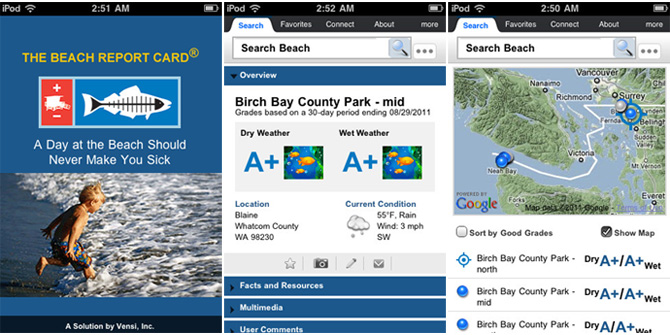
Beachgoers can now check the latest water quality grades at 650+ West Coast beaches via Heal the Bay’s Beach Report Card mobile app for the iPhone or Android, at www.beachreportcard.org.

The new, free Beach Report Card app provides the only access anytime and anywhere to a comprehensive, weekly analysis of coastline water quality.  The mobile app delivers A through F grades, weather conditions and user tips throughout beach locations in California, Oregon and Washingtonto swimmers, surfers and anyone who loves going in the ocean water.

In addition to discovering which beaches are safe or unsafe, beachgoers can look up and save their favorite local beaches, as well as learn details on beach closures.

Know before you go!

Beach Report Card app screens


As a Jewish parent and environmental scientist, I am consumed by guilt for taking the baby bottle shortcut when feeding our kids many years ago.  Yes, I put formula, and even – gasp –breast milk, in a plastic bottle and heated  it for 30 seconds in the microwave to satiate our kids and get them to stop crying. Who knows what was leached from those indestructible, clear plastic baby bottles while I was heating milk to lukewarm temperatures.

Of all people, I should have known better.  As more information came out in the public health literature about the risks of consuming Bisphenol A (BPA), an organic chemical used to produce polycarbonate plastics that are clear and nearly shatterproof, my guilt grew over exposing my three kids to an endocrine disrupting, potential neurotoxin and carcinogen.

Read more of this post »