The Aquarium’s Micro Biologists classes are a fun way to introduce your 3-to-5 year olds to environmental education and marine science through engaging games, stories, art and hands-on science activities.

Top
Heal the Bay Blog
Category: Heal the Bay Aquarium
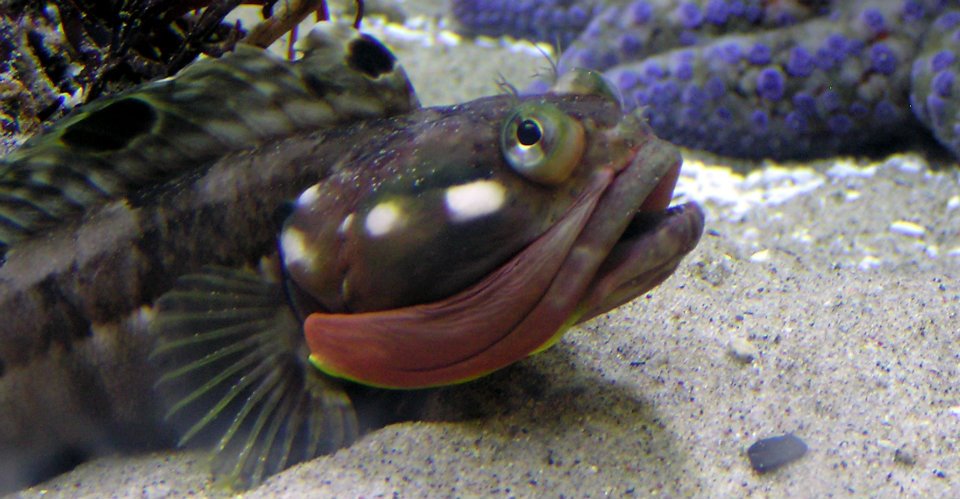
In honor of National Sarcastic Fringehead Day on October 30, we’ve made the sarcastic fringehead available for adoption for a limited time through the end of October. Don’t miss an opportunity to contribute to this unusual fish’s care. The Aquadoption also includes a yearlong membership to Heal the Bay and free family admission to our Santa Monica Pier Aquarium for the year. Learn more about this species below, from guest blogger Jenna Segal, the Aquarium’s volunteer coordinator.
One of our favorite creatures here at the Santa Monica Pier Aquarium is the sarcastic fringehead (Neoclinus blanchardi). This is a type of fish usually found in rocky reef and kelp forest habitats. Fringeheads range from Northern California down to central Baja California, and usually reach a size of 30.5 cm (12 in). Their diet consists primarily of crustaceans, octopuses, crabs and shrimp. Neoclinus are solitary and very territorial. They like to live in a small shelter, and have been found in a variety of habitats ranging from shells, rock crevices, worm tubes and beer bottles.
When another sarcastic fringehead starts encroaching on an individual fringehead’s territory, they will wrestle one another by opening their mouths wide and aggressively pressing them together–this determines which fish is bigger and therefore more dominant. During reproduction, females will lay eggs in holes, shells, rocks, etc. but the males guard the nest. Our juvenile fringehead is currently on exhibit in the Jewel Tanks found in the Kids’ Corner section of the Aquarium, and a larger fringehead can be found in a turban snail shell, across the gallery in the Sandy Bottom Exhibit.
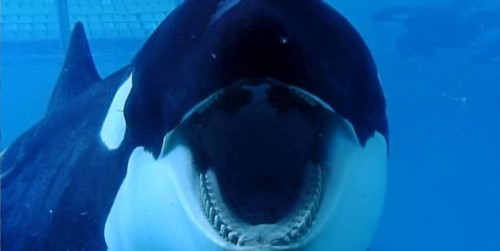
A few years ago, a blind date took me to see The Cove, thinking it would be a good conversation starter considering my love of the ocean. As it turned out, my bawling got in the way of any conversation. Needless to say, there wasn’t a second date. Going to see Blackfish last night was like a second date with the subject matter, albeit from a different perspective.
“Blackfish” looks at the issue of dolphins in captivity from the perspective of the interactions between the largest dolphins, Orcinus orca, and their human trainers, primarily at Sea World. It tells the story of Tillikum the giant orca who attacked and killed trainer Dawn Brancheau three years ago. How did this happen? Is it really a surprise? I will leave it to the movie to tell the story as it does so beautifully.
While not as graphically violent as “The Cove,” the content is pretty heavy and very poignant. While the graphic deaths are described instead of being shown, this is still a movie more suited to mature audiences. It steals a favorite story of mine by showing video of how dolphin trainers are able to get sperm samples from their animals.
Overall, the story presents a quandary that anyone who works in animal display fields must wrestle with: are the costs to the animals in captivity worth the benefits? Having spent the bulk of my adult career as a marine biology educator at an aquarium, I have struggled with the issue as well. For me, it was made easier knowing that the animal keepers I have worked with were doing everything in their power to keep the animals we worked with safe and healthy… and putting the educational value of the animals above the entertainment value.
At our Santa Monica Pier Aquarium, we provide our animals the space, habitat, food and enrichment modeled after the actual conditions in which they would naturally occur. This way, we are able to demonstrate respect for them and allow them to serve as natural ambassadors for the ocean as a whole. “Blackfish” raises the question of whether Sea World is really using orcas as ambassadors or just as entertaining money makers. I will leave that up to the viewer to decide, but I do recommend that anyone who loves orcas in or out of captivity go see “Blackfish.”
I have had the pleasure and privilege of seeing orcas swimming, playing, and feeding in the Puget Sound while I was in graduate school and it was truly a magical experience – one that I will cherish for the rest of my life. And I hope my next date with these blackfish won’t be in a tank, but will be to see them swimming through the waters of our Bay.
— Tara Treiber
Heal the Bay’s Education Director
Gain a better understanding of Santa Monica Bay habitat by visiting our Aquarium!
Josh Friedman, former aquarist intern at the Santa Monica Pier Aquarium, recently published the following article and accompanying photograph in Alert Diver Magazine. He is about to begin his third year of college.
When I tell people my biggest passion is underwater photography, they often respond with astonishment. I’m 19 years old and a sophomore in college, and it surprises people to learn that I have logged around 400 dives and fervently pursue photography of the marine world. School and other extracurricular interests take up the majority of my time, but during my breaks I am in the water, diving. The more I study environmental science and oceanography in school, the keener I am to get back into the water.
I started photographing marine life when I was certified as an open-water diver at age 12, and it has come to be what I love doing most. I have since become a rescue diver and now use a closed-circuit rebreather. To me, the most rewarding aspects of underwater photography are the life-changing experiences that occur in the ocean and the fascination and awe elicited by the photographs themselves. The sea is such an unfamiliar environment to many people, and by sharing photos I hope to encourage a sense of familiarity with and respect for the oceans — making marine conservation a more personal issue for people.
As the health of our oceans deteriorates, underwater photography has become a way for me to take action and encourage awareness among friends, family and the general public. Shark conservation in particular has become a very personal issue for me. I find sharks to be the most fascinating marine animals, and most of the dive trips I’ve taken have focused on diving with sharks. It saddens me to see widespread employment of fishing methods that lead to the large-scale and inhumane slaughter of sharks for their fins. As a result, I have committed myself to advocate for the conservation of shark populations worldwide and to expose unsustainable and destructive methods of fishing.
Diving has provided me with close, personal encounters with tiger sharks, bull sharks, oceanic whitetips and other species. Through these experiences I have come to understand much about the behavior and true nature of these animals. These interactions have driven my advocacy for these graceful creatures, and underwater photography has enabled me to use images of sharks to support their conservation by conveying that nature to my audience. Diving with sharks has made me living proof that they are not the ruthless, human-killing machines they have been portrayed to be.
In addition to driving my conservation efforts, the magnificence of the underwater world and its innumerable biological interactions and symbioses has made diving a significant and meaningful part of my life. Sensing the power, agility and playfulness of the wildlife that inhabit the oceanic environment is truly a singular experience. My hope is that more young people get involved in diving and come to really know the wondrous underwater environment, as this will undoubtedly help create a brighter future for our marine ecosystems.
Learn how to intern at Heal the Bay’s Santa Monica Pier Aquarium.
Learn more about shark conservation in California.
As I rode over Las Virgenes Road into the sun soaked valley, I was reciting what I would get to say to the 350-plus students and faculty of Mariposa School of Global Education.
The amazing students held their 5th Annual Beach Clean-A-Thon fundraiser and field trips April 15-17, which brought them down to the Santa Monica Pier Aquarium for education programs and a chance to help clean our beaches. As the students were learning about the animals off our coast and cleaning up their home, they were also raising funds to support their programs as well as donate to Heal the Bay. So I was there to accept the amazing gift of $2,300 they were presenting to Heal the Bay.
The students raised $23,000 through lemonade stands, video messages, letters and even their own piggy banks. I was welcomed on stage to shouts of “Nick!” from the audience, as they recognized me from their trip a month before. I spoke to them about how wonderful their commitment to the environment is and how they are the key to the future of our planet. When the oversized check presentation occurred (pictured left, courtesy Ziva Santop Photography), I realized I had a problem. I was on a motorcycle. Luckily for me they had a smaller version to fit in my pocket, but either way it was such a joy to accept such a wonderful gift and continue the two-year partnership with Mariposa.
— Nick Fash
Education Specialist, Heal the Bay’s Santa Monica Pier Aquarium
Schedule a cleanup for your school.
Plan a visit or field trip to our Aquarium.
Help us bring our ocean education programs to Los Angeles students.
In honor of dads and grads and in celebration of the male seahorse’s unique role in childbirth, the Santa Monica Pier Aquarium’s seahorses are available for aquadoption at the special price of $50 during the month of June. Fostering a seahorse through the Aquarium’s aquadoption program is a special way to connect with an animal; leave the actual daily care to Aquarium staff while you can feel proud of your important contribution to this unique creature’s well being.
Growing up to 12 inches in height, the Pacific seahorse, Hippocampus ingens, is among the largest of the world’s seahorses and the only one to be found along the California coast. In the seahorse family, the males do all the heavy lifting, carrying eggs in their brood pouch, which are deposited there by the female. The male can give birth to hundreds of babies – known as fry – at one time.
A yearlong aquadoption of a seahorse includes a personalized packet with an adoption certificate, photo, fact sheet and a yearlong membership to Heal the Bay – and free family admission to the Aquarium for the year. Aquadopt now!
Heal the Bay’s Santa Monica Pier Aquarium joins more than 1,800 museums nationwide in offering free admission to military personnel and their families this summer. In collaboration with the National Endowment for the Arts, Blue Star Families and the Department of Defense, the Aquarium will admit all active duty military personnel and up to five family members free of charge from Memorial Day through Labor Day.
This is the third year the Aquarium has participated in the Blue Star Museums program. Blue Star Families is a national, nonprofit network of military families from all ranks and services, including guard and reserve, dedicated to supporting, connecting and empowering military families. Blue Star Families hosts an array of programs with its partners and also works directly with the Department of Defense and senior members of local, state and federal government to highllight military family issues. Working in concert with fellow nonprofits, community advocates and public officials, Blue Star Families raises awareness of the challenges and strengths of military family life and works to make military life more sustainable.
Congress established the National Endowment for the Arts in 1965 as an independent agency of the federal government. To date, the NEA has awarded more than $4 billion to support artistic excellence, creativity, and innovation for the benefit of individuals and communities. The NEA extends its work through partnerships with state arts agencies, local leaders, other federal agencies, and the philanthropic sector.
View the complete list of Blue Star Museums.
Did you know that the Santa Monica Pier Aquarium annually welcomes more than 85,000 visitors to their education facility?That’s more than the capacity of Dodger Stadium and the Staples Center combined!
And even with such a talented staff, it’s still no wonder that the Aquarium relies heavily on the support and willingness of their volunteers. To date, the Aquarium has approximately 180 active volunteers serving within the numerous programs offered to the public. Some of these programs include Saturday story time, school field trips, Monday morning marine biology classes for three- to five-year-olds and marine-based presentations for visitors during public hours.
SMPA’s Volunteer Coordinator Jenna Segal started out as a volunteer herself back in 2010. She remembers the enjoyment of seeing students get excited about learning. “We might be their first point of [marine-related] education,” said Jenna. And with roughly 15,000 students visiting the Aquarium each year, education plays a key role in volunteering.
All volunteers go through a six-session training course, which involves learning some basics of marine biology and Heal the Bay’s hot topics. But don’t think it’s all work and no play here at the Aquarium. Most volunteers would agree that what they do is most gratifying, to say the least.
Barry Seid, a long time volunteer and honoree of the Bob Hertz Award for his loyalty and commitment, knows a little bit about the joys of being an Aquarium volunteer. “When you’re volunteering, you get more out of it than the people around you,” said Barry, who loves to mingle and joke around with every visitor. “It’s very satisfying, instant gratification.” When asked what might be his favorite volunteer-related memory, he answered sincerely. “Well, every memory has honestly been my favorite.” Which might explain the 13 years of service he has dedicated to the Aquarium thus far.
As we continue to celebrate the Aquarium’s 10-year anniversary and celebrate all that’s been accomplished, we can’t help but acknowledge the epic role each volunteer has played in this success. It’s not just about the training or the amount of hours invested, to volunteer is to pour your all into a cause that is dear to the heart; to educate and inspire the care and conservation of the Santa Monica Bay and its inhabitants. Here’s to another 10 years!
“We make a living by what we get, but we make a life by what we give” –Winston Churchill
— Deana Fry
Aquarium Intern
Heal the Bay’s Santa Monica Pier Aquarium annually recognizes all the amazing work – and hours – put in by Aquarium volunteers. Last week the marine science center held its pin ceremony honoring the volunteers.
What better way to celebrate Mother’s Day on May 12 than to adopt a shark egg at Heal the Bay’s Santa Monica Pier Aquarium? Moms can visit the Aquarium to check the progress of their swell shark or horn shark – both species grow in an egg casing for at least nine months – but the Aquarium staff will do all the work! It’s a day at the beach for Mom and an important way to connect with the marine environment, support an animal on exhibit and gain a greater understanding of the amazing ocean habitat of the Santa Monica Bay. An Aquadoption gift not only assists in the feeding and care of an animal, it also funds the maintenance of exhibits and the ongoing education and advocacy efforts core to Heal the Bay’s mission.
An Aquadoption includes a one-year family membership with free entry to the Aquarium, an adoption packet and a laminated animal ID card. Visit the Aquarium to get acquainted with prospective adoptees during public hours, Tuesday through Friday from 2-5 p.m. or weekends from 12:30 to 5 p.m.
You can also treat your mom to a special sighting this Mother’s Day during a Grunion Run. Starting Thursday and through Friday, Saturday and Sunday nights, you’ll have a rare opportunity to spot the sleek fish that comes onto land in the thousands to lay eggs, flopping in the moonlight on our local beaches. We have times and tips to spot the Grunion.
Consider dedicating a donation in honor of your mother. A gift to Heal the Bay is the perfect way to show someone how important they are while at the same time making a significant difference in our Bay. If you like, Heal the Bay will send notification of your dedication gift along with your personal note to the person of your choosing.
Whether you purchase a yearlong adoption for Mom, for a friend or for a child or grandparent, or foster an animal yourself, it is the gift that keeps on giving on behalf of marine life welfare. Newborn shark pups and eight other species of marine animals are also available for fostering through Aquadoption.
Heal the Bay’s Santa Monica Pier Aquarium recently teamed up with Wemo Media to help spread the word about ocean conservation via a new iPad game, SUPERFUGU.
The free 3-D game allows players to control an eco-warrior pufferfish named Fugu who must fend for himself to escape the threat of endangerment from urban and stormwater runoff, plastic pollution and overfishing.
Animated by Avatar Animation Director Andy Jones, with ocean science facts presented by oceanographer Dr. Sylvia Earle, SUPERFUGU launched on iTunes on May 1.