Top

Heal the Bay Blog

Author: Heal the Bay

It’s not every day that we get to report some good news.  But today, reflecting on the last 14 years, we can confidently say that our local beaches and creeks are on a solid path for improved water quality.

In fact, earlier this month, we reached a big milestone in the effort to clean up our local waterways.  July marks the end of a 14-year consent decree that resulted from a 1999 legal settlement among USEPA, Heal the Bay, NRDC and Santa Monica Baykeeper (now LA Waterkeeper).  Through the consent decree USEPA committed to approve Total Maximum Daily Loads or “TMDLs” for an extensive list of water bodies in the Los Angeles Region (Los Angeles and Ventura counties). 

What is a TMDL?  TMDLs are a calculation of the maximum amount of pollution that a waterbody (river, lake or the ocean) can handle before it can no longer meet its beneficial uses (i.e. habitat and recreation).  By developing and implementing TMDLs, water quality improves. In fact, TMDLs are arguably the most useful tool in the Clean Water Act toolbox environmental groups like ours have to actually clean up Southern California’s coastal waters and watersheds.  Prior to the consent decree, we hadn’t seen any quantitative or enforceable limits developed. 

As a result of this effort, 57 TMDLS have  been established for over 175 water bodies that address numerous pollutant impairments including elevated bacteria, metals, pesticides, PCBs and trash. Heal the Bay provided technical input on all of these TMDLs.  In addition, we had a major success late last year when the TMDLs were placed within the municipal stormwater permit, and therefore, became enforceable. 

Most importantly, as a result of these TMDLs, our creeks and beaches are on the path towards getting cleaner.  We see success stories throughout the region.  For instance as we noted in the last two Heal the Bay Beach Report Cards, low flow diversion projects implemented by the City of Los Angeles have resulted in much improved beach water quality at those locations (A and B grades, up from D and F grades).  Also the trash TMDLs have prevented millions of pounds of trash from reaching the Santa Monica Bay.

We still have a long way to go – many of the TMDLs will be implemented for years to come (some 20+ years into the future!).  For instance, we look forward to the implementation of Malibu Creek and Lagoon TMDL for Sedimentation and Nutrients to Address Benthic Community Impairments that was the final TMDL to be adopted under the consent decree.  Heal the Bay has been focused  on the Malibu Watershed for over a decade, and our data collection efforts highlighted this impairment.  

Heal the Bay will continue to push the Los Angeles Regional Water Quality Control Board to ensure that this TMDL and others are implemented and enforced.  We will also ensure that the TMDLs that are reconsidered uphold the strongest scientific backing (for instance the Marina del Rey Harbor Toxics TMDL and Ballona Creek Toxics and Metals TMDL are being reopened in the coming month.)

 But it is gratifying to look back over the past 14 years and see that our hard work and the efforts of many other stakeholders, including USEPA and the Los Angeles Regional Water Quality Control Board, have paid off.

–  Kirsten James

—  Heal the Bay’s Science and Policy Director, Water Quality

Sign up for our e-newsletter to stay up to date on Heal the Bay’s campaigns, or follow us on Twitter for real-time updates. 


Have you ever seen small holes on the beach and been perplexed by the mystery of what made them? They are from nocturnal bugs, called isopods, which burrow along our beaches to hide from the heat of the day and predators. They play an important role in beach ecology – breaking down decaying matter, like washed up kelp and seagrass. And, local seabirds, like sanderlings, rely on isopods for a crunchy snack while they walk along the shore.

You might be surprised to hear it, but Southern California’s isopod populations are in peril. Some beach experts fear that they are at risk of extinction, as indicated by a recent study conducted by ecologists, Jenny Dugan and David Hubbard. They examined historical changes in distribution and abundance of two intertidal isopod at SoCal beaches since 1905. The researchers found declining trends region-wide with local extinctions at about 60% of beach sites where they were reported over 100 years ago. Populations were stable at only a handful of beaches – not surprisingly, the more natural areas where beaches aren’t groomed or hardened with seawalls, like Point Dume in Malibu.

Although most people don’t have the same affection for isopods as they do dolphins and sea otters, these little critters are important indicators of change. Living in the upper zone of the beach, they are particularly vulnerable to human-induced environmental threats, like beach grooming and coastal development.

Beach, bluff, and dune protection won’t just help imperiled isopods on our beaches; these natural habitats are also important in buffering coastal communities against the threats associated with climate change.

According to a new study by scientists with the Natural Capital Project on July 14, 2013 natural coastal habitats such as dunes and reefs are vital to safeguarding millions of US residents who live in coastal communities, as well as billions of dollars in property from coastal storms and sea level rise. They found that these natural habitats provide both economic and environmental benefits to coastal communities poised to cope with climate change. Defaulting to seawalls and engineered structures is costly and may have unintended environmental and economic consequences in the long-term.

This research helps stress the importance of local climate change adaptation planning by local governments and the need to build resiliency by investing restoration and conservation of natural habitats, like beaches, dunes, and wetlands to protect coastal communities. Heal the Bay is working with partners in the Los Angeles area to help plan for climate change impacts and advance the adoption of adaptation strategies that protect public safety and the environment.

Check out this interactive map to see sea level rise and storm surge exposure projections for the U.S. over the next century — you can even zoom in to see the risks to your community or favorite spot.

Discover how Heal the Bay is working to address climate change.


California beach funding is a go, as the state’s full $1.8 million was approved and included in California’s budget.

Since 2008 when nearly $1 million was eliminated from the state’s beach monitoring funds, California’s Beach Program has struggled year after year to maintain a sufficient level of beach monitoring.  

State funding was in limbo for several years until Senate Bill 482 (Kehoe) was signed into law in 2011. SB 482 allowed up to $1.8 million in permit fees to be directed towards California’s Beach Program. (Of note, the estimated $1.8 million is based on the minimum funding needed to sustain a model monitoring program in California). Unfortunately, only $1 million of the $1.8 million allowed in the bill was approved in the 2012 state budget, a serious shortfall affecting the entire beach monitoring program.  

Beach water quality monitoring and strong pollution prevention measures are critical for protecting beach goers from waterborne diseases. Reduced monitoring could compromise not only public health protection but also the ability to track chronically polluted beaches.

Through Heal the Bay’s advocacy, along with the leadership of Assembly Member Richard Bloom and Senator Hannah-Beth Jackson, the full $1.8 million was included in the California state budget to fund California’s Beach Program during the next fiscal year (July 1, 2013 – June 30, 2014). Though there are many uncertainties when it comes to the future of beach funding, this is huge victory for water quality and public health!

— Amanda Griesbach
Beach Water Quality Scientist

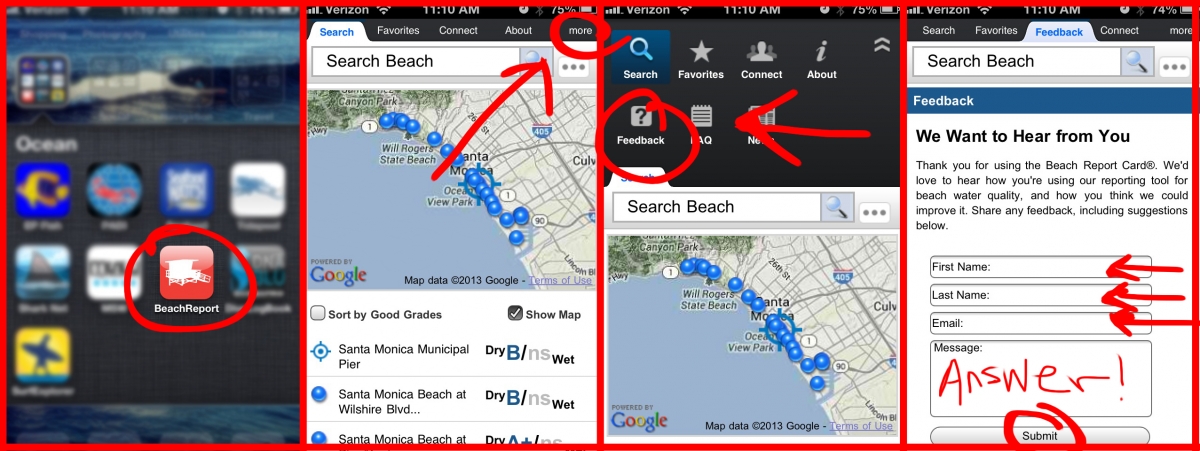
Is your favorite beach safe for swimming? Find out by checking our free Beach Report Card.


Here at Heal the Bay, we’re still floating, buoyed by the knowledge that the city of Los Angeles has taken another step toward sustainability by banning single-use plastic bags.

But we have to admit that the victory was made even sweeter, thanks to the surprise ice cream delivery sponsored by Heal the Bay alumna Leslie Tamminen and her husband Terry. Thank you, Tamminens! 

This week we’d also like to extend special thanks to Southern California Edison for their longtime support of our educational programs. SoCal Edison funded the Heal the Bay Santa Monica Pier Aquarium’s field trip program. The energy company has also supported our Education and the Environment Initiative over the last few years.

And props go to Santa Monica Seafood for their renewed support of our marine education Key to the Sea program

Only this morning we hosted a cleanup with Warner Bros. to help spread the word about their sci-fi movie Pacific Rim.

Among the SWAG prizes, “Go Big or Go Extinct” tee shirts made from recycled water cooler bottles.

Thanks to everyone who came to clean the beach with us!

 Partner your company with Heal the Bay. Contact Nina Borin or call 310.451.1500 x124.


Josh Friedman, former aquarist intern at the Santa Monica Pier Aquarium, recently published the following article and accompanying photograph in Alert Diver Magazine. He is about to begin his third year of college.

When I tell people my biggest passion is underwater photography, they often respond with astonishment. I’m 19 years old and a sophomore in college, and it surprises people to learn that I have logged around 400 dives and fervently pursue photography of the marine world. School and other extracurricular interests take up the majority of my time, but during my breaks I am in the water, diving. The more I study environmental science and oceanography in school, the keener I am to get back into the water.

I started photographing marine life when I was certified as an open-water diver at age 12, and it has come to be what I love doing most. I have since become a rescue diver and now use a closed-circuit rebreather. To me, the most rewarding aspects of underwater photography are the life-changing experiences that occur in the ocean and the fascination and awe elicited by the photographs themselves. The sea is such an unfamiliar environment to many people, and by sharing photos I hope to encourage a sense of familiarity with and respect for the oceans — making marine conservation a more personal issue for people.

As the health of our oceans deteriorates, underwater photography has become a way for me to take action and encourage awareness among friends, family and the general public. Shark conservation in particular has become a very personal issue for me. I find sharks to be the most fascinating marine animals, and most of the dive trips I’ve taken 
have focused on diving with sharks. It saddens me to see widespread employment of fishing methods that lead to the large-scale and inhumane slaughter of sharks for their fins. As a result, I have committed myself to advocate for the conservation of shark populations worldwide and to expose unsustainable and destructive methods of fishing.

Diving has provided me with close, personal encounters with tiger sharks, bull sharks, oceanic whitetips and other species. Through these experiences I have come to understand much about the behavior and true nature of these animals. These interactions have driven my advocacy for these graceful creatures, and underwater photography has enabled me to use images of sharks to support their conservation by conveying that nature to my audience. Diving with sharks has made
 me living proof that they are not the ruthless, human-killing machines they have been portrayed to be.

In addition to driving my conservation efforts, the magnificence of the underwater world and its innumerable biological interactions and symbioses has made diving 
a significant and meaningful part of my life. Sensing the power, agility and playfulness of the wildlife that inhabit the oceanic environment is truly a singular experience. My hope is that more young people get involved in diving and come to really know the wondrous underwater environment, as this will undoubtedly help create a brighter future for our marine ecosystems.

Learn how to intern at Heal the Bay’s Santa Monica Pier Aquarium.

Learn more about shark conservation in California.  


In the same week that the federal government declined to protect the great white shark, California’s ban on shark fin sales and possession went into effect.

According to an article in the Los Angeles Times, an estimated 73 million sharks are killed each year for their fins, which can sell for more than $2,000 a pound in California. The International Union for Conservation of Nature estimates that the populations of some shark species, such as hammerheads, have been reduced by as much as 90% in recent years.

In 2011, Heal the Bay, our partners and supporters urged the passage of legislation to protect the oceans and our environment by making the sale of shark fins illegal. We made a difference, and last year Governor Jerry Brown signed AB 376, which banned the sale, trade and distribution of shark fins in California. At the same time, he signed a companion bill that allowed existing stocks of on-hand shark fins to be sold until July 1, 2013.

Now that July 1 is here, restaurants are mandated to remove the item from their menus and store shelves. Violators could face penalties of up to six months in prison and fines up to $1,000.

Victory, however, was bittersweet. At least for the white shark population, as Friday, great white sharks in California were rejected for listing under the U.S. Endangered Species Act.

According to the San Francisco Chronicle: “The National Marine Fisheries Service declined to list the big sharks despite recent estimates showing only 350 adults and sub-adults in the two places along the West Coast where they congregate — Guadalupe Island, in Mexico, and in the area known as the Red Triangle between Monterey Bay, the Farallon Islands and Bodega Head.”

In California, the Department of Fish and Wildlife is collecting data and assessing whether a statewide threatened or endangered species listing is merited for this species.

Read more about our efforts to ban shark fin sales.

Learn about listing the white shark as endangered in California. 


If the realization that lawns are inefficient isn’t enough for you to move forward on replacing yours, now there’s even more incentive: cash!

The Los Angeles Department of Water and Power is currently offering an incentive from $1.50-$2 per square foot for residential customers who install “California friendly” plants and other water-conservation features. Commercial customers may receive $1 per square foot.

Grass is water-thirsty and high-maintenance, which is why LADWP is encouraging residents and businesses to remove their lawns. Forty percent of water use in L.A. occurs outdoors.

And, as we prepare for the dry season, James McDaniel, senior assistant general manager of LADWP’s water system, points out:  “We need to find ways to save precious potable water for indoor uses.”

There are some innovative and appealing ways to enhance a landscape with non-vegetative groundcover or paving materials like decomposed granite, pea gravel, rocks, pebbles, mulch and wood chips. A list of landscaping options is available at bewaterwise.org

All customers must pre-apply for a rebate and receive LADWP approval before starting the turf replacement. LADWP will also inspect the lawn before and after the project. To get started, visit LADWP.com/CF

Read more about low impact development.


If you’ve been planning to remove your lawn and replace it with water-wise landscaping instead, now’s the time!

The Los Angeles Department of Water and Power is currently offering a cash incentive from $1.50-$2 per square foot for residential customers who install “California friendly” plants and other water-conservation features. Commercial customers may receive $1 per square foot.

Grass is water-thirsty and high-maintenance, which is why LADWP is encouraging residents and businesses to remove their lawns. Forty percent of water use in L.A. occurs outdoors. And, as we prepare for the dry season, James McDaniel, senior assistant general manager of LADWP’s water system, points out:  “We need to find ways to save precious potable water for indoor uses.”

In addition, much of L.A.’s rainfall ends up just being wasted as it runs off into the storm drain system and eventually the ocean. This urban runoff contains dangerous pollutants for humans, animals and the environment.

Besides using California native plants, there are some innovative and appealing ways to enhance a landscape with non-vegetative groundcover or paving materials like decomposed granite, pea gravel, rocks, pebbles, mulch and wood chips. A list of landscaping options is available at www.bewaterwise.org

All customers must pre-apply for a rebate and receive LADWP approval before starting the turf replacement. LADWP will also inspect the lawn before and after the project. To get started, visit www.LADWP.com/CF


Of all of the things I thought I would do in this job, going to South Korea never crossed my mind. But three shots in the arm, several orientation meetings, and a pretty solid syllabus down, I’m one week out from joining with 150 students from the Pacific American Volunteer Association (PAVA) on a 12-day environmental expedition to learn about how different cultures live around  water.

Around the world and throughout history, cities have had to figure how to live with water and the ecosystems around them. New settlements build irrigation systems to support agriculture, cities engineer flood control systems to manage storm water, and communities celebrate the vitality of water through volunteerism or ritual. Los Angeles has its own very interesting tale to tell with local water, and my work here has been about trying to tell that story to students and our community partners.

One community partner that has responded to our water story in a big way is PAVA, whose students have joined me to explore the Los Angeles River for the past couple of years. Building on that experience, and always in search of a way to connect with their Korean heritage, PAVA came to us this past spring to present the idea of an expedition abroad.

South Korea too has had its share of water problems, from disappearing freshwater sources, to development encroaching upon natural space, to flooding problems in rural and urban areas. But beginning in the late 90’s and continuing today, their government has decided to turn the issue around, investing billions of dollars into revitalization and restoration, and bringing community back to these spaces. And so it is that Korea, among a few other nations, are leaders in this area, reimagining and reinvesting the role that water has in the country in a big way.

And now PAVA will venture to South Korea this summer to continue their watershed journey, undertaking an expedition in search of bringing those hard fought lessons in environmental restoration and revitalization from their mother country back to Los Angeles. As cultural ambassadors, these students will ask questions on their journey about the process and success of the South Korean effort, returning to Los Angeles with answers that might better inform their work and ours. What lessons do we have to learn from our distant neighbors? Check back in when I return to find out!

— Edward Murphy
Heal the Bay’s Watershed Education Manager

Whether your students are kindergartners or prepping for college, Heal the Bay offers education programs tailored just for them.


Heal the Bay headed to the South Bay last weekend to soak up some love in Manhattan Beach. First we cleaned the beach with 75 volunteers (including friends from Target and Mattel), netting 87 pounds of trash and enough cigarette butts to measure five feet.

Thank you to Simmzy’s Manhattan Beach for hosting the cleanup and the post-cleanup party featuring Golden Road Brewing’s Heal the Bay IPA! Simmzy’s owner Mike Simms participated in the cleanup, as did Heal the Board member Ian Eddleston, the family of board member Jorge Delgado and HtB supporter Woody Henderson, owner of Adventure Voyaging and 2012 Coastal Cleanup Day captain.

Afterwards, Simmzy’s was pouring Golden Road’s Heal the Bay IPA, donating $20 for each keg to Heal the Bay. Thank you again to Golden Road for brewing such a delicious benefit to our work.

Speaking of refreshments, Nothing Bundt Cake-Santa Monica just joined our list of Aquarium party partners.Thank you for joining the party and for your ongoing support!

We also send big props to outdoor gear purveyor REI for their longtime involvement in what we do to protect our waterways. 

Discover more ways to show your support for Heal the Bay.