
Top

Heal the Bay Blog

Author: Heal the Bay

For the last three months, I’ve been yearning to blog or write an op-ed on AB 376, the state bill that would ban the sale of shark fins in California. I haven’t been more excited about a marine conservation bill in nearly a decade.  But to be honest, having an environmental biologist like me write about shark conservation wouldn’t add much momentum to get the bill passed.

After all, nearly every major environmental and animal rights group in the nation strongly supports the bill.  Many of these groups persuaded globally known actors like Leonardo DiCaprio and January Jones to advocate for the bill via Twitter and op-eds. Even the Monterey Bay Aquarium, generally neutral on environmental bills, decided to sponsor the bill and hire well-respected lobbyists to fight for shark conservation.

The one person I know that could really make a difference in the fight to enact the shark fin ban is my brother, Jonathan.  After all, there is no food writer more highly respected nationally than Jonathan.  He’s the only food writer to earn a Pulitzer and he’s received seven James Beard Awards, the food industry’s equivalent of the Oscars.

Also, Jonathan’s writing delves into both the worlds of food and modern culture.  His writing on Chinese food is particularly distinct and well respected, as nearly every significant Chinese restaurant in the San Gabriel Valley has a copy of one of his reviews plastered on a window or framed in the lobby.

Unlike my brother, I’ve never consumed shark fin soup.  In fact, I remember threatening his physical harm at a Monterey Park Cantonese seafood palace that actually had a cart featuring the item for $30 a bowl back in the1990s.  Jonathan eagerly called the cart driver to our table just to get a rise out of me.  He thought it was hilarious.  I wasn’t laughing.

Read more of this post»

Add a comment to this post»


An adult female sea lion was found dead on Venice Beach on August 3. She had been shot three times.

The National Oceanic and Atmospheric Administration’s Office of Law Enforcement is investigating the shooting, as killing a marine mammal is a violation of the Marine Mammal Protection Act, which can result in a $100,000 fine and a year in prison.

It can be difficult to track down the perpetrators because the crime typically occurs far out at sea where there are few witnesses. Animals attacked may travel miles from the scene of the crime before washing up on shore.

Marine Animal Rescue is offering a $5,000 reward for information leading to the arrest and conviction of whomever killed this sea lion. According to Marine Animal Rescue, some fishermen have been known to kill seals, sea lions and pelicans because they view them as a threat to their livelihoods. Some shoot the animals while others use “California seal control devices,” otherwise known as seal bombs.

Those with information about the shooting or any other violation of the Marine Mammal Protection Act can contact the NOAA Office of Law Enforcement hotline 24 hours a day, seven days a week at (800) 853-1964.

In addition, sea lions are threatened by domoic acid, a powerful neurotoxin produced by a specific group of microscopic algae that sometimes blooms in coastal waters. Marine mammals such as sea lions eating fish laden with toxin can ingest sufficient domoic acid in the stomachs of their prey to experience symptoms of domoic acid poisoning. These symptoms can include a variety of neurological disorders including disorientation and seizures, and in severe cases, death.

The Marine Mammal Center in Northern California provides a seven-step guide to what to do if you find a stranded marine mammal.


In celebration of Ocean Awareness Month, artist Marina DeBris’ “Beach Couture — A Trash ‘n’ Fashion Show” showcases the artwork she crafts from detritus she picks up as she walks the Westside. “In the beginning I would just pick up stacks of Styrofoam cups and bring them to the local 7-Eleven, but I soon realized that this wasn’t really attacking the root problem. I needed a creative way to draw attention to it. 

“The whole idea of making beach detritus into art started just three years ago from the realization that the waste we create always comes back to haunt us,” said DeBris, who regularly lends her talents to Heal the Bay and other environmental groups.

“With this work, I’m hoping to dramatize in a playful way some of the problems our waste creates,” DeBris noted. “I use humor to startle viewers into taking a closer look at things we usually ignore. The goal is to encourage people to rethink their use of disposables and ultimately reduce waste.”

Marina DeBris’ art will be on view in celebration of Ocean Awareness Month from Aug. 2 – Sept. 5 at ZeroMinusPlus/Fred Segal Santa Monica, 500 Broadway, Santa Monica.

Hours: Mon-Sat 10 a.m.- 7 p.m. & Sun Noon-6 p.m.

 Find out more about Marina DeBris at http://www.washedup.us/


Pulitzer Prize winning culinary writer Jonathan Gold eloquently advocates for AB376, which would ban California sales of shark fins, in the Opinion section of the Sunday, August 7th Los Angeles Times . “There is no sustainable source of shark’s fin,” wrote Gold, noting that “nearly a third of shark species are approaching the point of extinction.”

Read Jonathon’s Op-Ed

Help Save Our Sharks

  • Take Action on AB 376Use our Action Alert to call your Senator and send them an e-mail urging their YES vote on AB 376.
  • Attend the Rally to Save Our Sharks on 8/13
    Please join Heal the Bay and other leading environmental groups on Saturday, August 13, 10am, at the Manhattan Beach Pier to tell our State Senators to stop the sale of shark fins and vote YES on AB 376! Shark costumes are encouraged!

Gold, dubbed “L.A.’s most adventurous eater” by The New Yorker, is the older brother of Heal the Bay President Mark Gold. For the past 25 years he’s specialized in writing about ethnic cuisine, spending significant time in restaurants that serve Cantonese food, including shark’s fin.

In his op-edJonathan notes that Chinese culinary culture has proven to be resilient over the centuries, able “to withstand the absence of sea-turtle skirt and bear paw, whose preparation obsessed the earliest Chinese gourmets. There is no third way with shark’s fin – we either stop eating it because we choose to preserve the species, or we stop eating it because soon there will be none left to eat.”

Read Jonathan’s entire op-ed (new window).

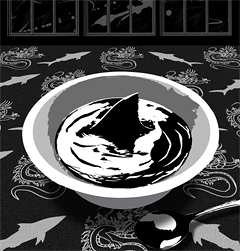
Shark Fin Soup (Illustration by Wes Bausmith / Los Angeles Times)
Illustration by Wes Bausmith / Los Angeles Times


A small town in Provence declared smoking off limits on a stretch of its beachfront, proclaiming itself the first non-smoking beach not only in France, but Europe.

According to the Associated Press, the smoking ban came into effect earlier this summer in La Ciotat, and compliance among the public at the packed beach has been strong. “We don’t stop smokers from going elsewhere, but this one we want to reserve for nonsmokers, for mothers and children so they can make sand castles and not cigarette butt castles,” Deputy Mayor for the Environment Noel Collura told the AP.

Cigarette butts remain the No. 1 item picked up by volunteers at Heal the Bay beach cleanups, despite the fact that Los Angeles, Santa Monica, Long Beach and Malibu have banned smoking on the beach. A typical cigarette butt can take anywhere from 18 months to 10 years to decompose, depending on conditions. Cigarette butts contain the chemicals filtered from cigarettes that leach into waterways and water supplies.

Read the story at http://www.msnbc.msn.com/id/44002823/ns/travel-destination_travel/

Photo courtesy Jacques Brinon  /  AP


Buy one of California’s newly-designed Whale Tail® specialty license plates and support Heal the Bay’s cleanup and education programs. Plus, be among the first 1,000 ocean lovers to get the new Ecoplate and pay $25 instead of $50, or get $25 off a personalized plate. Each of the first 1,000 to purchase one of these license plates will also receive two tickets to visit one of several California destination attractions.

But the best reward is: Each purchase of these new plates benefits Heal the Bay and supports our award-winning beach cleanup and education programs. We use these funds to support the 600+ cleanups we conduct each year along the L.A. County Coastline and to educate our volunteers on how to protect the ocean environment from pollution.

Learn more and purchase a new Whale Tail® plate.


With the world focused on the silly brinksmanship in Congress over the national debt ceiling, there hasn’t been enough focus on the ramifications of the recent California legislative redistricting process.  The final maps, created by an independent body called the California Citizens Redistricting Committee, just came out last week and the new districts are substantially different.  For the L.A. County coast, the changes are pretty dramatic.

Overall, our local coast didn’t do that well during redistricting.  Separating the ports in different congressional and senate districts is not good for San Pedro Bay and misses the opportunity to integrate environmental protection and cleanup efforts among the ports, and L.A. and Long Beach. The new state senate districts separate some of the strongest supporters of Santa Monica Mountains conservation from the actual resource.  That makes it tougher for Westside residents to help out on those issues.

Read more & comment»


The Twilight Dance Series partners with Heal the Bay on Thursday, August 4, 7-10 p.m., with Nelson Marquez & the Moderators and Tutu Sweeney & the Brothers Band set to perform a free concert at Santa Monica Pier.

Show your appreciation and “Protect What You Love!” by texting GIVE2HEAL to 20222 which will donate $5 to help keep our beaches safe, clean and healthy.

Learn more about the August 4th concert.


Does the scene in this photo count as algal impairment under the Clean Water Act?  I’m just curious if the folks in Florida that are attempting to blow up the Clean Water Act over proposed nutrient standards would agree that this is impairment.  After all, the kids appear to be enjoying themselves, and after all, isn’t that what recreational water contact is all about? Heal the Bay gets in a lot of fights on the definition of algal impairment with regulators and the regulated community.  When you see pictures like the ones from Qingdao in China, it makes you realize that the regulated community isn’t even willing to come part way on the issue.  If there is a Karenia bloom in Florida that poses a respiratory health risk to beach goers, is that an impairment?  If Malibu Creek has an antifreeze algae bloom that covers the entire creek for a quarter mile, is that impairment? The regulated community may argue that 10% algal cover for  30% of the time isn’t impairment (a definition previously used by some at EPA). But how can they look at pictures like those in China, Florida and Malibu Creek and not offer nutrient reduction recommendations?

Harmful algal blooms are a growing problem that are choking our nation’s rivers and coastal waters with devastating impacts to aquatic ecosystems.  Yet, the EPA and most states are still arguing over the right thing to do and completing an endless series of studies.  They should be requiring aggressive reductions in nutrient discharge loadings (nitrogen and phosphorus) and concentrations, and they should have done it years ago.

Add a comment to this post»


It’s time for Los Angeles to move beyond coal power. LADWP (Los Angeles Department of Water and Power) is considering a plan to sell its stake by 2014 in the Navajo Generating Station, which is, according to the Sierra Club, one of the largest and dirtiest coal-fired power plants in the entire country. The LADWP is asking for customer feedback on this plan.

Please take two minutes and complete the LADWP survey. Make sure to mark moving beyond coal as a high priority.

Photo: Navajo Generating Station via Wikipedia