Top

Heal the Bay Blog

How do you balance environmental conservation and food supply and income from fishing? A network of marine protected areas in Fiji designated in 2005 was re-looked at after locals objected to some of the closings. Both sides worked together on the project of redesigning the areas.

Dr. Stacy Jupiter, director of the Wildlife Conservation Society in Fiji says, “This participatory approach gives local people more ownership over the management process, which results in a higher likelihood of compliance with fishing bans inside the closures.”

Check it out.

Southern California now has its own set of marine protected areas as well. Read more about the process here.

Photo: Josh Friedman


How often can you create big local change with just a few key strokes (140 to be exact)? That’s what the Shorty Awards on Twitter are all about.

Today winds up the Twitter Shorty Awards campaign and our favorite master gardener, Mud Baron, reached the 500 nominations mark, thus, Los Angeles County school gardens win big time. Mud works to build sucessful school gardens for kids in L.A. and has been working tirelessly to get all kinds of supplies and pledges throughout his Twitter campaign on the condition that he receives at least 500 nominations. He reached and surpassed his goal.

Check out Mud’s nominations. You can also still add your own even though the initial goal was met. Follow Mud on Twitter at @Cocoxochitl and let him know you support what he does.

Urban green space instead of concrete isn’t just better for the students, it’s also better for the Bay!


Check out this link to Van Jones’ talk on the increasing impacts that plastic has on poor communities. Jones is an environmental advocate and attorney who spent the early part of his career fighting for equal rights for people of color, particularly African Americans.

In 2007 he founded an organization called Green for All, dedicated to building an environmentally friendly economy that would lift people out of poverty.  He also briefly served in President Obama’s White House Council on Environmental Quality.

In this clip, Jones describes how the production, use and disposal of plastics disproportionately harms poor people. Poverty in and of itself limits choices, making it difficult for people who are poor to purchase “safe” plastics, and making them more vulnerable to unsafe practices in jobs manufacturing plastics.

Mark Gold attended the TED conference at which Jones gave this speech, and you can read more about his impressions in the Spouting Off blog.

Watch Van Jones’ inspiring, and quite thoughtful, speech at ted.com


…more often than not people refer to the community as [just] people, but I think it’s a communion between the people and the environment…” –Kianna Nesbit, Principal of Youth Opportunities High School

People often talk about the need for more environmental leadership in our communities, but there’s sometimes a struggle with defining what that means.  In fact, very often it’s difficult to envision the path to this goal, precisely because the options for doing so have never been set. 

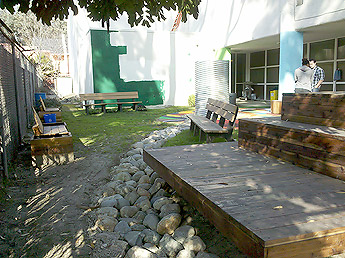
For a charter high school in Watts, South L.A., environmental leadership has been actualized through through a school garden project that will feature a cistern designed to capture and recycle rain water onsite.  The name of the school is Youth Opportunities High, which is managed by the Los Angeles Conservation Corps (LACC) and offers at-risk local youth the opportunity to reach for a better future.  The garden, the Watts Garden Community Plaza, is YO’s greening beautification project.  The project was made possible through funding from the City of Los Angeles’ Office of Community Beautification, the California Coastal Conservancy, and the Liberty Hill Foundation.

Planning for the Watts Garden Community Plaza’s construction was facilitated through a set of capacity-building trainings for the teachers, parents, and students of the school, that Heal the Bay offered through its Healthy Neighborhoods, Healthy Environment initiative.  As the garden project nears completion, the empowering effects of a community organizing effort to support of an environmental project have been inspiring.

While the cistern in the Watts Garden Plaza will make only a small contribution in capturing rain water and runoff, the garden as a whole will serve as a lasting educational tool, not only for Youth Opportunities High, but also for the surrounding community–embodying an example of how a “greening” project can be successfully undertaken by a small group of committed individuals.  As an accompanying effort to the Watts Garden, Heal the Bay has assisting Youth Opportunities High in the development of an after-school environmental program: the Generation Green (which will provide an important service to the community by developing environmental stewardship in its youth). 

The leading community organizer for the Watts Garden Plaza has been Youth Opportunities High’s Principal, Kianna Nesbit.  For her, the first step towards cultivating stewardship has always been connecting people to the environment: “…the more you see it, the more you feel a connection to it. I think that’s another reason why people don’t see a connection to it, is because they don’t see it in their communities. There’s no water flow, streams, so people have no connection to it.” 

Heal the Bay was introduced to Kianna by LACC over three years ago and we have since become allies in the shared fight against urban runoff and pollution in the streets of L.A.  Last year Kianna joined us in Sacramento to ask our State legislators to do something about the problem of plastic pollution that plagues our city’s streets.  The trash, created by a culture of disconnectedness, has an extreme impact on the Greater Los Angeles metropolitan area.  Not only is it a eyesore across neighborhoods, but it travels as trash through the storm drain system and is discharged into the ocean, where it harms our precious natural resources. 

The Watts Garden Plaza will start to visually connect the students of Youth Opportunities High to the process of how our water flows through our communities.  The goal is that by taking this first step, the seeds of environmental stewardship will be firmly planted and given the chance to grow and spread.

Watch videos: “Healthy Neighborhoods Open House” »
Watts Garden Youth Opportunities High School - Healthy Neighborhoods


A bike path in Arleta got a facelift recently in an effort to make it more welcoming to the community. The community hopes that more people will now frequent the area to walk, bike and spend time outside with their kids. About 240 volunteers came out to plant thousands of native CA plants by the path and for at least one, a Heal the Bay cleanup may have been the impetus to volunteer. Check it out.

Photo: BitBoy via Flickr


If you’ve been following the news about Marine Protected Areas, you might know that a map of these critical portions of protected habitat was recently approved for Southern California. This means that once the MPAs go into effect in mid-2011, fishing will be restricted or prohibited in specific areas along the coastline.

If you’re interested in finding out more about our new set of MPAs, you can check out an interactive map that shows where the MPAs are and details about the regulations.

Once you get to the map, click on “MPAs, Arrays, and Proposals” in the upper right hand corner. Check the “Adopted MLPA South Coast MPAs” box. Then zoom in and click on specific MPAs to learn more about the regulations and details for each site. You can access the maps at marinemap.org.


If you live in the South Bay and are concerned about the impacts your yard is having on the ocean, check out this ocean-friendly gardening workshop.

Our good friends at the Surfrider Foundation run the Ocean Friendly Gardens Program, and this workshop is put on in conjunction with West Basin Municipal Water DistrictG3 and the  South Bay Environmental Services Center. It’s in Hawthorne, on Feb 5, and it will teach you all about how to minimize your garden’s impact on our environment.

Our yards can be a haven for nature, providing food, habitat, shelter, and water to native birds, insects and reptiles. Unfortunately, the iconic sloping green lawn provides none of these things. In fact, maintaining a green lawn actually harms the environment because of the large amount of water, pesticides and fertilizers required.

Do yourself and the environment a favor, and get into ocean-friendly gardening!


The Santa Monica City Council unanimously approved an ordinance Tuesday night that bans single use plastic and paper bags, but allows retailers to sell “green” paper bags for at least a dime.  Due to the passage of Proposition 26 with its chilling impact on government’s ability to create and raise fees, Santa Monica abandoned  its original ordinance, which would have put the paper-bag fee at a quarter with some of the revenue coming back to the city. Instead, leaders opted to model their bill after  L.A. County’s recently approved ban.

Fifty people came out to support the bag ban ordinance, about 25 students with Santa Monica High School Team Marine teacher Ben Kay and 25 attendees from environmental groups and the general public.  As you might have expected, the students stole the show.  Dressed in costumes ranging from bag man to straw student to lid lady to bottle boy, the students came out during finals week to advocate for the bag ban.  In a proud moment for me, my son Zack, an ocean swimmer and three year co-president of the Heal the Bay Surfrider Club, testified in support of the ordinance.  Zack reminded council members that he started testifying to them as a freshman.  Now he’s a graduating senior.

Santa Monica is the undisputed greenest city in California (OK, Berkeley will dispute that). How did it take its leaders nearly four years to ban single use bags? If you guessed ongoing litigation threats from the Coalition to Save the Plastic Bag, then you’ve been paying attention.

Read more & comment» (new window)


Vicki Wawerchak, director of the Santa Monica Pier Aquarium, has been chronicling the process of readying a very special marine artifact for exhibit. Below is the fourth and final installment about the prepping of whale baleen.

Previous installments in this series:

1. A Whale of a Tale (December 22, 2010)

2. Brushing Up On Our Baleen (January 5, 2011)

3. Unraveling the Mysterious Baleen (January 11, 2011)

I hate waiting. Especially if it is for something I am really excited about. So when we finished prepping the baleen for the drying-out process, the next step was to wait. And wait. And wait.

It was a bit easier because I wasn’t going to be at the Aquarium for a few days so I didn’t feel the need to check on it daily. But when I finally returned, I barely set my bag down and turned on the computer before I went to check on our newly prepped specimen.  (Baleen are plates with hard bristles inside a whale’s mouth that trap and filter small organisms for nourishment.)

And to our excitement, the marine artifact was drying perfectly. The bristles were straight, the color was good, and the piece did not curl. Whew! But now we had to wait a few more days before we could take it out of the contraption we designed.  We continued to monitor it daily because as the moisture evaporated from the baleen, the piece shrunk. That meant the C-clamps had to be tightened and the drying rack had to be readjusted.

As a scientist who works with numerous live animals (including humans) every day, I have a few priorities. One is to ensure we provide an inviting, comfortable, safe, learning environment for students, the general public, volunteers and staff. The other is to ensure we provide a safe, healthy, high water quality habitat for all the animals we have on exhibit. From the smallest skeleton shrimp to our biggest bass, we want to make sure that the environment we create mimics their natural one. I do not take these tasks lightly.

The amount of care given to our live animals is replicated with our marine artifacts that we acquire through the many partnerships and relationships we have created through the years. The utmost care, attention to detail and responsibility needs to be executed when prepping and dealing with these artifacts. 

We understand that they were obtained from once-live animals and therefore we have an obligation to make sure we succeed not only in the prepping process, but also in how we use them for education. The room for error is small and at times the need to succeed can be overwhelming.

And succeed we did. We untied the lines that were holding the baleen plates together, carefully removed all the wood that we used to separate the baleen plates and slowly unscrewed the C-clamps.

What was left was a beautifully dried out specimen that is going to enhance our education capabilities. Most of the staff at the Aquarium had never seen a full section of baleen like this before, let alone used one this large as an educational tool. So, I am sure the passion and excitement that each one of them feels will come out when using the artifact to educate the general public about the majestic gray whales that migrate annually right off our beautiful coast.

Please visit the Aquarium during Whale of a Weekend, Feb. 19-20, to view the baleen first hand. Check back after the weekend to read how we used the baleen during education programs and how it was received.