Top

Heal the Bay Blog

Category: Heal the Bay Aquarium

October is National Seafood Month, and it’s time to celebrate our favorite fishy foods, but also to reflect on how best to select the food we put on our plates.

Each time we go to a supermarket or restaurant we are confronted with a choice about what food items to buy. Concerns over mercury levels and a growing desire to eat local, sustainable foods have made this decision harder than ever.

Salmon? What exactly does this mean when you read it on a menu?  The truth is that it could be farmed or wild, and any one of six different fishes from two different genera from opposite ends of the Earth.  Not so simple anymore, huh?  Let me help you out a bit. 

There are two basic types of salmon: Atlantic and Pacific.  The Atlantic salmon is in the genus Salmo and originally came from the Atlantic Ocean (I say originally as they are now farmed all over the world).  These fish hatch in freshwater rivers and then head to the ocean to grow and mature.  Once they are ready to spawn, they will swim back up the river from which they came, spawn, then head back out into the ocean.  They may repeat this process several times over their lifespan. 

Pacific salmon, on the other hand, are in the genus Oncorhynchus, and come from the Pacific Ocean.  Unlike their Atlantic Ocean cousins, they die after their one and only spawning event, and this is where the trouble begins.  All farmed salmon is Atlantic salmon, and it is now farmed all over the world including places like Chile and British Columbia (read “Pacific Ocean”). 

Not only are these salmon farms destroying the ecosystem with all of the waste they produce and all of the diseases and parasites they harbor, but on occasion the Atlantic salmon will escape and make their way into the same rivers to spawn as the native Pacific salmon, where they can outcompete the single spawning Pacific salmon, as well as disrupt the delicate arctic ecosystem they have invaded.  When the Pacific salmon die, their bodies’ nutrients are released into the nutrient-deprived arctic, beginning the explosion of life that occurs in the arctic during the spring and summer months.  Without these nutrients the arctic ecosystem would be unable to function properly.

Furthermore, the healthy omega-3 fatty acids are virtually nonexistent in farmed salmon.  They are fed a pellet of chicken parts, corn, and ground up fish, amongst other things, instead of the omega-3 rich marine crustaceans they consume in the wild.  Also, farmed salmon is dyed its typical bright orange or else it would be an unappetizing drab gray.  There are a host of other reasons why farmed salmon should never ever wind up on your plate, and I will be happy to inform you further if you still need more reasons to avoid this poor excuse for natures mighty wild salmon.

So when looking for salmon, always make sure that it is wild Alaskan.  Not only is it much healthier for you, but it tastes so much better and is not destroying our ocean ecosystem.

–Aquarium Education Specialist (and avid fisherman), Nick Fash


Sustainable seafood choices are available at Heal the Bay partners, including the local Santa Monica Seafood and your neighborhood Whole Foods Market.

Find more seafood facts at fishwatch.gov


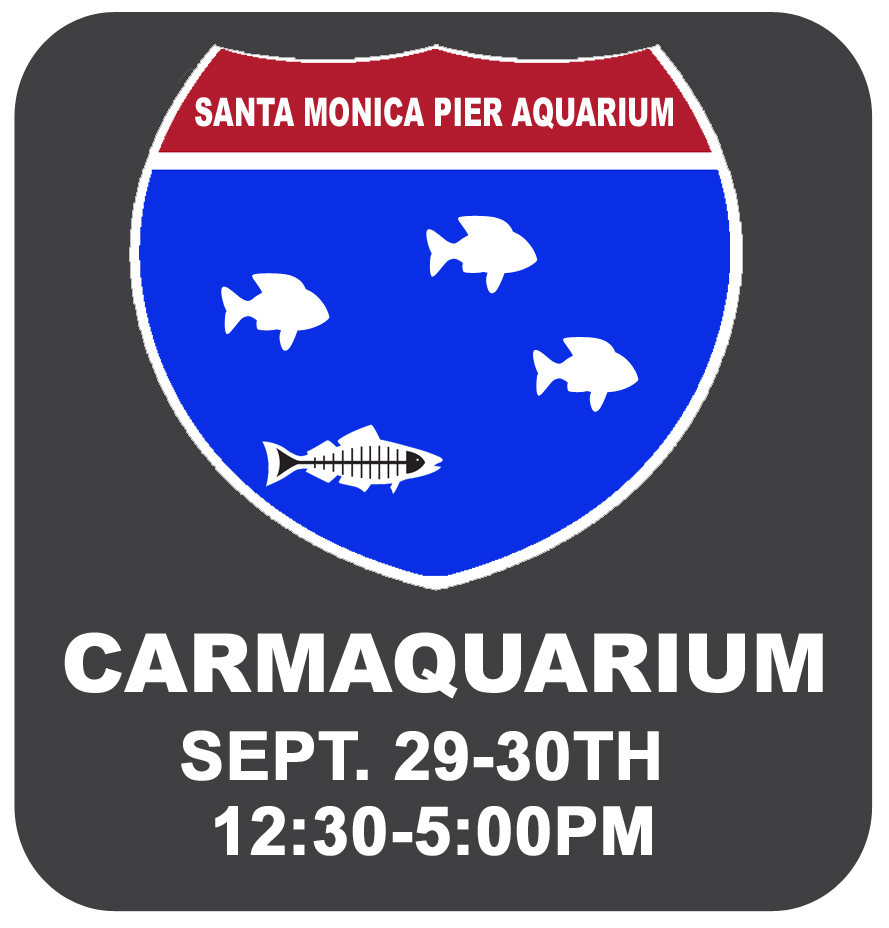
Angelenos are once again being asked to stay off the roads this weekend as Caltrans closes a portion of the 405 freeway to demolish the north side of the Mulholland Drive Bridge. The second phase of the mega project, known as Carmageddon, inspired staff at our Santa Monica Pier Aquarium to remind locals to visit our locals – of the marine life variety,that is! Programs manager Tara Crow put a blanket invite out on Facebook to the Westside crowd. She even went the extra mile (surface streets only), designing her own Carmegeddon logo:

Carmaquarium!

“What you doin’ this weekend Westside? ” Tara wrote. “Avoid the traffic and come hang out with the local sealife at the Santa Monica Pier Aquarium between 12:30-5 p.m. We’ll have shark feeding, story times, crafts, puppets and all sorts of other activities to keep you busy.”

Facebook fans bit – and raised her one –taking liberties with a Boy George hit of the 80’s. (Full disclosure here: the opening lines of the chorus were re-written by my husband, which prompted our education director Tara Treiber to rework the lyrics to the second half of the chorus. Sing along with their combined efforts: “Carma-carma-carma carma carma-aquarium–with fish that glow, fish that glow, Swimming would be easy if your seaweed were like my dreams – red, brown and green, red, brown and gre-e-e-een.”)

So hum a few bars and make your way to the Aquarium this weekend for a rockin’ good time beneath the Pier. We’ll even reward you with a free Heal the Bay wristband and a sticker for your bumper!

-Randi Parent, Outreach Manager at Heal the Bay’s Santa Monica Pier Aquarium


As summer fades away – along with the tourists that season brings – Heal the Bay’s Santa Monica Pier Aquarium is exhibiting a new local species: the wolf-eel, Anarrhichthys ocellatus.  At nearly three-feet long, the juvenile wolf-eel is neither wolf nor eel, but a member of the wolffish family (named for their large front teeth) and will grow to be about seven feet long. The eel-shaped, grayish colored wolf-eel is patterned with gorgeous dark spots and can be found peering out of a rocky outcropping in the Aquarium’s Kelp Forest Exhibit. 

The Aquarium typically closes for maintenance for most of September, but this year the facility will remain open throughout the month for regular hours: 2:00 to 5:00 p.m. Tuesday through Friday with the exception of Tuesday, Sept. 11, when the Aquarium will be closed for Coastal Cleanup Education Day. The Aquarium is open during weekends from 12:30 to 5:00 p.m.  Plan your visit to see the wolf-eel at the Santa Monica Pier Aquarium.


As summer fades away – along with the tourists that season brings – just in time to welcome back the local community, Heal the Bay’s Santa Monica Pier Aquarium is exhibiting a new local species – a juvenile wolf-eel, Anarrhichthys ocellatus. At nearly three-feet long, the wolf-eel is neither wolf nor eel, but a member of the wolffish family (named for their large front teeth) and will grow to be about seven feet long. The eel-shaped, grayish colored wolf-eel is patterned with gorgeous dark spots and can be found peering out of a rocky outcropping in the Aquarium’s Kelp Forest Exhibit.
The Aquarium typically closes for maintenance for most of September, but this year the facility will remain open throughout the month for regular hours: from 2:00 to 5:00 p.m. Tuesday through Friday – with the exception of Tuesday, Sept. 11th, when the Aquarium will be closed for Coastal Cleanup Education Day. Weekends, the Aquarium is open from 12:30 to 5:00 p.m. Meet the wolf-eel and visit the more than 100 additional species on exhibit.


No other animal on Earth has captured the imagination and stirred the range of emotions like the Great White Shark, aka The Landlord. Yes, the Landlord, the lord of the land, or in this case, the lord of the sea. The nickname we SoCal natives have bestowed on this beautiful and misunderstood fish has everything to do with shaking off that jittery feeling we sometimes get out in the water. I will admit there have been times I’ve even heard cellos strumming that all too famous tune. Because honestly, who hasn’t thought about it? The Landlord owns the place, and we just rent the space.

Every summer, predictably, the images of white sharks gobbling up an elephant seal or breaching out of water with a little sea lion in its mouth is the topic of conversation on every TV in the U.S. This time every year, images and programs about sharks and shark attacks seem to consume the airwaves. The news media frenzy about any little story related to shark attacks. And, of course, you can always rely on weeklong programming dedicated to sharks.

I have always questioned this kind of programming and have wondered if this is exploitive or if the people viewing are actually getting educated about the important issues that are facing the global shark population. Are these programs dispelling fear and myth or galvanizing people to appreciate and respect sharks?

The past few years have been very special in the Santa Monica Bay because of the regular appearances of white sharks, sometime small ones and sometimes … big ones!  Last week a large white shark was seen off shore near Venice and earlier this week a young white shark was spotted just off of King Harbor. What a treat! What an amazing event to have the Landlord pay us a visit. I get excited about these sightings because these animals are very rare.

In fact the population of white sharks number in the low hundreds off of the California coast. Decades of over fishing and shark finning have depleted white sharks and other shark species in California and around the world. Groups like Oceana and the Center for Biological Diversity are calling on the government to list the white shark on the federal Endangered Species Act.

At the Santa Monica Pier Aquarium we get to educate thousands of school children and visitors about current marine science issues and the relevant work we do as Heal the Bay. Sharks and the conservation of sharks is a critical part of the education we provide to all of our visitors.

Last year, Heal the Bay helped champion an important law making it illegal to possess or sell shark fins in California. This law is a part of a global movement aimed at saving shark populations everywhere.  It is so satisfying to see a new generation of adults and children learning about the white shark with respect and admiration rather than through fear from misconceptions. It will take continued education and activism to save the white shark from extinction.  Please do your part in helping the Landlord get the respect it deserves.

Jose Bacallao, Operations Manager, Heal the Bay’s Santa Monica Pier Aquarium

Want to get active and protect what you love? Join Heal the Bay.


Seven-year-old Jack Mcguinness has a passion for all animals, according to his mom Karen Mcguinness. So our Science Adventure Camp this summer was right up his alley.

After a week of fun getting to know the 100-plus species of marine life at our Santa Monica Pier Aquarium, Jack was inspired to fundraise for the Aquarium as well as adopt a swell shark egg through the marine education facility’s aquadoption program.

To run his lemonade and cookie stand, Jack enlisted the help of his siblings, who took turns holding a sign and flagging down customers. Thank you Jack for becoming a steward of the marine environment and for supporting the Aquarium!

Join Jack and support our work. Donate now or adopt an SMPA animal as a birthday or anniversary gift.


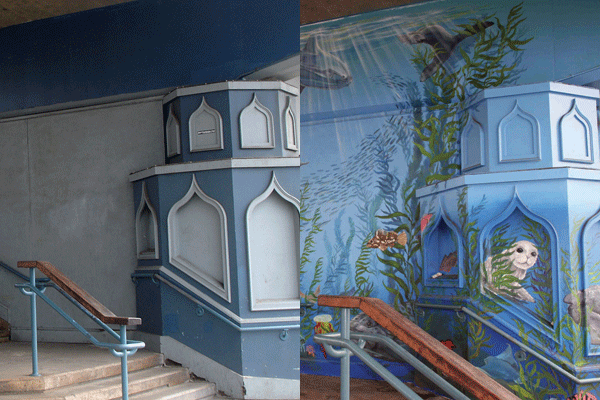
Muralist David Legaspi passed away earlier this month, leaving behind a legacy enjoyed by thousands of people each year, the mural outside the Santa Monica Pier Aquarium (SMPA).

David completed the mural appropriately enough in celebration of Earth Day in 2007, which members of the SMPA staff still recall as one of their favorite events in the Aquarium’s history. Under David’s guidance, painting the mural was a community effort, with countless people—from German tourists to a dad and his young daughter, even some high school students—each grabbing a paintbrush to help populate the underwater world he’d created. It was a true community celebration and collaboration — the kind he generated wherever he worked.

Not only did the mural brighten up a dark corner of the pier, it quickly became its own photo opportunity. It seems like a day doesn’t pass when we don’t look out our windows to see someone outside the Aquarium posing for photos in front of it. It’s hard to imagine how many vacation photos, press shots, engagement pictures and recordings of class fieldtrips the mural has provided a backdrop for since its completion.


David Legaspi SMPA Mural Before and AfterBefore and After: David Legaspi SMPA Mural

We first met David when he came to the Aquarium during public hours to research certain rock fish in our tanks for one of his many murals at our local schools. At that time, he and Randi Parent, SMPA’s Outreach Manager, discussed the possibility of David painting an underwater scene outside the Aquarium. With the permission of the Pier Corporation, he launched the full-scale project outside our office windows.

Aquarium visitors are not the only people fortunate to appreciate David’s legacy, as he will live on in the innumerous murals he created around the city and the amount of people whom he has touched along the way. We feel very privileged to have been a part of it all.

Randi Parent recalls: “My last conversation with David was just a few months ago. He was hoping to come back here to complete our underwater scene by painting on the underside of the ramp. He told me how he’d recently been in Australia and a friend showed him her vacation photos taken at the SM Pier. There she was, standing in front of his mural, and she didn’t realize it was his work! He was so pleased with what a small world it is.”

–Randi Parent (SMPA Outreach Manager) and Tara Crow (SMPA Programs Manager)

A Celebration of Life for David is being held June 27, 2012 at 1 p.m. at Barnum Hall on Santa Monica High School campus. For more information, visit the event’s Facebook page.

In lieu of flowers, contributions may be made to: David Legaspi III Memorial Fund, PO Box 2863, Malibu, CA 90265.

Messages can be sent to the family at legaspimemorial@yahoo.com.

View a map of David’s public murals, most of them in Los Angeles area schools.


Tune in to the British Broadcasting Corporation’s Lonely Planet “California Adventure” special at 10 a.m. Sunday to tour Heal the Bay’s Santa Monica Pier Aquarium with the popular travel show’s host, Dominic Bonnuccelli. 

Maria Calleia, who works in program development for Lonely Planet Television, requested permission to film at the Aquarium a few months ago.  She said the show was eager to feature Heal The Bay and our Aquarium in an upcoming special, ‘Subaru California Eco Adventure.’ Host Bonnuccelli travels to locations up and down the California Coast – in…no surprise, a Subaru – to experience eco-oriented adventures and visit organizations active in conservation and preservation.  

Calleia, an L.A. native, said she selected Heal the Bay to represent Southern California’s environmental community because of the enormity of our efforts, the organization’s credibility and our lengthy track record of making the region’s coastal waters and watersheds safe, healthy and clean. More than 100 species of marine animals and plants call the Aquarium home, including Pacific sea horses, sea stars and swell sharks.

 Along with the segment on the Aquarium and Heal the Bay, featured are the 31st Annual Avalon Harbor Cleanup, a visit to the Santa Barbara Marine Mammal Center and an interview with Sara Bayles, founder of a cleanup effort to pick up trash on the beach around Santa Monica lifeguard tower 26 for 365 non-consecutive days. Sara blogs about her experiences at The Daily Ocean.

 Watch  BBC America on Sundaymorning to see how our Aquarium shines as the public face of Heal the Bay. Check your local listings, but Time Warner Cable station 131 will air the show from 10-11 a.m.

Tour our Aquarium for yourself. Plan your visit.


In honor of dads and grads everywhere and in celebration of the male seahorse’s unique role in childbirth, through the month of June only, the Santa Monica Pier Aquarium’s seahorses are now available for Aquadoption for just $50.

Growing up to 12 inches in height, the Pacific seahorse, Hippocampus ingens, is among the largest of the world’s seahorses and the only one to be found along the California coast. In the seahorse family, the males give birth, carrying eggs in their brood pouch, which are deposited there by the female. The male can give birth to hundreds of babies – known as fry – at one time.

A yearlong aquadoption of a seahorse includes a personalized packet with an adoption certificate, photo, fact sheet and a full year’s membership to Heal the Bay – and free family admission. Consider this one-of-a-kind gift for the dad who has everything and to celebrate the graduate in the family.

Learn more about our Aquadoption animals.


Today’s blog post is by Aquarium Education Specialist Amanda Jones 

Hello Muddah, Hello Fadduh!

Greetings from Camp, by the Water

Having so much fun, by the pier

Discovering creatures from deep and seashore near

Open Ocean and Rocky Shore

Are two habitats we’ll explore

Sea cucumbers are full of goo

They’ll teach us about sharks, fishes and big whales too

Plastic bottles and pollution

Not the smartest evolution

Kids empowered will save the day

Marine habitats are cleaner, thanks to Heal the Bay!

Camps are week-long or just one day

This gives you parents time to play

Arts and crafts and instruction, too

Teachers Nick and Amanda are waiting for you

Sign up right now, or you’ll miss out

If this happens, your kids will pout

It is simple, sign up online

We promise their experience will be sublime!

(with thanks to Amilcare Ponchielli and Allan Sherman)

For more information and to register, phone (310) 393-6149, ext. 103, or learn more about our range of summer science education programs

Enroll your 1st-5th grader now in Summer Science Adventure Camp. Space is available on a first-come, first-served basis.