Top

Heal the Bay Blog

To present an alternative to the Discovery Channel’s Shark Week (and cult TV movies like Sharknado), Heal the Bay staff write about the marine animals they love so much. The general public has been fed terrifying misconceptions about these creatures, and our mission is to raise awareness about the unique and important role sharks play in our local ocean ecosystem.

Every summer, predictably, images and videos of white sharks gobbling up elephant seals and little sea lions is the topic of conversation on every small screen in the U.S. Between the news media coverage of sharks in the South Bay and week-long cable programming dedicated to sharks I wonder and worry just what people are learning. Are people actually getting “smarter” regarding sharks, or is this coverage promoting fear and misinformation?

I react very differently to the news of shark sightings, as I find the appearance of white sharks in Southern California absolutely thrilling because they are so rare. (Just this week there was a reported sighting of a very large white shark lunching on a sea lion off of the Palos Verdes peninsula.) In fact the population of white sharks is estimated to be in the low hundreds off of the California coast. Although white sharks are currently protected in California waters, decades of over fishing, shark finning and bycatch have depleted white sharks and other shark species in California.

Currently the California Department of Fish and Wildlife is collecting data and assessing whether a threatened or endangered species listing is merited for this species. Collecting the most current scientific data will make it possible to gauge population estimates for white sharks and in turn help establish proper management and regulatory policies.

For Heal the Bay, the conservation of sharks has been a critical part of the work we do through our educational programs, advocacy and policy development. Last year, Heal the Bay helped champion an important law making it illegal to possess or sell shark fins in California. This type of work not only benefits sharks but the entire ecology of the Santa Monica Bay.

So, are people actually getting “smarter” regarding sharks? Well, I have my doubts. I do know that the work we do at the Santa Monica Pier Aquarium is educating a new generation of adults and children that will treat sharks with respect and admiration rather than with fear from misconceptions. It will take continued education and activism to save the white shark from extinction. 

Please do your part in helping the Landlord get the respect it deserves.

—  Jose Bacallao
Operations Manager and Aquarist, Heal the Bay’s Santa Monica Pier Aquarium


The Beach Report Card Summer Shades Contest

APP UPDATE: We are currently experiencing some issues with the Beach Report Card App due to opperating system changes. In the meantime, please go directly to beachreportcard.org for all your healthy beach reporting needs!

Is the water quality at your favorite California beach shady? Find out in the Beach Report Card (BRC) Summer Shades Contest! Watch the water quality at your favorite beach and you could win an exclusive pair of Heal the Bay shades.


We’re giving away ten pairs of our limited edition “I Heal the Bay” sunglasses over the next ten days. Every day, starting Tuesday August 6th, we will pick a winner and announce them on Facebook, Twitter and Instagram. To win a pair of shades, be the first to answer the daily trivia question found on our Facebook page.

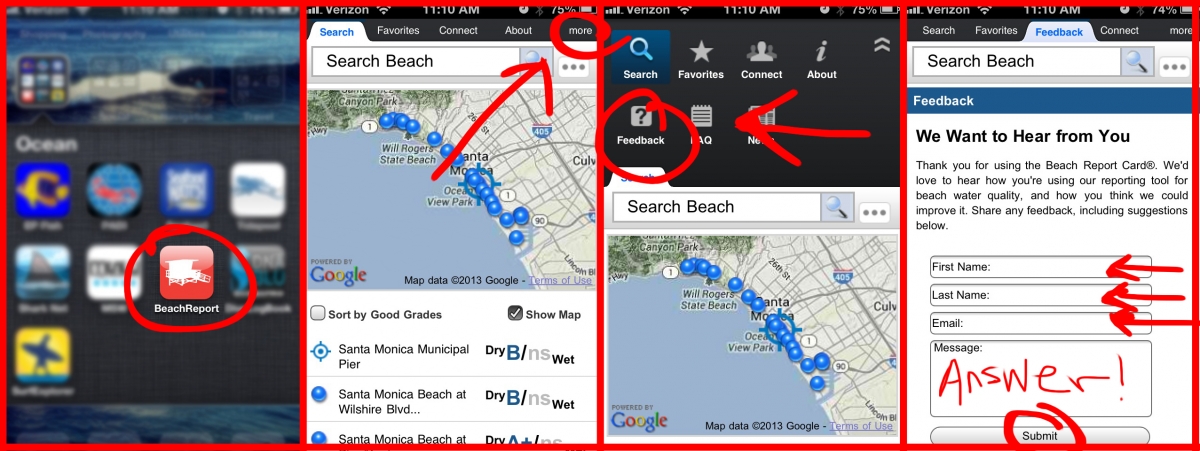
To enter, download the Beach Report Card mobile app and leave your answer as a comment in the feedback tab including the hashtag #SummerShades.

Here’s How To Leave Feedback on the Beach Report Card App:

How-To Leave Feedback on the Beach Report Card App


Amy Smart sporting Heal the Bay sunglasses at Bring Back the Beach


To present an alternative to the Discovery Channel’s Shark Week (and cult TV movies like Sharknado), Heal the Bay staff write about the marine animals they love so much. The general public has been fed terrifying misconceptions about these creatures, and our mission is to raise awareness about the unique and important role sharks play in our local ocean ecosystem. 

“The oldest and strongest emotion of mankind is fear, and the oldest and strongest kind of fear is fear of the unknown.”
H.P. Lovecraft

For most people the world over, the thought of a solitary fin slicing through the waves in the open ocean is absolutely terrifying. The fact is, you’re more likely to get bit by another person than you are to get bit by a shark. 1,587 people were bit by other people in New York City alone in one year. Shark bites that same year in the US? 13.

On average the number of fatalities due to shark bites worldwide ranges between four and six per year. The yearly risk in the U.S. of dying from a shark bite is roughly 1 in 250 million. In contrast, the yearly risk of dying from a vending machine accident is roughly 1 in 112 million. Vending machines are roughly twice as deadly as sharks. How many people do you think would buy tickets to see Attack of the 50 foot Vending Machine?

So why does this fear of sharks pervade our collective nightmares? We irrationally fixate on extremely unlikely threats, like shark attacks or the zombie apocalypse (which I am personally preparing for), while much more likely and high risk threats like heart disease, car accidents, or even the flu don’t occupy our minds and silver screens in quite the same way.  I guess it’s just not as fun to be afraid of the flu as it is to imagine sharks as crazed, bloodthirsty killers lying in wait under the waves, ready to pull you under, or in some cases, dropping down onto your head from the sky as it’s ejected from a tornado in downtown L.A.

The flu just doesn’t make good television. A bloodthirsty shark does. Jaws is the seventh highest grossing movie of all time in North America. Its famous animatronic protagonist has been etched into the minds and nightmares of so many of us, that it’s hard to shake their tarnished image and convince people that sharks are worth protecting. Peter Benchley, author of the book and screenplay for Jaws, said, “Knowing what I know now, I could never write that book today. Sharks don’t target human beings, and they certainly don’t hold grudges.”

We fear sharks because we don’t know them or understand them. We haven’t had positive experiences with sharks and only know the way the media and popular culture has portrayed them – as evil killing machines. This mentality is to blame in part for the ever-increasing slaughter of sharks worldwide, bringing some species to the brink of extinction. 

Your chances of even seeing a shark, much less getting bitten by one, are so slim, that to encounter one in the wild is to be incredibly lucky. During my divemaster training in Utila, Honduras our boat full of fresh-faced dive students had just tied off at a dive spot off the north shore of the island. A few students hopped in the water to relieve themselves, and suddenly one of them yelled “SHARK!” What happened next was comedic. The students who were in the water started swimming frantically back to the boat and clambered aboard as the entire crew of the dive shop jumped overboard like lemmings, falling over each other and practically trampling their students in order to get in the water and catch a glimpse of the shark. I was one of the first in the water and screamed like a schoolgirl into my snorkel at the sight of the beautiful grey shape that gracefully glided out of sight.

Once I learned about sharks and began to understand them I realized there is nothing to fear. I began to see how beautiful they are, how important their existence is to the fragile ocean ecosystem, and how threatened their existence on this planet really is. Their plight is dire; between 20 and 100 million sharks die every year at the hands of humans, and efforts to protect them tend to fall on deaf ears. People are far more likely to want to protect the cute and the fuzzy, and sharks don’t get the kind of conservation attention or empathy enjoyed by pandas or tigers.

You can learn more about these graceful creatures at our Santa Monica Pier Aquarium, and someday maybe, begin to love them and protect them.

—Ana Luisa Ahern, Interactive Campaigns Manager

Annual Risk Of Death During One’s Lifetime

Disease and Accidental Causes of Deaths 

Annual Deaths 

Death Risk During One’s Lifetime 

Heart disease

652,486

1 in 5

Cancer

553,888

1 in 7

Stroke

150,074

1 in 24

Hospital Infections

99,000

1 in 38

Flu

59,664

1 in 63

Car accidents

44,757

1 in 84

Suicide

31,484

1 in 119

Accidental poisoning

19,456

1 in 193

MRSA (resistant bacteria)

19,000

1 in 197

Falls

17,229

1 in 218

Drowning

3,306

1 in 1,134

Bike accident

762

1 in 4,919

Air/space accident

742

1 in 5,051

Excessive cold

620

1 in 6,045

Sun/heat exposure

273

1 in 13,729

Lightning

47

1 in 79,746

Train crash

24

1 in 156,169

Fireworks

11

1 in 340,733

Shark attack

1

1 in 3,748,067


Sources: All accidental death information from National Safety Council. Disease death information from Centers for Disease Control and Prevention. Shark fatality data provided by the International Shark Attack File.

Lifetime risk is calculated by dividing 2003 population (290,850,005) by the number of deaths, divided by 77.6, the life expectancy of a person born in 2003.

© International Shark Attack File
Florida Museum of Natural History, University of Florida


To present an alternative to the Discovery Channel’s Shark Week (and cult TV movies like Sharknado), Heal the Bay staff write about the marine animals they love so much. The general public has been fed terrifying misconceptions about these creatures, and our mission is to raise awareness about the unique and important role sharks play in our local ocean ecosystem.

Through our Angler Outreach Program, Heal the Bay engages fishermen throughout the Santa Monica Bay area to teach anglers about fish contamination. In the process, we also learn about different types of fish and sharks these fishermen catch from the piers, including the Pacific angel shark (Squatina californica).

The angel shark can be observed in shallow waters from Alaska to southern California and from Ecuador to Chile. The forward part is flattened and the rear part similar to the other sharks, eyes and gill openings are at the top, pectoral and pelvic fins are large and horizontally, have two dorsal fins and the lower lobe of the caudal fin is larger than the upper lobe.

They can grow up to five feet long and produce litters of up to 13 pups.

They look harmless, but if disturbed in their natural environment, can cause serious injuries with their bite, as they possess powerful and flexible jaws.

Valued for their meat during the ’80s, California’s angel shark populations were devastated by overfishing. Educational programs for conservation have played a very important role in our environment to protect this and other species of sharks.

Although sightings remain rare, angel sharks have been reported by our educational outreach team members at Santa Monica and Venice piers.

Watch a video of an angel shark feeding.

–Frankie Orrala, Angler Outreach Program Manager


To present an alternative to the Discovery Channel’s Shark Week (and cult TV movies like Sharknado), Heal the Bay staff write about the marine animals they love so much. The general public has been fed terrifying misconceptions about these creatures, and our mission is to raise awareness about the unique and important role sharks play in our local ocean ecosystem.

The Santa Monica Pier Aquarium’s swell sharks were my gateway shark. Growing up on the East Coast and vacationing on the Outer Banks of North Carolina, my surfcasting father created a bit of shark paranoia in me. He spent hours knee deep in the waves, casting for blues, drum, striped bass and mackerel.  I was usually not far away, playing for hours in the warm Atlantic waves. On occasion Dad would yell: “Get out of the water, I see a shark circling back!”

I never actually saw a shark in those waves on the Outer Banks, but the fear of the unknown — and the unseen — coupled with my father’s obvious concern left me with an unhealthy, unfounded fear.

Fast-forward to 2001 (we won’t discuss how far forward), and I find myself working in an aquarium with the opportunity to spend some quality time with sharks.  Our five swell sharks, Cephaloscyllium ventriosm, aren’t the creatures of my nightmares, but learning interesting facts about their behavior specifically and more about sharks in general has turned my fear into fascination. Images of hammerheads, great whites and whale sharks now surround my desk.  I adamantly argue to whomever will listen for shark conservation measures, knowing the vital role they serve in the ocean.

And they are deserving of our respect as an ancient species – fossil deposits containing evidence of swell sharks in Southern California date them back at least 5.3 million years.  Another fun fact: swell sharks make up for their size (at maturity they reach a mere three feet in length) by swelling up to deter predators. The shark will twist its body into a U-shape, grab its tail fin and swallow seawater to double its size. 

For the last several years, the swell sharks at the Aquarium have been producing eggs, a sign the sharks are well adjusted and thriving.  Developing eggs are on display in our shark nursery.  What begins looking like a tiny tadpole grows in the egg casing for 10 to 12 months and becomes a fully developed juvenile shark – about six inches long and known as a pup. The pup breaks out, often first swimming upside down as it gets its bearings. Aquarium staff and volunteers love to point visitors to the shark nursery exhibit, providing running commentary on the journey from egg to pup.

So this shark fearing kid grew into an adult armed with enough information to truly appreciate and advocate on behalf of these magnificent creatures.

— Randi Parent
Heal the Bay’s Aquarium Outreach Manager

Anyone can contribute to the health and well being of the Aquarium’s swell sharks through our Aquadoption program. The adult sharks, developing eggs and pups are available for yearlong adoptions, along with seven other species on exhibit at the Aquarium.  

Watch one of our baby swell sharks do flips!


To present an alternative to the Discovery Channel’s Shark Week (and cult TV movies like Sharknado), Heal the Bay staff write about the marine animals they love so much. The general public has been fed terrifying misconceptions about these creatures, and our mission is to raise awareness about the unique and important role sharks play in our local ocean ecosystem. 

Do the recent gloomy summer mornings have you transiting the streets of L.A. in fear that a Sharknado may pop out of the sky? Hopefully not. But, you also probably aren’t considering the ocean action being displayed in the Bay by our local shark ninja, the thresher shark. Threshers just might be deserving of their own action film.

Threshers are best known for their trademark tail fin that has an upper lobe so long that it makes up half of the shark’s length and a third of their body weight. While threshers typically travel alone, it’s not uncommon to find them in the Santa Monica Bay. They are frequently found off the coast of Malibu, and although they prefer offshore waters, last month anglers on the Venice Pier caught a few thresher sharks.

Threshers live in tropical and temperate waters throughout the world. But, the secrets of their ninja-like tail have been difficult to unveil. Scientists have long wondered how they use their strikingly long tail fin. In the past year, this understanding has advanced. Recent findings show that threshers often use their tail to strike and stun fish before eating them. A diver in the Philippines also recently filmed a thresher using its tail to hunt — whipping and stunning a school of sardines. This marks the first video recording of the thresher’s tail slapping feeding behavior.

Thresher sharks are not dangerous to people, in fact, we are lucky to have such an interesting predator living the Santa Monica Bay. And, it’s just one of over 30 species of cartilaginous sharks, rays, and skates (known scientifically as “elasmobranchs”) that live in or pass through the Bay – ranging from the cartoon-like shovelnose guitarfish to the speedy shortfin mako shark. The diversity of habitats in the Bay helps provide food and shelter for these sharks, skates, and rays.

Many of these species are doing well locally, but unfortunately, sharks aren’t faring so well globally.  The International Union for Conservation of Nature (IUCN) estimates that 30% of shark and ray species globally are threatened or near-threatened with extinction. Unfortunately, the inhumane practice of shark finning is one of the biggest threats to elasmobranchs – up to 73 million sharks are killed each year to support the global shark fin industry.

California has been a significant market for shark fin in the past, which catalyzed the enactment of AB 376, state legislation that prohibits the possession, sale, and distribution of detached shark fins in California. Regrettably, the US government is considering a measure that would threaten California’s shark fin law, along with similar shark protections passed by several other states.

Please make your voice heard by signing this online petition to tell your representative to keep state shark fin trade laws intact.

— Sarah Sikich
Heal the Bay’s Coastal Resources Director, Science & Policy 


To present an alternative to the Discovery Channel’s Shark Week (and cult TV movies like Sharknado), Heal the Bay staff write about the marine animals they love so much. The general public has been fed terrifying misconceptions about these creatures, and our mission is to raise awareness about the unique and important role sharks play in our local ocean ecosystem.

They’re small, timid and super cute! But I forgot all about that when I first encountered a leopard shark during one of my early forays into surfing.

I was out at Sunset Beach with one of Heal the Bay’s awesome volunteers, Boun, who is the perfect surfing teacher, given his supportive and mellow nature, which allowed me to relax and thoroughly enjoy the experience.  While we were waiting for that killer wave, we were chatting on our boards when all of sudden Boun said: “Oh cool, a shark!”

Like most people I had heard that sharks can confuse people in wetsuits for seals, so of course I immediately freaked out.  Boun saw my frightened face and quickly said: “Oh, no worries…they’re just leopard sharks!”  After my momentary panic I remembered that leopard sharks are harmless to humans and — as I mentioned earlier — pretty darn cute. 

You can find Leopard sharks in the Pacific coast of North America starting in Oregon all the way down to Mazatlan in Mexico.  They measure about 4-5 feet and are easy to identify due to the dark spots and saddle type markings that give them their name. Leopard sharks love to hang out in sand and mud flats, rocky reefs and kelp beds. 

If you’ve ever want to see this beautiful creature for yourself, you’re in luck! They frequent local waters, such as Catalina Island. I was lucky enough to be invited to visit USC Wrigley’s Marine Science Center on the island, and we got to snorkel out in the kelp forest where we saw many leopard sharks swimming lazily along the bottom of the kelp bed.  And, no, I did not freak out this time!

La Jolla Shores beach in San Diego is another popular leopard shark hangout.  Snorkeling and kayaking are great ways to get close to these cuties.

If you are looking for something closer to home you can always try Mother’s Beach or Venice Beach where we have also heard of many leopard shark sightings. 

Finally if you are one of those people that prefers a tank between you and your sharks, check them out at our Santa Monica Pier Aquarium (underneath the pier) where every week we host Shark Sunday at 3:30 p.m.


 — Melissa Aguayo
Heal the Bay’s Education Outreach Manager


We must use time wisely and forever realize that the time is always ripe to do right.—Nelson Mandela

Our monthly Nothin’ But Sand beach cleanup was made even more significant last week, as it was held in honor of anti-apartheid hero Nelson Mandela as part of an international volunteer effort to encourage people to donate 67 minutes of their time to their favorite causes.

Rico Cabrera, Jr, founder of the locally-based Rico Gets Better Foundation partnered with us to bring 460 volunteers to Will Rogers Beach. Saturday’s effort removed more than 100 pounds of debris from the shore. Thank you to Rico, his crew and our own dedicated beach cleaners!

To spur the spirit of grassroots organizing, we would also like to thank advocacy group Keep Hermosa hermosa for encouraging Hermosa Beach residents to attend a proposed oil drilling EIR scoping meeting at the Hermosa Beach Community Center held on July 24. An oil company, E&B Natural Resources, is proposing to drill four blocks inland from a beloved local beach. Residents will vote on the project in approximately a year. Until then, it’s important to continue to raise informed and well-researched questions about the environmental, economic and community health impacts of opening Hermosa Beach to drilling.

Cigarette butts were the hot agenda item at this week’s Corporate Healer Cleanup with DirecTV.  Forty volunteers collected enough cigarettes to measure 6 and a half feet. Thank for being such wonderful corporate citizens!

This week we also extend props to Mattel, Inc. for their commitment to supporting our Youth Education Day 2013, an event that will officially kick off Coastal Cleanup Day activities in September.

And once again, we thank the folks at Golden Road Brewing who guided us through their beer-making process as part of a Heal the Bay members event on July 13 (pictured above). What a relaxing way to spend a hot afternoon, learning about what goes into our favorite craft beer, the Heal the Bay IPA. (Still haven’t tried it? We hear it’s still available at Whole Foods and was even spotted at a Trader Joe’s!)

The big kahuna of cleanups is just around the corner…Coastal Cleanup Day on September 21! Get your friends and family on board!


Guest blogger Melissa Riche is a PR consultant and interior designer. She recounts a pleasant weekend sail with friends that becomes a mission — and a lesson in why decorative balloons are an environmental disaster.

On a recent Sunday, the conditions didn’t look promising for a great sail: grey skies, the threat of rain, and barely a breeze indicated that we wouldn’t be gliding along at the usual 10-12 knots.  Out past the end of the Marina del Rey tidal break, our predictions came true, but the five of us were happy to be out on the water to blow away the week’s cobwebs. 

Dawdling along at 4 knots on a calm sea, Kelly saw her first balloon. “Steve!” she cried to her husband, “we have to go pick it up.” Steve turned on the motor to make navigating easier and Kelly leaned over the side with a gaffer hook to grab the balloon.  Wrapping the balloon’s long string around the hook took several attempts, but she managed to haul it in and proudly showed off her catch to the rest of the crew.  It was a Stars and Stripes July 4th Mylar special.

Little did we know, this was about to be the theme of the afternoon.  During the next couple of hours, while Steve and Kelly, Jim, Tracy and I meandered around the bay with no purpose other than a relaxing Sunday sail, we hauled in 34 balloons.  We weren’t even looking for them.  We would be sitting chatting, telling stories, eating our lunch and just having a good time when someone would shout out “balloon!”

Photo by Stephen Graziano

We took turns bringing them in. Sometimes we missed the first pass because the balloon strings would slip through the hook, so Jim, my husband and my old sailing pal Tracy took to bending over the side of the boat, arms outstretched, to grab the odd ones. Two or more tied together made hooking them much easier.  We even got in some ‘man overboard’ sailing practice to pick up a couple of balloons we’d missed first time.

Later on, as we headed back, we saw a dark shadow bobbing some distance away.  “What’s that over there?  Is it a small boat?  Is there someone in trouble?” I wondered.   We headed towards the mystery silhouette – about 200 yards away but big enough for us to see a strange outline.  As we got closer Jim’s 20/10 eyesight identified ‘more balloons’ and we all laughed and groaned in disbelief.  How could there be so many balloons out on the water?  Kelly and Stephen who sail in the bay at least twice a month said they’d never picked up more than one or two balloons in the water on any one sail.  This time it was a group of 8 purple Mylar balloons.  Tracy and I landed the catch of the day!

“OK, that’s enough,” we declared.  But in fact just as we landed the big catch, we saw another balloon about 50 yards away so we picked that one up too.  And on the way back, as the wind dropped some more and the sea became glass-like, we saw balloons everywhere.  Groups of yellow and pink, yellow and white, single green single blue, ‘Hello Kitty’ birthday balloons, a mylar butterfly and more.

Back on the dock, we spread them out and counted them — 34 balloons altogether.

The balloon catching had made for a really fun sail on an otherwise unexciting weather day, but the downside of our enjoyment was clear to all of us.  If we could pick up 34 balloons in one day without even trying, how many more ended up in the bottom of the ocean, threatening marine life with plastic and likely toxins from the balloons’ graphic designs– which came off in our hands when we pulled them in – not too mention entanglement from the long strings.

For years I’ve been a supporter of banning plastic bags (we banned them in England long ago), and so I was delighted to support both Environment California and Heal the Bay in their work to encourage plastic bag bans and even more thrilled when cities throughout California started to institute the bans.

But balloons. We’ve all bought them for friends and family special occasions.  They’re fun, they’re decorative – and then what happens to them?  When I see events marking a launch with a balloon release, I wonder where the balloons end up.  When you see all those balloons blowing in the wind at car dealerships – where do they go?  All those families celebrating birthdays on the beaches – the wind catches the balloon and away it goes.

Our poor Santa Monica Bay suffers so many indignities.  Perhaps in addition to banning plastic bags, we should at least start a discussion about balloons.

At the very least, I encourage everyone who sails in the bay to do as we did, and pick up balloons when they see them.

Pictured above: The author, kneeling on the dock, holds a sampling of the balloons the crew retrieved from the bay. (Photo by Stephen Graziano)


My first exposure to the Colorado River was as a kid.  I was very fortunate to take a two week white water rafting trip down the Colorado River with my family.  To this day it is the best vacation that I have ever taken. Experiencing this amazing natural wonder so intimately was the adventure of a lifetime.

Fast-forward to now, when, as a resident of Southern California, I rely on the Colorado River each and every day.  Angelenos are among the 20 million Californians who depend upon the Colorado River for at least a portion of their drinking water.  Most of the California-grown vegetables we eat are irrigated with Colorado River water.  Unfortunately, demand on the river’s water now exceeds supply, which is depleting both river flow and bringing water stored in reservoirs to historic lows. 

There is currently considerable “buzz” around the Bay Delta — and rightly so.  This system is under enormous pressure.  The draft Bay-Delta Conservation Plan (BDCP) was recently released, which is the state’s strategy for the Sacramento-San Joaquin River Bay Delta system that aims to ensure a more reliable water supply and a healthy ecosystem.  Of note, many environmental groups have raised concerns over the draft BDCP and have provided counter-proposals.  The Colorado River provides roughly the same amount of water for urban Southern California as does the Bay-Delta, and both systems are under intense pressures. Yet the Colorado receives much less attention in California than the Bay-Delta receives.  Colorado River Day provides an opportunity to reflect and give the much needed attention to the Colorado River system.   

Heal the Bay has long advocated for maximizing our local water supplies, thereby decreasing our region’s need for imported water and relieving pressure on these over-taxed river systems.  At the same time, focusing on local water helps us improve the water quality in our rivers and ocean.  For instance by infiltrating stormwater into groundwater basins, we increase our local water supply and prevent polluted stormwater runoff.  By increasing the recycling of treated wastewater, we offset the need for imported water and reduce discharge to our rivers and streams.   Further, increasing our local water supply will save ratepayers money over generations.  Los Angeles Department of Water and Power drafted cost comparison models that show the cost of Metropolitan Water District imported water will eclipse the cost of conserved water in 2015, groundwater cleanup for recharge in 2022, reclaimed waste water in 2028, and reused stormwater in 2029.[1] In other words, investing in local water is a win-win scenario.    

I hope to take another river trip down the Colorado someday.  I recently learned that the Colorado River supports a $26 billion recreation economy!  However, we Californians need to make some serious changes in our reliance on imported water to ensure that this precious resource is protected and visitors and wildlife can enjoy this resource in perpetuity.  Let’s use Colorado River Day as an opportunity to ask our leaders to take the steps necessary to make sure this becomes a reality.

 — Kirsten James
Science and Policy Director, Water Quality

 Keep track of West Coast beach water quality with Heal the Bay’s Beach Report Card®


[1] LADWP, Local Water Supply Sensitivities, November 2011.