Top

Heal the Bay Blog

Category: Locations

It has come to Heal the Bay’s attention that some kayaks in the Malibu area have been tagged with a notice that states they are not allowed to be moored or placed on the beach within the newly established marine protected areas (MPAs) near Point Dume.

These tags contain inaccurate information and are of unknown origin.

MPAs allow for the mooring of vessels or any other non-consumptive use activities, such as surfing, kayaking, diving and sailing. Heal the Bay and other organizations are involved in marine protected area monitoring, but not enforcement.  Enforcement is being conducted by the Department of Fish and Game.

Refer to the Department of Fish and Game website for information on MPAs and the only list of restricted activities.

Fake MPA Sticker

Sample Misinformation Tag


Even if you live miles from the ocean, there are some simple steps you can take in your home to protect your favorite beach (as well as your local neighborhood, park or river).

Over the coming weeks, we will be sharing short, educational and fun videos with tips on 10 ways you can heal the Bay — so keep an eye on this page (or subscribe to our YouTube channel)!

Our first video comes from Melissa Aguayo, Heal the Bay’s Speakers Bureau Manager

Hold on to Your Balloons

10 Ways You Can Heal the Bay

1. Keep your Litter out of the Gutter

Keep trash, yard trimmings, and other litter off the street and out of the storm drains so they don’t end up in the ocean. Clean up after your dog, cat, or horse to keep the waste out of the storm drain and away from your favorite beach. Report full catch basins to the Dept. of Public Works: L.A. City: (800) 974- 9794 L.A. County: (800) 303- 0003. For non-L.A. County residents find your local city numbers.

2. Bag the Plastic Bags

Instead of accepting plastic bags from the grocery store, bring your own reusable bag. Single-use plastic bags create loads of unnecessary litter; they are easily blown by the wind, and they often end up in the ocean. Plastic takes hundreds of years to degrade, and creates hazards for marine life and other wildlife.

3. Hold on to Your Balloons

Released helium balloons eventually pop and fall back to land, ending up in the ocean where animals mistake them for food. Always pop balloons and put them in the trash.

4. Beware of Six-Pack Rings

Avoid buying them, and any other loop of plastic, or cut them up before you throw them out. Marine animals choke on garbage and get tangled in trash. Unlike people, birds and fish don’t have hands to remove items caught around their necks.

5. Don’t Be a Drip

Overwatering is wasteful and moves trash and toxins to the ocean. Turn off the faucet when you don’t need it. Fix leaky pipes and install low-flow shower heads and toilets. Help the sewage treatment plants do a better job by conserving water.

6. Go Non-Toxic

If you must use harsh chemical products, when you are through bring them to authorized household hazardous waste drop-off centers. For locations near you, call (800) CLEAN-UP. Instead, avoid buying products like liquid drain openers. Use pesticides as little as possible and look for non- toxic alternatives. Use compost instead of chemical fertilizers. Best of all, using simple recipes and ingredients, you can make your own environmentally-friendly cleaners.

7. Make a Clean Sweep

Use a broom, not a hose, to clean sidewalks and driveways. Watering the driveway won’t make it grow! Sweep trash into a dustpan, not the gutter, and use the garden clippings as mulch to fertilize your yard.

8. Recycle Used Motor Oil

You can recycle your used motor oil at gas stations, auto parts stores, and garages. Never pour it down the drain, in the gutter, or on the ground. Motor oil is extremely toxic.

9. Go to a Car Wash

Most car washes recycle their water. But if you clean your car at home, always wash it on your lawn to recapture lost water, use a bucket to conserve water and consider a ‘waterless’ car wash like Lucky Earth or Ecover.

10. Become a part of Heal the Bay

Help us continue to protect the Santa Monica Bay and all of California’s coastal waters; become an environmental advocate, volunteer or join as a member.

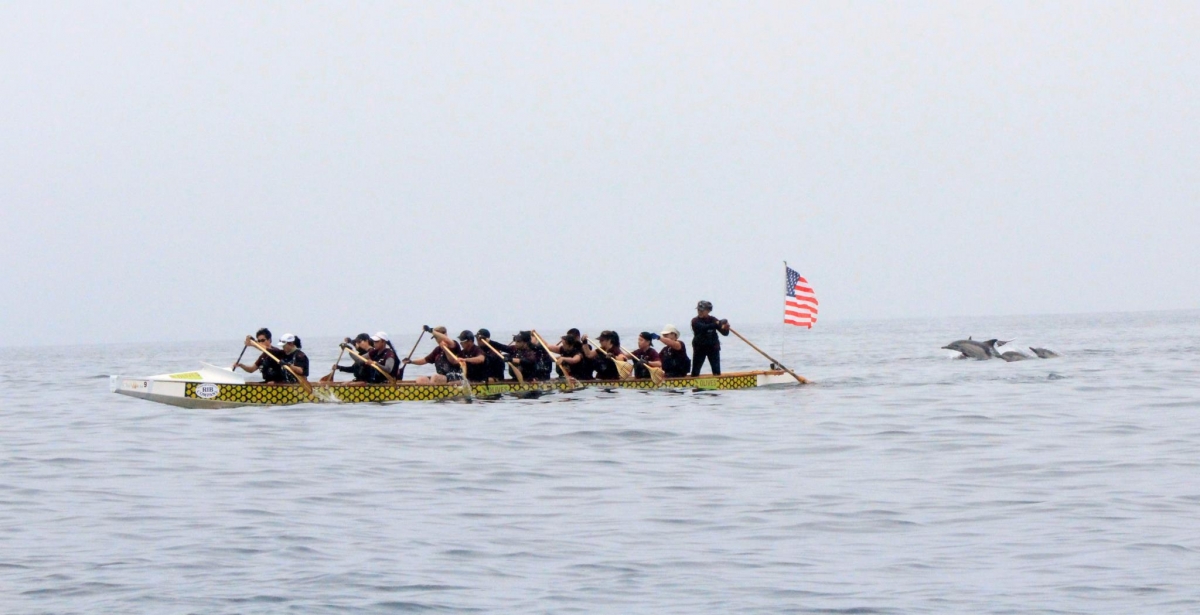
After months of training, the AeroDragons Dragon Boat Club, met their goal to “go where no man has gone before” by paddling a dragon boat in the open ocean from Two Harbors at Catalina Island back to Mother’s Beach on Naples Island, Long Beach.

Dragon boats are not typically designed for open-ocean travel, making the crossing a dangerous undertaking, but the team succeeded nonetheless.  The AeroDragons Dragon Boat Club members challenged themselves, not only to set a new record by making the first open-ocean crossing of the Catalina Channel by a dragon boat, but also to use the paddle out as a third party event to raise funds for Heal the Bay.

The Club’s team couldn’t have asked for more perfect conditions on the morning of September 24th, with calm seas and virtually no wind or waves.  It took the team three hours and 26 minutes to paddle the 21-mile crossing. 

During the paddle out, the team reported multiple sightings of blue whales and dolphins, including a pod of hundreds of dolphins near Point Fermin.

Congratulations to the Long Beach-based club for going, where no dragon boat has gone before. 

Read more.

AeroDragons dragon boat team encounters dolphins during historic Catalina Channel Crossing


Today’s guest blogger is Melissa Aguayo, Heal the Bay’s Speakers Bureau Manager

The New Year is just around the corner, and we all know what that means… New Year’s resolutions.

Some people like to focus on their health while others focus on helping others or even saving money. If only there was an easy way to do all three… oh wait, there is! 

Kicking your bottled water habit and switching to tap and a reusable bottle will save you money. Plus, it’s better for the environment and your health! Confused? Keep reading. 

Save Money 
Bottled water is expensive; it costs anywhere from 240 to 10,000 times more per gallon than tap water. The average tap water in California costs about $1.60 per thousand gallons while the average bottled water costs about $0.90 per gallon-that means you are paying over 560 times more for a product that falls from the sky! In fact, if you look at the price per gallon, you will pay more for single-use bottles than for gasoline. In 2009 Americans spent $10.6 billion on bottled water and almost half of that bottled water came from public tap water supplies. Beverage companies do a great job of marketing bottled water as purer and safer; however this is not necessarily true. 

Protect Your Health
Our tap water is safe and highly regulated by the federal government. On the other hand, the Food and Drug Administration has much less stringent rules and only regulates the 30-40% of bottled water sold across state lines. Even then, testing is intermittent and once the water is bottled and stored, it does not have to be tested at all. The Natural Resources Defense Council completed a four-year study where they tested 1,000 bottles of 103 bottled water brands. Among many shocking discoveries, they found several companies buying water from a spring in Massachusetts which was located near a hazardous waste site. The water was contaminated with carcinogenic chemicals. Many plastic bottles also contain phthalates and BPA (Bisphenol A) which are both carcinogenic chemicals and can leach into the water.

Help the Environment
Many bottled water companies take water from local public sources, which harm the environment by depleting groundwater sources which the local community relies on. Once this water is removed it has to be packaged, in plastic. The U.S. alone uses about 17.6 million barrels of oil to produce plastic bottles. That would be enough oil to fuel more than one million vehicles each year. These bottles then have to be transported over hundreds of miles which consumes energy and releases pollutants. At the end of all this we are left with billions of empty bottles of which only 16% are recycled. The other 84% will end up in landfills or littering our streets where they can make their way to our rivers, lakes or oceans through the storm drain system. 

So there you have it, three incredibly important reasons to make switching to tap and reusable water bottles this New Year’s resolution. It’s a small change that will go a long way. 

Now go return that ugly sweater Aunt Liz gave you and exchange it for a reusable water bottle.


The Los Angeles City Council’s energy and environment committee today approved an action asking for a Chief Administrative Officer-Chief Legislative Analyst report on a single-use bag ban within 30 days. Also, the Bureau of Sanitation must implement a public outreach program over the next 60 days.

Immediately after the committee meeting, the city council met to celebrate outgoing president Eric Garcetti’s long-term leadership. After Jimmy Kimmel’s monologue and the rest of the festivities, the council heard the bag-ban item.

Read more » 


The Los Angeles City Council heard testimony from over 60 people today on the long-awaited single-use plastic bag ban.  The environmental community was well represented and attired in natty green.  Other supporters included reusable bag manufacturers, the California Grocers Assn., the L.A. Chamber of Commerce, and 17 neighborhood councils!  Clearly, a life without single-use plastic bags is a popular movement that has grown well beyond L.A. County, Long Beach, Malibu, Santa Monica Calabasas and other SoCal cities.

Opposition was provided by bag man Stephen “This bag is more than a toy” Joseph and Crown Poly bag manufacturing staff.  Joseph tried to tie the city council vote to California’s ranking by industry titans as the place they’d least likely want to do business.  I’m not sure where the ranking came from, but Joseph did say that Texas was No. 1.  Enough said.

Thanks to a prior commitment to the environmental community from Council President Eric Garcetti, the City Council heard the testimony. However, members were uncomfortable taking action without the bag ban first going through the Energy and Environment Committee.

Read more » 


Today’s blogger is staffer Jose Bacallao, senior aquarist at Heal the Bay’s Santa Monica Pier Aquarium.

Winter can be brutal in So Cal. I know all the East Coast transplants in L.A. are rolling their eyes right now – but it’s wet, cold and windy here, too.  Moreover, working as an aquarist at the Santa Monica Pier Aquarium – shorts and flip flops being the uniform of choice – December can really hurt. Yes indeed, it hurts from our little toes to the tips of our fingers.

So, whether it’s hot or cold, we have to get in the water once a week to collect kelp and other organisms for the Aquarium. Collecting is a top priority as our animals need fresh algae, live mysid shrimp and other animals to thrive on exhibit, enabling us to educate the public and the students from hundred of schools that visit annually. This past week we went “jelly fishing”.

Over the past four years our team of aquarist staff and interns has been culturing and exhibiting Moon Jellies. We work hard to grow our sea jellies in-house and culture new “baby jellies” (ephyrae) to avoid having to collect live sea jellies from the wild. But over the past several weeks, following two power outages, we lost the majority of our moon jellies. The power outages devastated our culture and exhibit program. After much discussion and debate, staff agreed the time had come to bring in a few wild specimens and “start over” again. This was an exciting opportunity not only to revitalize the Aquarium’s sea jelly culture, but also to involve our aquarist interns on a fun collection trip.

We spent a few days communicating with colleagues from other aquaria in order to find the best collection spot and after getting a great tip, we decided that our best shot would be trying a secret spot in Long Beach. We were very anxious for the next morning and our chance to collect new moon jellies. Although moon jellies aren’t very good swimmers (they’re plankton after all) we knew that just because they were spotted on Monday didn’t guarantee they’d be there Tuesday morning. A lot can happen in just a few hours, just ask the Lakers and Chris Paul.

When we arrived the next morning, we were stoked. In the back section of the bay we spotted about 300-400 moon jellies. The collection plan was very direct and easy. Our interns were to walk the docks with buckets and collection bags and access the jellies from land, while Seth and I collected from the water. I’ll be honest, I had never tried the latter method but I had a really good feeling about it. You see for the past few months we’ve been spending our lunch hour on our stand up paddleboards (SUP) so we thought, why not? 

Let me tell you, there is no better way to collect jellies than on my C4 iSUP! Aquarist Seth Lawrence on his board and me on mine, with coolers, nets and bags and in no time we had collected our targeted amount. Together we collected 25 adult moon jellies. We carefully bagged our jellies for transport, careful to keep them free from air bubbles, treated our interns to a celebratory “victory coffee” and drove them back to the Aquarium. They are now on exhibit at the Aquarium and we are working hard to start a new culture of baby jellies. With some luck and cooperation from the moon jellies, we hope to be back to tip-top shape by end of winter.

Meanwhile, come visit these graceful creatures on exhibit at the Aquarium or for a meaningful holiday gift, aquadopt one »


If you’ve strolled down a Southern California  pier, you’ve probably seen the warning sign: “No Coma White Croaker” (Don’t Eat White Croaker”). The reason for the warning? The effects of widespread DDT and PCB contamination in our local waters from the 1940s-1980s that’s worked its way up the food chain.

The kinds of health problems that have been linked to DDT and PCBs include effects on the nervous, immune, endocrine, and reproductive systems, infant development, and cancer.

To spread the alert of this danger, members of our Pier Angler Outreach Program have educated nearly 100,000 anglers over the past eight years on the health risks of eating certain fish they’ve caught on their lines, most notably, white croaker, black croaker, barred sand bass, topsmelt and barracuda.

In addition, members of our team, employing languages from Spanish to Tagolog to English, suggest cooking methods if the anglers choose to eat any of their contaminated catch.

Our EPA-award winning efforts span eight different piers: Santa Monica, Venice, Hermosa, Redondo, Pier J, Rainbow Harbor, Belmont and Seal Beach.

Find out more en espanol.

Download a guide to eating fish caught in the bay.


A five-year grant is headed to scientists researching harmful algal bloom “hot spots”—aka “Red Tide”— in southern and central California.

In addition to investigating methods that could provide early warning detection of toxic blooms, the $4million project will boost the capabilities of California management agencies to safeguard living resources, public health and economies.

The study was funded through a national competition of the Ecology and Oceanography of Harmful Algal Blooms (ECOHAB), a program run by the National  Oceanic Atmospheric Administration’s National Ocean Service/National Centers for Coastal Ocean Science.

According to a statement from the National Oceanic Atmospheric Administration (NOAA), research will be carried out at the University of California Santa Cruz, the University of Southern California, Moss Landing Marine Laboratory, Monterey Bay Aquarium Research Institute, the Southern California Coastal Water Research Project, University of California Los Angeles, and NOAA’s Center for Coastal Environmental Health and Biomolecular Research.

Some species of red tides produce a toxin that when eaten can lead to potentially fatal human illness. The toxins can also cause illness and death in marine mammals and birds. To find out more about the hazards of algal blooms, visit the NOAA National Ocean Service Harmful Algal Blooms website: http://oceanservice.noaa.gov/hazards/hab/

Read Aquarium Director Vicki Wawerchak’s The Truth About Red Tides.


Make a difference for our coast and ocean!

Ever wonder what you can do to help take care of the beaches and ocean you love? Did you know there are tons of simple things you can do at home, at work, and at school that can have a huge, positive impact? The California Coastal Commission has created the Coastal Stewardship Pledge, with everyday tips you can use to help our environment. Show you care by taking the pledge today. There is a special pledge for classrooms and youth groups and a Spanish language pledge as well.

Some simple things you can start doing right now:

  • Refill a water bottle instead of buying a single-use one.
  • When packing food for your school lunch, put food in reusable containers rather than disposable plastic and paper bags.
  • Start a recycling program at your office.

You can read the stories of people like you who care for our coast.

Join the thousands of other Californians who have already become Coastal Stewards! Thank you for making a difference for our coast and ocean.


Organizations: Please consider becoming Coastal Stewardship Partners by linking to the pledge from your website or distributing shorter printed versions of the pledge to your participants. For details, please email coast4u@coastal.ca.gov.


Visit the California Coastal Commission’s Public Education Program at www.coastforyou.org


Become A Coastal Steward Logo