Top

Heal the Bay Blog

Category: Locations

Editor’s Note: Mark shares some more of his more memorable moments at Heal the Bay. Read the first installment A Wave of Memories.

The Ahmanson Ranch campaign.  I remember: touring the watershed with Board President Tony Pritzker and former Interior Secretary Bruce Babbitt, representing Washington Mutual.  Flying up to a WaMu shareholders meeting with Rob Reiner and Alfre Woodard on a private jet to protest the development.  The coalition of Hollywood (Chris Albrecht and Reiner), electeds, Native Americans, Mary Weisbrock and Save Open Space, Heal the Bay (Mark Abramson’s covert maps of Ahmanson Ranch riparian habitat were key), and the brilliant campaign work of Chad Griffin and Steve Barkan.  Getting screamed at by Reiner at a meeting.  The only other person that ever yelled at me like that was my dad.  I can only imagine what would have happened if we lost! The anti-climactic press event celebration when the state purchased the land (Governor Davis was being recalled).  The joy of taking my kids, Zack, Jake and Natalie, to the Ranch just days after it opened to the public.

Litigation  I’ve always been a “sue as a last resort” kind of advocate, but sometimes litigation is the only solution.  NRDC’s Joel Reynolds and I spent countless hours with former L.A. County Sanitation Districts’ GM Jim Stahl to settle the full secondary treatment lawsuit about the Carson plant.  Once we got through the “sewage is good for the fish arguments” (thank you Willard Bascom of the Southern California Coastal Waters Research Project in the late 1980s) and the “sewage solids are needed to cover up the DDT and PCB contaminated sediments” or “two wrongs make a right” argument, we were able to negotiate a resolution quickly.  In fact, it only took the Sanitation Districts four years to build its full secondary facilities.  Also, we partnered with NRDC on some industrial waste litigation and an industrial stormwater lawsuit against the Port of Long Beach (led by current criminal court judge Gail Ruderman Feuer).  I still remember all the inspections of pretty nasty Port facilities.

Read more of this post » 


The Santa Monica City Council unanimously supported a resolution last night affirming individual environmental rights to clean air, water and soil, sustainable water and food supplies, and a climate unaltered by anthropogenic impacts.  Nearly 40 speakers ranging from high school and college students to environmental activists from Northern California spoke in support of the sustainability bill of rights.

The resolution, crafted by Santa Monica city staff in response to a draft ordinance recommended by the city’s Task Force on the Environment, commits the city to come back this summer with recommended legal changes to allow individuals to protect those rights.  Although the council vote only approved a resolution instead of a legally enforceable ordinance, the action puts the city on track to a process that provides individuals defensible environmental rights and extends protective rights to local natural resources.

Last night was a first step towards changing the dialogue on environmental protection in Santa Monica, and hopefully that shift in dialogue will move far beyond the city’s borders. The recommended legal changes to Santa Monica law will come to the city council at the same time as the third iteration (and third decade) of goals and metrics under Santa Monica’s Sustainable City Plan. We could see a draft as early as mid-summer.

We all have the right to clean air, water and soil, and corporate rights should never supersede these rights.  The time is now to move from just voluntary intentions to making these sustainability goals legal, enforceable obligations.


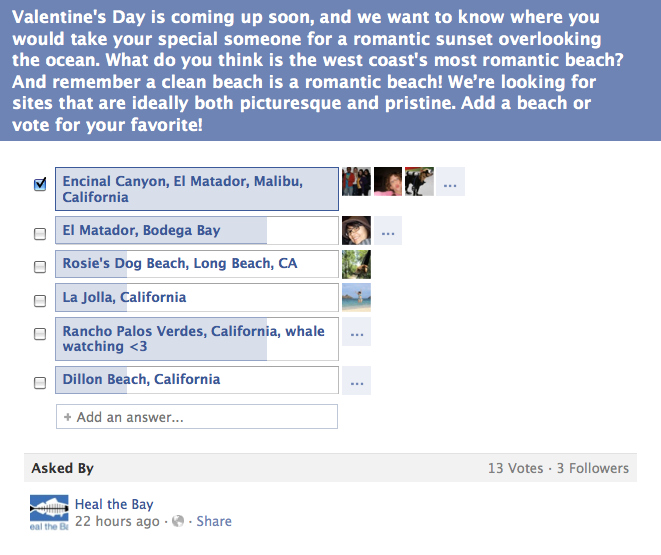
Last chance to cast your vote! Get your vote in today!

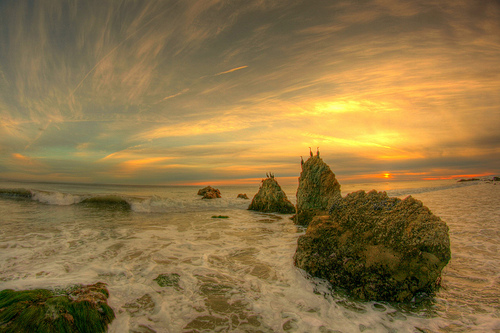
El Matador Beach Photo by Barry M. VS. Ranchos Palos Verdes Photo by Eric Magnuson

With Valentine’s Day approaching, we want to know the ideal coastal spot for sparking a romantic mood. It can be anywhere along the U.S. West Coast, from California to Oregon and Washington.  El Matador and Ranchos Palos Verdes have garnered top votes, which one will claim the top spot? 

Cast your vote! 

Facebook Question: Most Romantic Beaches for Valentine's Day


I started volunteering at Heal the Bay as a 22-year- old in 1986.  Over the last 25 years, I have some amazing memories.  Here is an extremely abridged list of a few of the most memorable.

 My first hearing at the Los Angeles Regional Water Quality Control Board.  L.A. County San’s general manager, Chuck Carry, chewed my head off publicly for stating that the Carson Plant was violating the Clean Water Act’s sludge dumping prohibition by discharging centrate (the liquid removed from centrifuged sludge) off of Palos Verdes. After the Regional Board ruled that Heal the Bay was right, wise and kindly board member Chuck Vernon came over to me to offer support for hanging in there against Carry.  Definitely a Mean Joe Green-Coke moment.  That was the first of my over 200 Regional and State Water Board meetings.

Heal the Bay’s annual meetings  At one meeting, U.S. Sen. Pete Wilson and Attorney General John Van De Kamp, two of the three gubernatorial candidates in 1990, gave plenary talks.  Wilson announced for the first time that he would create Cal-EPA if he was elected.  He won the seat and he did just that.  Other annual meetings included a Senate environmental debate between eventual winner Barbara Boxer, Congressman and Santa Monica Bay Restoration Project founder Mel Levine, and Lt. Governor Leo McCarthy, and an L.A. mayoral environmental debate with every candidate but the eventual winner, Richard Riordan.  I still remember then-Councilman Nate Holden stating that he’d make Santa Monica Bay drinkable if he was elected.

Surfboard Art — one of the most creative, amazing events in non-profit group history.   The brainchild of Olympic swimmer John Moffat, the project gave America’s top artists a Clark Foam blank that they could decorate as they saw fit.  The creativity of Board member Cydney Mandel and the leadership of the Dill brothers were key.  Boards were created by Lita Albuquerque, Laddie John and Guy Dill, Joni Mitchell, Peter Max, and Ed Moses.  But despite a show in the Corcoran Gallery and other locales, it was a horrible fundraiser because the boards were raffled off rather than auctioned off.

Read more of this post »


Today’s guest blogger is Margy Feldman, Heal the Bay’s director of advancement.

The fog and chill hung in the air as I arrived for a recent morning walk in Manhattan Beach. I found it difficult to see the breakers across the dark sand. Slowly the fog began to lift, the sand began to dry and as I stared into the vast and luminous ocean, the horizon finally became clearer. The sun fought through the misty sky. It was a new day on the coast of Southern California. More and more people began hitting the strand as the South Bay woke up.

The sun began to warm me, and although I had my iPod with me, it was more pleasing to hear the sound of waves crashing – the steady and forever force, clearing my head and reminding me how lucky I am to live so close to the ocean. I reflected on cherished days relaxing on the beach, reading a book, exercising, playing with my family and swimming where the water is clean and safe.

I grew up enjoying the beaches of Long Island and the Jersey Shore. And my husband and I raised our son on the sand at Redondo Beach. My fondest memories have been made on beaches. If you flip through my family albums you would think we spent our whole lives basking in the salt air. Recently, I joined Heal the Bay to help advance their financial support, fundraising and friend-raising. I was attracted by the incredible work the organization has done leading the efforts in Southern California, locally and even nationally to protect our oceans. The mission is so compelling. As a mother, nurturing what we all love drew me to the cause. 

The extra bonus for me is Heal the Bay’s commitment to education. I’m getting steeped in the many programs Heal the Bay offers to children all over Southern California, from kindergarten through high school.  Amazingly, countless children in areas like Compton and East L.A. have never had the opportunity.  We help Title 1 schools bring kids that have never been to the beach to our shorelines.

Our programs not only introduce these kids to the feeling of sand between their toes and the awesomeness of the never-ending waves, but they also teach them to be better environmental stewards. They learn about what causes pollution, how it impacts sea life and how to safeguard the sea for generations of children to come.

If you are reading this, it’s because you are part of this extraordinary movement to protect our oceans, preserve our beaches and ensure that our sea life flourishes. It is truly a Happy New Year knowing that your generosity of time and dollars continue to help make this possible for limitless years to come!

Heal the Bay volunteers who helped make the new marine protected areas (MPAs) a reality can now join our new citizen scientist program, MPA Watch. Staff scientist Dana Murray, who manages the program, says you don’t need to be an expert to lend a hand.

“We had many supporters and people who worked hard to get MPAs approved in L.A. County,” she said. “We thought this was a good way for people to stay involved.”

Pairs of volunteers with binoculars, clipboards and cameras already have started canvassing the beaches, recording data on what they see people doing, from scuba diving to commercial squid fishing.

Join Dana and become an official steward of the sea at two upcoming classes.

Can’t make it this week? For future trainings, contact Dana.

Or, celebrate Underwater Parks Day with us Sat., January 21 at Point Dume and our Aquarium.

Learn more.


Can good design change the world? According to JUST DESIGN Socially Conscious Design for Critical Causes, a new book about communication design for the greater good, the answer is a resounding “Yes”!

Containing more than 140 stories of socially-engaged design the book showcases a diverse collection of projects, people and causes, such as trashionista Marina DeBris and Project H, the humanitarian design nonprofit.

JUST DESIGN author Christopher Simmons, principal creative director of the noted San Francisco design office, MINE, says he wrote the book because, “For many, doing good work that also does good in the world is part of the ethos of design practice.”

Learn more.


“The same nutrients that make your grass grow also will make algal blooms grow if they wash down the storm drains and into the waterways,” notes Susie Santilena, an environmental engineer in water quality at Heal the Bay.

The nitrogen and phosphorus in fertilizers that are so good for plants, may contribute to toxic red tides in the ocean and can make algae run wild in freshwater areas like Malibu Creek, creating dead zones as the green scum blocks sunlight and inhibits the growth of other plants and animals, Santilena says.

The algae even wreaks havoc when it dies, because it sucks oxygen out of the water as it decomposes, a process known as eutrophication.

“When you don’t have oxygen in your waterway, your marine life suffocates and you get fish die-offs because there’s no dissolved oxygen in your water,” she says. “And there are aesthetic issues—algae growth can create pond scum, which is just kind of gross to look at in waterways.”

So what to do? It’s tricky, environmental advocates say, because while organic fertilizers such as steer manure and worm castings have advantages that chemical fertilizers don’t share, both can create destructive runoff if they aren’t applied carefully.

Learn more.


On Jan. 11, San Luis Obispo County became the 15th community in the state to pass a ban on single-use plastic bags in an effort to encourage citizens to use reusable bags instead.

The California Grocers Association endorsed the proposal, as did representatives of local landfills, who said plastic bags are a problem for them. Approximately 130 million plastic bags are used each year in the county alone, and only three percent of those are recycled.

In an attempt to stop the ban in SLO County, the Save the Plastic Bag Coalition said after the meeting that it would file a lawsuit within 30 days, serving a “threat of litigation” to the board. The coalition issued a similar challenge when the Manhattan Beach City Council approved a bag ban in 2008, which ultimately failed in July 2011 when the California Supreme Court unanimously ruled in the city’s favor. The Manhattan Beach plastic bag ban goes into effect Saturday, Jan. 14.

Momentum for plastic bag bans has been building since 2007, when San Francisco became the first city in the nation to ban the free distribution of plastic bags. Other cities and counties across the country have followed, including Seattle, Portland, Ore., San Jose, Los Angeles County, and Washington, D.C. Smaller cities such as Santa Monica, Long Beach, Carpinteria and Fairfax have enacted some form of ban or limitation on the use of plastic bags.

The SLO County ban will apply to single-use plastic bags at supermarkets, pharmacies, convenience stores and big-box stores as part of an effort to get shoppers to start bringing in reusable bags. It is scheduled to go into effect on Oct. 1. 2012.

Heal the Bay has led the legislative fight to enact a bag ban for more than five years as part of its ongoing efforts to tackle plastic pollution in California seas and neighborhoods. Join us and take action.

Learn more more about the San Luis County bag ban.

Read about plastic pollution and its impact here.