
Top

Heal the Bay Blog

Category: News

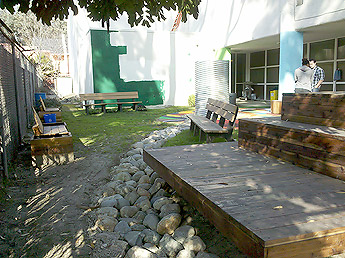
A bike path in Arleta got a facelift recently in an effort to make it more welcoming to the community. The community hopes that more people will now frequent the area to walk, bike and spend time outside with their kids. About 240 volunteers came out to plant thousands of native CA plants by the path and for at least one, a Heal the Bay cleanup may have been the impetus to volunteer. Check it out.

Photo: BitBoy via Flickr


In a unanimous decision, the City of Santa Monica tonight passed one of the most aggressive and far-reaching plastic bag bans in the State of California. The ban, which will go into effect in September 2011, will ban all grocery stores, pharmacies and retailers from distributing plastic bags.

Press Release

Learn More

Exceptions will be made for restaurants selling food and drink for take-out, but the popular farmers markets will no longer be able to distribute plastic bags. Stores can sell paper bags, provided they are made of at least 40% recycled paper, for a minimum of 10¢ each.

Each year, Santa Monica residents use in excess of 25 million plastic bags. The ban will encourage shoppers to bring heavy-duty reusable bags from home, eliminating millions of bags from the waste stream.

Plastic bags blowing down city streets and in our parks make our neighborhoods look like garbage dumps. When they enter the ocean, either through the stormdrain system or by blowing across our beaches, they kill or injure marine animals. In fact, they are frequently eaten by animals who mistake them for jellyfish.

Santa Monica’s bag ban has been in the works for 2 years. Our congratulations to the City Council for their landmark decision!


For years Heal the Bay has battled beach trash in Southern California. Now, a new hotel in Madrid is bringing attention to the issue of marine debris in a whole new way. The hotel is built from garbage and was constructed by German artist Ha Schult to demonstrate the growing issue of trash in the ocean.

Check it out here.

Photo: Mesaba via Flicker


Plastic bag bans are really taking off all over the world. It seems each week brings with it reports of new bans. The beginning of this month brought us  a ban on Maui and Kauai taking effect, a Brownsville, TX ban, a South Padre Island, TX vote in favor of a bag ban, a bag ban for Kenya, Bulgaria set to charge a plastic bag tax and Oregon now expected to pass a statewide ban this legislative session (which would make it the first state to ban bags in the US). Each ban may differ in its enforcement and implementation but all of them move us in a more sustainable direction. What a way to celebrate the New Year!

But with all the good news, hurdles still remain for bag bans in California. In Marin County, a bag ban effort was thwarted last week when the Save the Plastic Bag Coalition threatened to sue the county if it went through with its ban. The group and its lawyer Stephen Joseph contend that banning plastic bags is actually bad for the environment. They say that banning plastic will lead folks to paper, also environmentally damaging. Haven’t they ever heard of a reusable bag? The group  wants Marin County to complete an environmental impact report. Otherwise it says it will bring a lawsuit against the county. Save the Plastic Bag is suing the City of Manhattan Beach on the same grounds. Marin is currently planning what to do next, reviewing the coalition’s threat and trying to move forward.

In the meantime, let’s get the City of Los Angeles to join the many others who have banned plastic bags. Sign this petition urging the City of L.A. to be the next bag-banner!


This past December may go down as the most productive month for regional  water quality and coastal ecosystem protection since September 2003. Last month featured five critical positive decisions:

Los Angeles approved the Low Impact Development Ordinance for the city.  The measure will reduce runoff pollution, increase rainwater capture and use, and improve flood control.  Also, Long Beach approved a similar LID measure in its updated building code in November.

Speaking of Long Beach, the city joined Los Angeles County in banning single use plastic bags.  Like the county, the ban will kick in this summer.

Read more & comment » (new window)


Today a guest post from Susie Santilena, a member of Heal the Bay’s Science and Policy department:

I graduated from Middle College High School in Los Angeles Unified School District nearly a decade ago, and I’ve had nightmares about returning ever since. In one vivid scene, I come back and end up taking a pop quiz I didn’t study for. Or there’s the one where after years of thinking I graduated, I find out I’m missing a single credit that prevents me from getting my diploma and nullifies all of the college degrees I’ve received since.

After being haunted by these crazy visions, who knew that my work as a Water Quality Engineer at Heal the Bay would bring me back to LAUSD this month? Or that my return would have such a dreamy ending?

On Dec. 14, I testified at an LAUSD School Board meeting on behalf of Heal the Bay in support of a resolution that is sure to save the district a lot of water and a ton of money. That’s great news for all of us.

Read more & comment » (new window)


Despite the deck of cards stacked against many of the inland neighborhoods in which we work, Heal the Bay’s programs staff has had the fortune of experiencing some key victories with community organization work.

One of the most recent and exciting wins this year was the approval, by State Parks, of the building of the WAYS Reading & Fitness Park, which will recycle street water to irrigate its own landscape. This self-sustaining park in South Los Angeles  will do its part to help conserve one of our most precious natural resources: water. The $1.3 million project represents the latest twist in a journey that started over two years ago at a Watts Gang Task Force meeting with Kendra Okonkwo, founder and executive director of Wisdom Academy for Young Scientists (a charter elementary school).

The WAYS Reading & Fitness Park project has covered uncharted ground for both Heal the Bay and Wisdom Academy. From the beginning, this project embodied both the symbolic and concrete convergence of social and environmental issues. The project’s partnership began under a program that Heal the Bay was piloting, thanks to a grant from the California Coastal Conservancy.  Given the pilot nature of the project, Mrs. Okonkwo and Heal the Bay had no preconceived notions of what to expect from the collaboration and never imagined its ultimate scope and caliber.

The project’s park site was chosen by the membership of Wisdom Academy based on a neighborhood exploration walk, which lead to the selection of a quiet traffic median behind the school.  The location was surrounded by residential homes and unclaimed other than by illegal dumpers. As is too often the case, the absence of something positive in a community allows the negative forces to take over.  For the folks of South L.A.’s Wisdom Academy, the opportunity to reclaim this abandoned space back was a no brainer.  The next step was to dive into a series of design workshops.  Shared Spaces was contracted to gather input from the surrounding community and visualize what a park could look like at the selected location.  Architect Steve Cancian led and facilitated the design workshops (WAYS Concept Level Site Plan.pdf).

Through this partnership, Wisdom Academy and members of the neighborhood produced a rudimentary conceptual design that evolved from a small budget of around $7,000, which was paid for by the City of Los Angeles Community Beautification Grant, to an impressive budget of $1.3 million to implement Best Management Practice (BMPs) components that will make this park truly unique for the Los Angeles metropolitan area.  In addition, Liberty Hill Foundation stepped up to support this community organization effort, taking a gamble as a funder given the unprecedented nature of the organizing tactics that were used to support this transformative project.

The WAYS Reading & Fitness Park project has become the perfect example of a ground-up, grassroots effort evolving from and, at the same time, directly supporting a local community.  The members of the park’s neighborhood conceptualized and designed the project.  Next, they will build and then ultimately maintain the park,  taking full ownership of what was previously an abandoned site.

All of this energy and momentum hasn’t gone unnoticed by City of L.A. officials. Councilwoman Jan Perry has now become aggressively involved, championing access to the park, which is on city-owned land in her district. Much work remains to be done of course, and construction will take several years to complete; but for now, we should all take a moment and celebrate this momentous victory for the environment and the people of South L.A.


Just four years ago, in an refreshing showing of  cooperation, a coalition of environmental groups, concerned citizens, retail stores and local governments banded together to brainstorm a solution to the plastic bag problem in L.A. The “urban tumbleweed” was becoming a ubiquitous sight. Bags were caught in trees, found on the freeway, floating in the river and the bay, clogging storm drains and entangling marine life. The average Californian was using about 500 single-use plastic bags a year and recycling efforts were a flop. There had to be a better way.

The coalition formed an event, “A Day Without a Bag.” The event aimed to educate shoppers about the environmental harms of wasteful plastic bags and give them another option — a free one at that. Sites popped up all over the county to give away free reusable bags. 

The day of action took off and has since been celebrated in many creative ways. Seen as L.A.’s holiday gift to the environment, A Day Without a Bag usually involves a “green Santa” giving away reusable bags, sometimes with a “plastic bag monster” in tow. One year, plastic trash zombies even danced to Michael Jackson’s Thriller downtown to raise awareness about plastic pollution in the Santa Monica Bay.

With statewide plastic bag legislation falling through earlier this year, local action ramped up, and recently we’ve seen plastic bag bans from the County of L.A., the City of Long Beach and San Jose. In addition to holding close to 200 giveaway sites last week all over southern California, a summit was also held by the coalition to guide local officials through the process of enacting their own bans. The summit materials are posted online. This year’s event was a huge success. In addition to green Santa doing his thing, Sherrif Lee Baca even stopped by to help Compton High School students hand out reusable bags.

Learn more about the 2010 Day Without a Bag.

So, in addition to your two turtle doves, your five golden rings and your partridge in a pear tree, hopefully you landed yourself a great new free reusable bag on us and our partners for the holidays.

Happy last minute shopping.


Today, the Los Angeles City Council voted to move forward with an important ordinance on low impact development (LID). The proposed ordinance will now be reviewed by the City Attorney before a final vote likely to be held in early spring of 2011. Heal the Bay and other members of the Green Los Angeles Coalition have been advocating for the Ordinance’s passage for nearly two years.

Learn More

About the Ordinance

The City of LA has been considering a low impact development ordinance for nearly two years. Specifically, this regulation will make LID a key part of new and re-development throughout the city.  It exempts any project that deals with less than 500 square feet of impermeable surface, and larger developments or remodels must propose anything from installing a drainspout redirect, which would channel the water from gutters off of driveways and into a garden, to more elaborate tools to help rainwater and urban runoff filter into the ground.

What is LID?

Low impact development refers to building in a way that captures a majority of rainwater and runoff on site, mostly by creating permeable surfaces like gardens and green space but also by diverting rainspouts and using permeable asphalt and other paving surfaces.

Why is LID Important?

When water flows down city streets, it picks up chemicals, trash and bacteria, and carries those pollutants into the stormdrain system, where they are carried directly out to our rivers, creeks and beaches. When water instead is diverted to a permeable surface, like a garden, that water percolates through the ground, where it is naturally filtered and cleaned, and ultimately ends up recharging our natural groundwater supplies.

Because Southern California imports so much of our water, it is critical that we conserve and reuse as much water as possible. LID captures water that would otherwise be wasted and returns it to our water table. In addition LID saves local governments money in complying with Clean Water Act regulations.